
🏙️ Assignment Overview
Title: City Growth Pattern Assessment
Due Date: 6 November 2025
Length: ~20 pages (5,000–7,000 words)
References: Minimum 20 (APA 7th edition)
Methods Required:
- Document Analysis
- Google Earth Historical Imagery Analysis
Objective:
To evaluate how your city has grown spatially, functionally, and demographically over time—identifying key patterns, drivers, and consequences of urban growth.
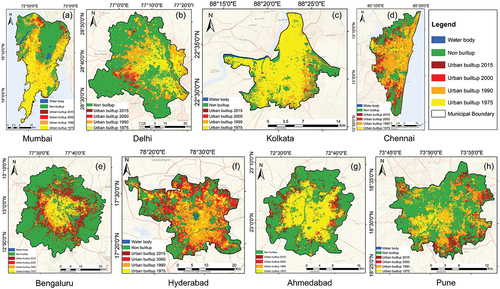
📘 1. Selecting Your Study Area
- Choose your city or urban agglomeration—preferably one you know well or can easily research (e.g., Delhi, Bhopal, Dehradun, Jaipur, etc.).
- Define administrative boundaries (Municipal Corporation or Development Authority).
- Note its population and area at different census years (e.g., 1991, 2001, 2011, 2021 projections).
- Mention relevance or unique aspects (e.g., TOD initiatives, water bodies, industrial zones, or heritage areas).
🗂️ 2. Research Framework
Structure your study around urban growth pattern dimensions such as:
- Spatial expansion (built-up area increase, direction of spread)
- Population growth and density changes
- Land use transformation
- Transport infrastructure development
- Environmental change (green cover, water bodies, encroachments)
- Policy and planning influences (master plans, zoning policies)
🧭 3. Methodology
3.1 Document Analysis
A. Purpose
To interpret and extract information from existing policy, planning, and secondary data sources that reveal urban growth dynamics.
B. Sources
Collect official and academic documents such as:
- Master Plans / Development Plans
- City Development Plans (CDPs) under JNNURM or AMRUT
- Census of India (1991, 2001, 2011, 2021 projection)
- Urban Local Body (ULB) reports
- Land records, zoning maps, and notifications
- Peer-reviewed journal articles
- Reports from NIUA, TCPO, MoHUA, NITI Aayog, and World Bank
C. Procedure
- Collect Documents: Download PDFs from government or institutional websites.
- Read and Code Themes: Identify recurring themes such as urban sprawl, infrastructure, and land-use change.
- Extract Data: Tabulate information such as population growth, land use zoning, and policy measures.
- Synthesize Findings: Connect document evidence with observed spatial changes.
D. Expected Outputs
- Timeline of policy interventions and major city expansion phases
- Tables summarizing land use distribution by decade
- Summary of planning priorities and deviations observed
3.2 Google Earth Historical Imagery Analysis
A. Purpose
To visually and spatially assess changes in the city’s built-up area, green cover, and infrastructure using satellite imagery.
B. Tools
- Google Earth Pro (Desktop version)
- Google Earth Engine (optional for advanced users)
- QGIS (optional for overlay and measurement)
C. Procedure
- Open Google Earth Pro → Locate your city.
- Activate Historical Imagery Tool → View satellite images from different years (e.g., 2000, 2005, 2010, 2015, 2020, 2025).
- Identify Built-up Expansion:
- Use polygon tool to delineate built-up area at each time point.
- Note direction and pattern of expansion (radial, ribbon, clustered, leapfrog).
- Capture Screenshots/Exports:
- Take georeferenced snapshots for each decade.
- Annotate major features: highways, metro lines, industrial areas, and water bodies.
- Overlay and Compare:
- Compare built-up growth visually.
- Calculate area change (using polygon measurement tool).
- Interpretation:
- Correlate observed changes with events (e.g., policy introduction, infrastructure development, economic growth).
D. Expected Outputs
- 6–8 maps or image sets (2000–2025) showing city growth
- Quantitative table of land cover change (sq. km or % change)
- Graph showing built-up area vs population over time
🧩 4. Suggested Structure for the 20-Page Write-Up
| Section | Suggested Length (Pages) | Content Guidelines |
|---|---|---|
| 1. Introduction | 1–2 | Define study objectives, significance, and research questions. |
| 2. Literature Review | 3–4 | Summarize theories of urban growth (e.g., concentric, sector, multiple nuclei), review previous studies on similar cities. |
| 3. Study Area Description | 1–2 | Describe location, demography, economy, planning jurisdiction, etc. |
| 4. Methodology | 2–3 | Explain document analysis and Google Earth historical imagery methods in detail (steps, tools, data sources). |
| 5. Results – Spatial Analysis | 4–5 | Present imagery analysis results, maps, tables, charts. Describe growth patterns decade-wise. |
| 6. Results – Policy/Document Analysis | 2–3 | Discuss findings from master plans and policy documents. Link with spatial trends. |
| 7. Discussion | 2–3 | Interpret results: causes and impacts of growth, effectiveness of planning policies. |
| 8. Conclusions & Recommendations | 1–2 | Summarize insights and suggest planning interventions for sustainable growth. |
| 9. References | 1–2 | APA 7th format, minimum 20 high-quality sources. |
📊 5. Data and Visualization Tips
- Maps: Create comparative maps for 2000, 2010, 2020, 2025.
- Graphs: Show population growth, land use change, or density gradients.
- Tables: Summarize built-up area change, policy interventions, or infrastructure expansion.
- Images: Label Google Earth snapshots clearly (with year, direction, key features).
🧾 6. Referencing Guidelines (APA 7)
In-text citation examples:
- (Census of India, 2011)
- (Town & Country Planning Organization [TCPO], 2020)
- (Jain & Khisty, 2013)
Reference list examples:
- Census of India. (2011). Primary Census Abstract for Urban Agglomerations. Government of India.
- Jain, A. K. (2013). Urban Transport: Planning and Management. APH Publishing.
- Town & Country Planning Organization. (2020). Urban and Regional Development Plans Formulation and Implementation (URDPFI) Guidelines. MoHUA.
- Google Earth Pro. (2025). Historical Imagery for Bhopal [Satellite Data]. Google LLC.
- UN-Habitat. (2020). World Cities Report 2020: The Value of Sustainable Urbanization. United Nations.
Use citation management software (e.g., Zotero, Mendeley, or EndNote) to maintain APA 7 consistency.
🧠 7. Writing and Formatting Guidelines
- Font: Times New Roman, 12 pt
- Spacing: 1.5 or double
- Margins: 1 inch on all sides
- Figures and Tables: Numbered and titled (e.g., Figure 3: Built-up Growth 2000–2020)
- Page Numbers: Bottom right corner
- Sections: Numbered logically (1.0, 1.1, etc.)
- Appendices: Include additional maps or raw data if needed
🔍 8. Quality and Evaluation Criteria
| Parameter | Weightage (%) | What to Focus On |
|---|---|---|
| Clarity of Objective & Scope | 10 | Defined problem, justification of study area |
| Use of Document Analysis | 20 | Integration of planning documents and policies |
| Use of Google Earth Analysis | 25 | Clear maps, data accuracy, interpretation |
| Data Integration & Discussion | 20 | Linking spatial and policy findings |
| Writing Quality & APA Referencing | 15 | Academic tone, citations, reference quality |
| Presentation (Formatting & Visuals) | 10 | Professional layout, map clarity |
🧩 9. Suggested Reference Categories
To reach 20+ sources, include a mix of:
- Official data sources – Census of India, MoHUA, TCPO, NITI Aayog
- Books on urban planning – Kadiyali, Hutchinson, Papacostas, Jain
- Peer-reviewed journal articles – Environment and Urbanization ASIA, Cities, Habitat International
- Reports – UN-Habitat, World Bank, NIUA
- Spatial data sources – Google Earth, NASA Earth Data
🕓 10. Suggested Timeline
| Date | Task |
|---|---|
| Oct 12–18, 2025 | Select city and collect all planning documents |
| Oct 19–24, 2025 | Conduct Google Earth imagery analysis (2000–2025) |
| Oct 25–30, 2025 | Write Methodology and Results sections |
| Oct 31–Nov 3, 2025 | Write Introduction, Literature Review, Discussion |
| Nov 4, 2025 | Finalize formatting, APA references, proofread |
| Nov 5–6, 2025 | Prepare submission (PDF and MS word file + cover page + checklist) |
 Track2Training
You must be logged in to post a comment.