
By Shashikant Nishant Sharma
The rapid urbanisation of cities, particularly in developing countries such as India, has intensified the demand for efficient, sustainable, and inclusive transport systems. Traditional transport planning approaches, which primarily relied on static models and infrastructure expansion, are increasingly proving inadequate in addressing contemporary mobility challenges such as congestion, environmental degradation, safety concerns, and inequitable accessibility. In this context, Intelligent Transport Systems (ITS) have emerged as a transformative paradigm, integrating information and communication technologies (ICT), artificial intelligence (AI), and data analytics to optimise transport operations and enhance user experience.
Recent advancements in ITS go beyond conventional traffic management systems and encompass a broader ecosystem involving smart infrastructure, real-time data integration, predictive analytics, and user-centric mobility services. The study by Lodhi, Jaiswal, and Sharma (2023) highlights that ITS has evolved significantly from basic traffic signal coordination to complex, adaptive systems capable of real-time decision-making and predictive modelling. These developments are particularly relevant in the context of Transit-Oriented Development (TOD), where efficient multimodal integration and first-last mile connectivity are essential for sustainable urban mobility.
This post critically examines the recent developments in ITS, focusing on technological innovations, integration with urban planning frameworks, implications for sustainability, and emerging challenges, with a particular emphasis on developing country contexts.
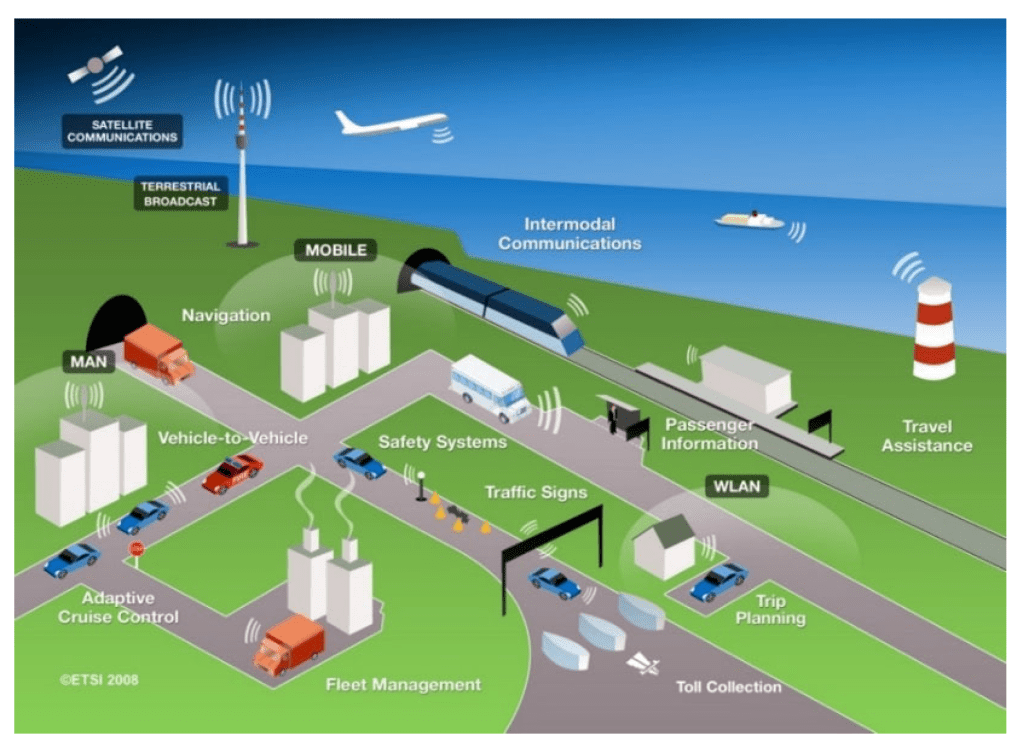
Evolution of Intelligent Transport Systems
The evolution of ITS can be understood as a transition from hardware-centric systems to data-driven intelligent ecosystems. Early ITS applications were largely limited to traffic signal control, electronic toll collection, and basic surveillance systems. However, recent advancements have shifted the focus toward integrated platforms that leverage big data, AI, and cloud computing.
Lodhi et al. (2023) emphasise that contemporary ITS frameworks are characterised by real-time data acquisition through sensors, GPS devices, and mobile applications, enabling dynamic traffic management and informed decision-making. This shift aligns with the broader transformation toward smart cities, where transport systems are interconnected with other urban subsystems such as energy, land use, and governance.
Furthermore, the integration of ITS with Land Use Transport Interaction (LUTI) models has enhanced the ability to simulate and predict travel behaviour. Sharma and Dehalwar (2025) highlight that advanced LUTI models now incorporate behavioural and attitudinal variables, enabling planners to better understand the complex interplay between urban form and mobility patterns.
Artificial Intelligence and Data-Driven Mobility
One of the most significant recent developments in ITS is the integration of Artificial Intelligence (AI) and machine learning techniques. AI-driven systems enable predictive analytics, anomaly detection, and optimisation of transport networks, thereby enhancing efficiency and reliability.
Sharma and Dehalwar (2026) demonstrate that AI-based mobility modelling can significantly improve the accuracy of demand forecasting and traffic management. These models utilise large datasets, including travel behaviour, socio-demographic characteristics, and environmental variables, to generate insights that were previously unattainable through conventional methods.
In the context of first and last mile connectivity, AI has been instrumental in identifying key determinants of mode choice. Yadav, Dehalwar, and Sharma (2026) reveal that environmental factors such as walkability, safety, and accessibility significantly influence user preferences, and AI models can effectively capture these relationships. Similarly, user-centric machine learning frameworks have been developed to predict multimodal accessibility in TOD zones, enabling more targeted and efficient interventions (Yadav et al., 2026).
These advancements underscore the shift toward personalised mobility solutions, where transport systems are tailored to individual needs and preferences, thereby enhancing user satisfaction and system efficiency.
Digital Twins and Smart Infrastructure
The concept of Digital Twins has emerged as a groundbreaking innovation in ITS, enabling the creation of virtual replicas of physical transport systems. These digital models facilitate real-time monitoring, simulation, and optimisation of transport networks, thereby enhancing operational efficiency and resilience.
Sharma (2026) highlights that Urban Spatial Digital Twins (USDT) play a crucial role in integrating transport systems with broader urban planning frameworks, particularly in TOD contexts. By simulating various scenarios, digital twins enable planners to assess the impact of infrastructure investments, policy interventions, and behavioural changes on transport outcomes.
Moreover, digital twins have been increasingly applied in last-mile logistics and autonomous vehicle systems. Sharma (2026) demonstrates that AI-driven optimisation and digital twin technologies can significantly enhance the efficiency of logistics operations, reduce emissions, and support the adoption of electric vehicles. These technologies also enable predictive risk modelling and safety validation, which are critical for the deployment of autonomous transport systems.
The integration of digital twins with ITS represents a paradigm shift toward proactive and predictive transport planning, moving beyond reactive approaches.
ITS and Sustainable Urban Mobility
Sustainability is a central objective of modern transport planning, and ITS plays a pivotal role in achieving environmental, economic, and social sustainability goals. The integration of ITS with TOD principles has been particularly effective in promoting sustainable mobility patterns.
Sharma, Kumar, and Dehalwar (2024) identify key precursors of TOD, including high-density development, mixed land use, and efficient public transport systems. ITS enhances these elements by improving connectivity, reducing travel time, and facilitating seamless multimodal integration.
In the context of environmental sustainability, ITS contributes to the reduction of greenhouse gas emissions through optimised traffic flow, reduced congestion, and the promotion of alternative modes of transport. Sharma (2025) emphasises that the integration of generative AI and digital twins in last-mile logistics can significantly reduce energy consumption and support the adoption of electric vehicles.
Additionally, the role of ITS in enhancing public transport systems cannot be overlooked. Lodhi et al. (2024) demonstrate that user satisfaction in bus systems can be significantly improved through ITS applications such as real-time information systems, smart ticketing, and service reliability enhancements.
Safety and Inclusivity in ITS
Safety remains a critical concern in urban transport systems, and ITS has introduced several innovations to enhance road safety. Advanced technologies such as surrogate safety analysis, real-time monitoring, and predictive analytics have enabled proactive identification and mitigation of safety risks.
Sharma, Singh, and Dehalwar (2024) highlight that surrogate safety measures, combined with ITS technologies, can significantly improve road safety outcomes by identifying potential conflict points and implementing preventive measures.
Furthermore, ITS has the potential to enhance inclusivity in transport systems by addressing the needs of vulnerable user groups, including pedestrians, cyclists, and senior citizens. Sharma and Dehalwar (2025) emphasise the importance of inclusive transport policies and the role of ITS in ensuring equitable access to mobility services.
The systematic review of pedestrian safety (Sharma & Dehalwar, 2025) further underscores the importance of integrating ITS with urban design interventions to create safer and more accessible transport environments.
Behavioural Dimensions and User-Centric ITS
Recent developments in ITS have increasingly focused on understanding and influencing travel behaviour. Traditional transport models often overlooked behavioural aspects, leading to suboptimal outcomes. However, contemporary ITS frameworks incorporate behavioural insights to design more effective interventions.
Yadav et al. (2025, 2026) highlight that user satisfaction, perceived safety, and environmental factors play a crucial role in shaping travel behaviour, particularly in first and last mile connectivity. These findings are supported by Lalramsangi, Garg, and Sharma (2025), who demonstrate that route choice behaviour in hill cities is influenced by accessibility, safety, and environmental conditions.
The integration of behavioural insights into ITS enables the development of user-centric transport systems, where policies and interventions are designed based on actual user needs and preferences. This approach aligns with the principles of TOD and sustainable urban mobility.
Challenges and Future Directions
Despite the significant advancements in ITS, several challenges remain. These include issues related to data privacy, interoperability, infrastructure costs, and institutional capacity. The implementation of ITS in developing countries is often hindered by fragmented governance structures and limited technical expertise.
Moreover, the integration of ITS with existing urban systems requires a holistic approach that considers land use, governance, and socio-economic factors. Sharma and Dehalwar (2025) emphasise the need for comprehensive planning frameworks that integrate transport systems with broader urban development strategies.
Future developments in ITS are likely to focus on the integration of emerging technologies such as blockchain, Internet of Things (IoT), and autonomous systems. The development of agentic AI systems, capable of autonomous decision-making, represents a significant frontier in ITS research and practice.
Conclusion
The recent developments in Intelligent Transport Systems represent a transformative shift in urban mobility, driven by technological innovations and a growing emphasis on sustainability and inclusivity. From AI-driven mobility modelling and digital twins to user-centric frameworks and sustainable logistics, ITS has evolved into a comprehensive ecosystem that addresses the complex challenges of modern urban transport systems.
The integration of ITS with Transit-Oriented Development further enhances its potential to promote sustainable and efficient mobility patterns, particularly in rapidly urbanising regions. However, the successful implementation of ITS requires a holistic approach that addresses technological, institutional, and behavioural dimensions.
As cities continue to evolve, ITS will play a critical role in shaping the future of urban mobility, enabling smarter, safer, and more sustainable transport systems.
References
Lodhi, A. S., Jaiswal, A., & Sharma, S. N. (2023). An investigation into the recent developments in intelligent transport system. In Proceedings of the Eastern Asia Society for Transportation Studies (Vol. 14).
Yadav, K., Dehalwar, K. & Sharma, S.N. Exploring the environmental determinants of mode choice in first and last mile connectivity: evidence from a systematic review. Innov. Infrastruct. Solut. 11, 204 (2026). https://doi.org/10.1007/s41062-026-02614-0
Sharma, S. N., & Dehalwar, K. (2026). Urban spatial digital twin in sustainability spur economic growth in transit-oriented development-based development. In Tenable engineering for a sustainable future (1st ed.). Elsevier. https://doi.org/10.26643/9780443405761-9
Lalramsangi, V., Garg, Y. K., & Sharma, S. N. (2025). Route choices to access public open spaces in hill cities. Environment and Urbanization ASIA, 16(2), 283–299. https://doi.org/10.1177/09754253251388721
Lodhi, A. S., Jaiswal, A., & Sharma, S. N. (2024). Assessing bus users’ satisfaction using discrete choice models: A case of Bhopal. Innovative Infrastructure Solutions, 9(11), 437. https://doi.org/10.1007/s41062-024-01652-w
Sharma, S. N. (2026). Urban spatial digital twin (USDT) in sustainability to spur economic growth for TOD-based development. In D. S.-K. Ting & N. P. Awazi (Eds.), Tenable engineering for a sustainable future: Integrating SDGs and natural resource utilization (1st ed.). Elsevier. https://shop.elsevier.com/books/tenable-engineering-for-a-sustainable-future/ting/978-0-443-40576-1Sharma, S. N. (2025). Generative AI and Digital Twins for Sustainable Last-Mile Logistics: Enabling Green Operations and Electric Vehicle Integration. In A. Awad & D. Al Ahmari (Eds.), Accelerating Logistics Through Generative AI, Digital Twins, and Autonomous Operations (pp. 183-216). IGI Global Scientific Publishing. https://doi.org/10.4018/979-8-3373-7006-4.ch007
Sharma, S. N., & Dehalwar, K. (2026). Advances in AI-based mobility modelling: Toward intelligent transport infrastructure in smart cities. In S. Ahmad, S. Jha, & M. A. Haque (Eds.), AI-based data mobility and intelligent modeling for smart cities. IGI Global Scientific Publishing. https://doi.org/10.4018/979-8-3373-4202-3
Sharma, S. N. (2026). Digital twins and AI-driven optimisation for sustainable last-mile logistics in emerging economies. In M. H. Shaik, I. B. M. Ibrahim, M. A. Mahammad, & K. Abdullah (Eds.), Digital twin approaches in autonomous vehicles. IGI Global Scientific Publishing. https://doi.org/10.4018/979-8-3373-7785-8
Sharma, S. N. (2026). Urban last-mile logistics and environmental sustainability: Green logistics and electric vehicle adoption. In R. Masengu & D. C. Jaravaza (Eds.), Sustainable last-mile logistics: Challenges, innovations, and policy perspectives. IGI Global Scientific Publishing. https://doi.org/10.4018/979-8-3373-7128-3
Sharma, S. N., & Dehalwar, K. (2025). A systematic literature review of pedestrian safety in urban transport systems. Journal of Road Safety, 36(4), 55–78. https://doi.org/10.33492/JRS-D-25-4-2707507
Sharma, S. N., & Dehalwar, K. (2025). A systematic literature review of transit-oriented development to assess its role in economic development of cities. Transportation in Developing Economies, 11(2), 23. https://doi.org/10.1007/s40890-025-00245-1
Sharma, S. N., & Dehalwar, K. (2025). Examining the inclusivity of India’s National Urban Transport Policy for senior citizens. In D. S.-K. Ting & J. A. Stagner (Eds.), Transforming healthcare infrastructure (1st ed., pp. 115–134). CRC Press. https://doi.org/10.1201/9781003513834-5
Sharma, S. N., & Dehawar, K. (2025). Review of land use transportation interaction model in smart urban growth management. European Transport / Trasporti Europei, 103, 1–15. https://doi.org/10.5281/zenodo.17315313
Sharma, S. N., Kumar, A., & Dehalwar, K. (2024). The precursors of transit-oriented development. Economic and Political Weekly, 59(14), 16–20. https://doi.org/10.5281/zenodo.10939448
Sharma, S. N., Singh, D., & Dehalwar, K. (2024). Surrogate safety analysis: Leveraging advanced technologies for safer roads. Suranaree Journal of Science and Technology, 31(4), 010320(1–14). https://doi.org/10.55766/sujst-2024-04-e03837
Yadav, K., Dehalwar, K., & Sharma, S. N. (2025). Assessing the factors affecting first and last mile accessibility in transit-oriented development: A literature review. GeoJournal, 90, 298. https://doi.org/10.1007/s10708-025-11546-8
Yadav, K., Dehalwar, K., Sharma, S. N., & Yadav, S. (2025). Understanding user satisfaction in last-mile connectivity under transit-oriented development in Tier 2 Indian cities: A climate-sensitive perspective. IOP Conference Series: Earth and Environmental Science.1579, 012006. https://doi.org/10.1088/1755-1315/1579/1/012006 Yadav, K., Dehalwar, K. & Sharma, S.N. A user-centric machine learning framework for predicting multi-modal accessibility in transit-oriented development zones for sustainable urban construction in tier-2 Indian cities. Asian J Civ Eng (2026). https://doi.org/10.1007/s42107-025-01625-z


 Track2Training