
By Shashikant Nishant Sharma
The title “Doctor” is among the most respected forms of professional recognition in modern society. Across universities, hospitals, research laboratories, courts, and policy institutions, the title symbolizes advanced expertise, rigorous training, intellectual contribution, and public trust. Yet, in contemporary public discourse, the word “doctor” has increasingly become associated almost exclusively with medical practitioners. This narrowing of meaning has generated confusion regarding the rightful use of the prefix “Dr.” by holders of doctoral degrees such as the Doctor of Philosophy (PhD).
Historically, however, the title “Doctor” originated in academia—not medicine. The term derives from the Latin word docere, meaning “to teach.” Medieval European universities used the designation to identify scholars who had achieved the highest level of learning and were authorized to teach others. Long before physicians commonly used the title, universities in Bologna, Paris, and Oxford conferred the title “Doctor” upon distinguished scholars in theology, law, and philosophy.
This historical reality is important because it challenges a widespread misconception: that only medical practitioners are “real doctors.” In truth, medical professionals adopted the title later, largely as a courtesy associated with learned status and professional prestige. The original “doctor” was a scholar, researcher, and teacher. Therefore, recognizing PhD holders with the title “Dr.” is not merely acceptable; it is historically accurate, academically justified, and socially important.
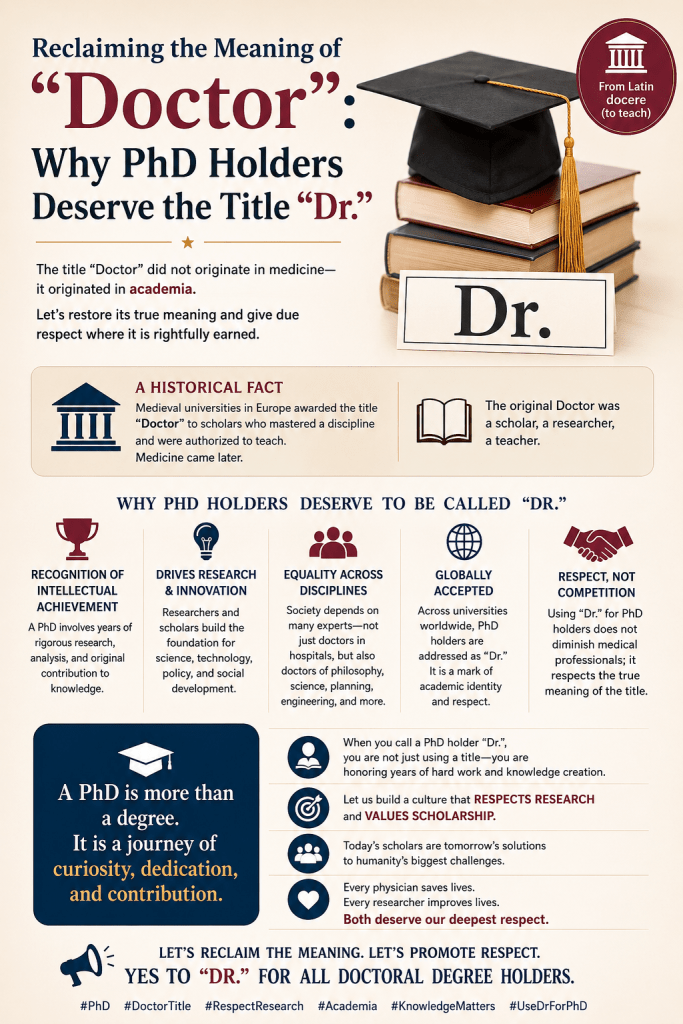
Historical Evolution of the Doctoral Title
The doctoral tradition emerged during the medieval period when universities became formal centers of higher learning in Europe. In the 12th and 13th centuries, universities granted the title doctor to individuals who demonstrated mastery over a discipline and were qualified to teach at the university level. The title indicated scholarly authority rather than medical expertise.
Medicine was only one among several disciplines in which doctoral qualifications were awarded. Theology, law, and philosophy were equally important. In many cases, physicians during the medieval and early modern periods did not possess doctoral qualifications at all. Some medical practitioners were trained through apprenticeships rather than universities.
The development of the modern PhD in 19th-century Germany transformed doctoral education worldwide. The PhD became the highest research qualification, emphasizing original contribution to knowledge, rigorous methodology, and scholarly publication. Universities across Europe, the United States, and later Asia adopted the PhD model as the pinnacle of academic achievement.
Thus, the academic doctorate is not secondary to medical doctorates; rather, it represents the historical foundation of the term itself.
The Difference Between “Doctor” and “Medical Doctor”
One major source of confusion arises from the interchangeable public use of the words “doctor” and “physician.” In reality, they are not identical concepts. A physician is a healthcare professional trained in medicine, while a doctor is any individual who holds a doctoral-level qualification.
Medical practitioners typically earn degrees such as MD, MBBS, MBChB, or equivalent clinical qualifications depending on the country. In contrast, PhD holders complete advanced research training culminating in a dissertation that contributes new knowledge to a discipline. Both pathways involve years of specialized education, but they serve different purposes.
Importantly, many educational systems do not classify the MD as a research doctorate equivalent to a PhD. In the United States, for example, the MD is considered a professional doctorate rather than a research doctorate. This distinction demonstrates that the use of “Dr.” is not limited to clinical professions.
A PhD holder earns the title through intellectual contribution, research capability, peer-reviewed scholarship, and academic rigor. Their work advances science, technology, policy, literature, engineering, economics, urban planning, and countless other fields that shape society. To deny them the title “Dr.” would be to undermine the value of research and higher education itself.
Why Society Should Promote “Dr.” for PhD Holders
1. Recognition of Intellectual Achievement
A PhD represents one of the highest academic accomplishments attainable. It typically requires years of coursework, independent research, publication, fieldwork, data analysis, and dissertation defense. In many disciplines, doctoral candidates contribute original findings that influence public policy, scientific advancement, technological innovation, and social development.
Using “Dr.” acknowledges this intellectual labor and scholarly contribution. Society routinely celebrates athletes, celebrities, and entrepreneurs with honorific recognition. Scholars and researchers who dedicate years to knowledge production deserve equal respect.
2. Encouraging Research Culture
Countries aspiring to become knowledge economies must strengthen the social status of researchers and academics. Nations that excel in innovation—such as Germany, the United States, Japan, and South Korea—place strong cultural value on academic research and doctoral education.
Recognizing PhD holders as “Dr.” can encourage young students to pursue advanced research careers. When society visibly respects scholars, it promotes scientific inquiry, innovation, evidence-based policymaking, and intellectual development.
In countries like India, where research ecosystems are still evolving, strengthening respect for doctoral education can improve academic culture, institutional quality, and research productivity.
3. Correcting Public Misconceptions
The public often assumes that anyone using “Dr.” must be a medical practitioner. However, this misconception results from cultural habit rather than historical truth. Scholars, scientists, economists, psychologists, engineers, planners, and educationists who hold doctorates have equal legitimacy in using the title.
The solution is not to deny PhD holders the title, but to improve public understanding of professional distinctions. Context matters. In hospitals, “doctor” may naturally imply a physician. In universities and research institutions, it commonly refers to a scholar.
Professional clarity can be achieved through credential disclosure rather than title restriction. For example:
- Dr. Raj Sharma, PhD (Urban Planning)
- Dr. Anita Verma, MD (Cardiology)
Such practices reduce confusion while respecting all doctoral qualifications.
4. Equality Across Disciplines
Modern society depends on expertise beyond medicine. Climate scientists guide environmental policy. Economists shape fiscal systems. Engineers design infrastructure. Urban planners improve transportation systems. Political scientists strengthen democratic institutions. Education researchers improve learning outcomes.
Why should only one profession monopolize the title “doctor” when multiple disciplines contribute critically to human development?
A PhD holder in epidemiology may save lives through research. A transportation researcher may reduce road fatalities through urban planning. A climate scientist may influence sustainability policies affecting millions. Their contributions are no less significant simply because they occur outside hospitals.
The Paradigm Shift: From Clinical Authority to Knowledge Authority
Historically, the authority associated with “doctor” has evolved. Earlier societies linked the title to teaching and scholarship. The 20th century increasingly connected it with medicine because healthcare professionals became highly visible public figures.
However, the 21st century demands a broader understanding. Today’s world faces complex challenges:
- Climate change
- Artificial intelligence ethics
- Urban congestion
- Public policy failures
- Sustainable mobility
- Democratic participation
- Cybersecurity
- Public health crises
These problems require interdisciplinary expertise. Researchers and scholars play central roles in solving them. Therefore, the meaning of “doctor” should return to its broader intellectual foundation.
The paradigm must shift from viewing “doctor” solely as a clinical identity toward recognizing it as a marker of advanced expertise and knowledge production.
International Perspectives on the Use of “Dr.”
Globally, the use of “Dr.” varies by cultural and institutional context.
In Germany, doctoral titles are highly respected and commonly used in public life. In the United States, university professors with PhDs are routinely addressed as “Doctor” in academic settings. In the United Kingdom, both medical practitioners and PhD holders use the title, though contextual expectations differ.
In India, the University Grants Commission (UGC) recognizes doctoral degrees awarded by accredited universities. PhD holders legally and academically possess the right to use the “Dr.” prefix. Nevertheless, social misunderstanding sometimes leads to questioning their legitimacy.
Promoting awareness about the historical and academic basis of the title can help normalize its proper use.
Ethical Use of the Title
Promoting “Dr.” for PhD holders does not mean encouraging misleading representation. Ethical use requires transparency.
A PhD holder should never imply being a medical practitioner in healthcare settings unless medically qualified. Similarly, medical practitioners should not imply holding research doctorates unless they possess them.
The key principle is contextual honesty.
For example:
- In universities, conferences, and research publications, “Dr.” for PhD holders is entirely appropriate.
- In hospitals, specifying professional roles may help avoid confusion.
This balanced approach respects all professions without diminishing academic achievement.
Academic Prestige and Social Responsibility
The decline in respect for academic titles in some societies reflects broader anti-intellectual tendencies. Researchers are sometimes undervalued despite their contributions to technology, infrastructure, governance, and science.
Recognizing PhD holders with the title “Dr.” reinforces the importance of evidence-based thinking and scholarly expertise. It reminds society that progress depends not only on treatment of disease but also on the generation of knowledge.
Universities should actively promote doctoral identity through institutional communication, public engagement, and professional recognition. Governments should also encourage respect for research professions as part of national development strategies.
Conclusion
The title “Doctor” originated in academia centuries before it became associated with medicine. Its roots lie in scholarship, teaching, and the pursuit of knowledge. PhD holders, who dedicate years to original research and intellectual advancement, possess both the historical and academic legitimacy to use the title “Dr.”
Society should actively promote the respectful use of “Dr.” for doctoral degree holders because doing so:
- Recognizes intellectual achievement,
- Encourages research culture,
- Corrects historical misconceptions,
- Promotes interdisciplinary equality, and
- Strengthens respect for knowledge and scholarship.
Medical practitioners unquestionably deserve public respect for their critical role in healthcare. However, acknowledging the legitimacy of PhD holders as “Dr.” does not diminish medicine; rather, it restores the broader and more accurate meaning of the title itself.
In an era increasingly shaped by science, innovation, and research, reclaiming the academic identity of “Doctor” is not merely symbolic—it is essential for building a knowledge-driven society.
References (APA 7th Edition)
The Doctorate Worldwide Boud, D., & Lee, A. (2009). Changing practices of doctoral education. Routledge.
The Formation of Scholars Clark, B. R. (1995). Places of inquiry: Research and advanced education in modern universities. University of California Press.
A History of the University in Europe de Ridder-Symoens, H. (Ed.). (1992). A history of the university in Europe: Universities in the Middle Ages. Cambridge University Press.
Wikipedia contributors. (2026). Doctor (title). Wikipedia. https://en.wikipedia.org/wiki/Doctor_(title)
Wikipedia contributors. (2026). Doctor of Medicine. Wikipedia. https://en.wikipedia.org/wiki/Doctor_of_Medicine
Yarlagadda, Y. (2026). The history and global usage of the doctor title: Implications for medical practitioners and physiotherapists. Retrieved from https://yeswanthyarlagadda.com/the-history-and-global-usage-of-the-doctor-title-implications-for-medical-practitioners-and-physiotherapists/
Valeman. (2025). Why academics use the title “Doctor” — and why so many people get it wrong. Medium. Retrieved from https://valeman.medium.com/why-academics-use-the-title-doctor-and-why-so-many-people-get-it-wrong-8aa18fa816de
ScienceInsights. (2026). Is a PhD a doctor? What the title really means. Retrieved from https://scienceinsights.org/is-a-phd-a-doctor-what-the-title-really-means/
The Classroom. (2010). How to correctly use the titles Dr. & PhD with a name. Retrieved from https://www.theclassroom.com/how-to-correctly-use-the-titles-dr-phd-with-a-name-12082451.html


 Track2Training
You must be logged in to post a comment.