
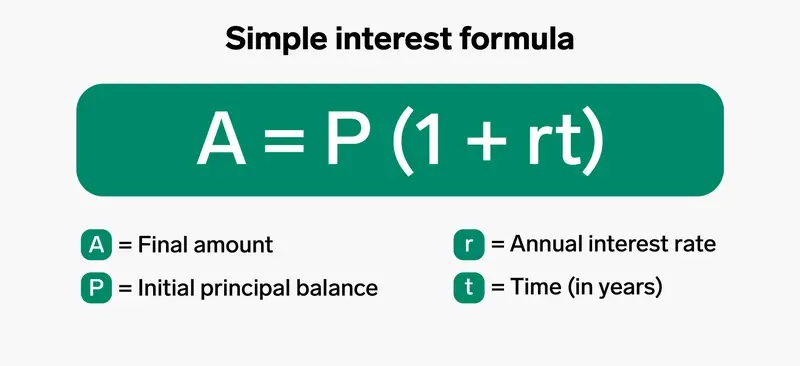
Simple Interest (SI)

Daily writing prompt
What advice would you give to your teenage self?

๐Ÿ”น Meaning of Simple Interest

Simple Interest (SI) is the interest calculated only on the original principal amount, for the entire duration of the loan or investment.
It does not include interest on previously earned interest (unlike compound interest).

Simple interest is commonly used in:

  • Short-term loans
  • Personal borrowing
  • Fixed deposits (in some cases)
  • Educational examples
  • Basic financial planning

๐Ÿ”น Formula of Simple Interest

SI=Pร—Rร—T100SI = \frac{P \times R \times T}{100}SI=100Pร—Rร—Tโ€‹

Where:

  • SI = Simple Interest
  • P = Principal amount (Initial investment or loan)
  • R = Rate of interest (per annum in %)
  • T = Time (in years)

๐Ÿ”น Total Amount Formula

To find the total amount payable or receivable:A=P+SIA = P + SIA=P+SI

Where:

  • A = Final Amount
  • P = Principal
  • SI = Simple Interest

๐Ÿ”Ž Example 1: Basic Calculation

Problem:

A person invests โ‚น50,000 at an interest rate of 8% per year for 3 years.
Find the simple interest and total amount.

Step 1: Apply Formula

SI=Pร—Rร—T100SI = \frac{P \times R \times T}{100}SI=100Pร—Rร—Tโ€‹ SI=50,000ร—8ร—3100SI = \frac{50,000 \times 8 \times 3}{100}SI=10050,000ร—8ร—3โ€‹ SI=12,00,000100SI = \frac{12,00,000}{100}SI=10012,00,000โ€‹ SI=โ‚น12,000SI = โ‚น12,000SI=โ‚น12,000

Step 2: Find Total Amount

A=P+SIA = P + SIA=P+SI A=50,000+12,000A = 50,000 + 12,000A=50,000+12,000 A=โ‚น62,000A = โ‚น62,000A=โ‚น62,000

โœ… Answer:

  • Simple Interest = โ‚น12,000
  • Total Amount = โ‚น62,000

๐Ÿ”Ž Example 2: Finding Rate of Interest

Problem:

โ‚น30,000 becomes โ‚น36,000 in 4 years under simple interest. Find the rate.

Step 1: Find SI

SI=Aโˆ’PSI = A – PSI=Aโˆ’P SI=36,000โˆ’30,000SI = 36,000 – 30,000SI=36,000โˆ’30,000 SI=โ‚น6,000SI = โ‚น6,000SI=โ‚น6,000

Step 2: Use SI Formula

SI=Pร—Rร—T100SI = \frac{P \times R \times T}{100}SI=100Pร—Rร—Tโ€‹ 6,000=30,000ร—Rร—41006,000 = \frac{30,000 \times R \times 4}{100}6,000=10030,000ร—Rร—4โ€‹ 6,000=1,200R6,000 = 1,200R6,000=1,200R R=5%R = 5\%R=5%

โœ… Answer:

Rate of Interest = 5% per annum


๐Ÿ”น Key Characteristics of Simple Interest

โœ” Interest remains constant every year
โœ” Easy to calculate
โœ” Suitable for short-term financial decisions
โœ” Does not consider time value compounding


๐Ÿ”น When to Use Simple Interest

  • Short-term business loans
  • Borrowing from individuals
  • Treasury bills (basic calculations)
  • Quick financial estimation
  • School-level financial mathematics

๐Ÿ“Œ Important Note

In long-term investments, Compound Interest gives higher returns because interest is earned on interest. Simple interest is mainly useful for straightforward and short-duration financial calculations.

Classic & Foundational Urban Planning Books

Daily writing prompt
What advice would you give to your teenage self?
  1. “Garden Cities of To-Morrow”
    • Author: Ebenezer Howard
    • Year: 1898
    • Key Idea: Introduced the Garden City concept, advocating self-contained communities with greenbelts.
  2. “The City in History”
    • Author: Lewis Mumford
    • Year: 1961
    • Key Idea: A historical analysis of urban development and planning.
  3. “The Death and Life of Great American Cities”
    • Author: Jane Jacobs
    • Year: 1961
    • Key Idea: Criticized modernist urban planning and emphasized vibrant, mixed-use neighborhoods.
  4. “Urbanism as a Way of Life”
    • Author: Louis Wirth
    • Year: 1938
    • Key Idea: Explored how urbanization shapes social structures.
  5. “The Image of the City”
    • Author: Kevin Lynch
    • Year: 1960
    • Key Idea: Introduced concepts like legibility and mental maps in city planning.

Modern & Contemporary Planning Books

  1. “A Theory of Good City Form”
    • Author: Kevin Lynch
    • Year: 1981
    • Key Idea: Developed a framework for evaluating urban design quality.
  2. “Good City Form”
    • Author: Kevin Lynch
    • Year: 1984
    • Key Idea: Expanded on his earlier work on city imageability and planning.
  3. “Cities of Tomorrow: An Intellectual History of Urban Planning and Design in the Twentieth Century”
    • Author: Peter Hall
    • Year: 1988
    • Key Idea: Analyzes urban planning theories and their real-world applications.
  4. “The Just City”
    • Author: Susan S. Fainstein
    • Year: 2010
    • Key Idea: Advocates for social justice in urban planning.
  5. “The Resilient City: How Modern Cities Recover from Disaster”
  • Authors: Lawrence J. Vale & Thomas J. Campanella
  • Year: 2005
  • Key Idea: Examines how cities rebuild after disasters.

Transportation & Sustainable Planning Books

  1. “The High Cost of Free Parking”
  • Author: Donald Shoup
  • Year: 2005
  • Key Idea: Discusses how excessive parking requirements harm urban areas.
  1. “Transit-Oriented Development in the United States”
  • Authors: Robert Cervero et al.
  • Year: 2004
  • Key Idea: Explores the benefits and design principles of Transit-Oriented Development (TOD).
  1. “Walkable City: How Downtown Can Save America, One Step at a Time”
  • Author: Jeff Speck
  • Year: 2012
  • Key Idea: Promotes walkability as key to successful urban planning.
  1. “The Sustainable Urban Development Reader”
  • Authors: Stephen Wheeler & Timothy Beatley
  • Year: 2004
  • Key Idea: A collection of important essays on sustainable urbanism.
  1. “Cycling and Society”
  • Authors: Dave Horton, Paul Rosen, Peter Cox
  • Year: 2007
  • Key Idea: Examines cycling’s role in urban transport and sustainability