
Compound Interest in Architecture and Planning Projects

Daily writing prompt
What is the biggest challenge you will face in the next six months?

๐Ÿ”น Meaning of Compound Interest (CI)

Compound Interest is interest calculated on:

  • The original principal, and
  • The accumulated interest from previous periods.

It reflects the time value of money, which is extremely important in long-term architecture, urban planning, and infrastructure projects.


๐Ÿ”น Basic Formula

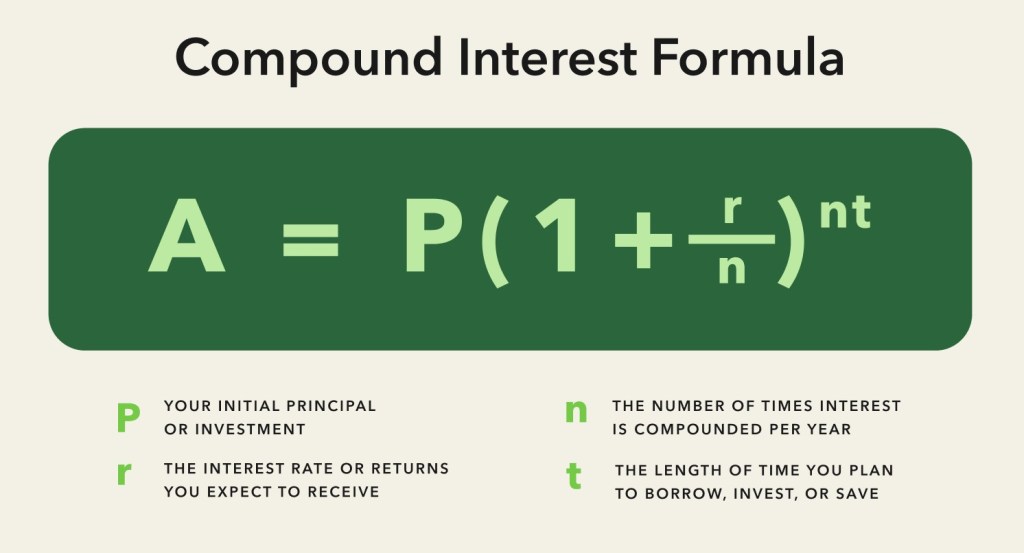
A=P(1+rn)ntA = P (1 + \frac{r}{n})^{nt}A=P(1+nrโ€‹)nt

Where:

  • A = Final Amount
  • P = Principal investment
  • r = Annual interest rate (decimal form)
  • n = Number of compounding periods per year
  • t = Time in years

If compounded annually:A=P(1+r)tA = P(1 + r)^tA=P(1+r)t

Compound Interest:CI=Aโˆ’PCI = A – PCI=Aโˆ’P


๐Ÿ”Ž Why Compound Interest Matters in Architecture & Planning

Architecture and planning projects typically involve:

  • Long project life cycles (10โ€“50 years)
  • Large capital investments
  • Phased development
  • Loan financing
  • Land value appreciation

Compound interest helps evaluate:

โœ” Project feasibility
โœ” Real estate returns
โœ” Infrastructure financing
โœ” Urban land value growth
โœ” Lifecycle costing


๐Ÿข 1. Application in Real Estate Development

Example:

An architect develops a commercial complex.

  • Initial Investment = โ‚น2 Crore
  • Annual appreciation = 10%
  • Time = 5 years

Calculation:

A=2,00,00,000(1+0.10)5A = 2,00,00,000(1 + 0.10)^5A=2,00,00,000(1+0.10)5 A=2,00,00,000(1.6105)A = 2,00,00,000(1.6105)A=2,00,00,000(1.6105) A=โ‚น3,22,10,000A = โ‚น3,22,10,000A=โ‚น3,22,10,000

Compound Gain:

CI=3,22,10,000โˆ’2,00,00,000CI = 3,22,10,000 – 2,00,00,000CI=3,22,10,000โˆ’2,00,00,000 CI=โ‚น1,22,10,000CI = โ‚น1,22,10,000CI=โ‚น1,22,10,000

โœ… Property value increased significantly due to compounding.


๐Ÿš‡ 2. Application in Infrastructure Planning

Large-scale urban transport projects (Metro, BRT, TOD zones) require heavy borrowing.

Examples include projects like:

  • Delhi Metro Rail Corporation
  • Mumbai Metro

Loans are often repaid with compound interest.

Suppose:

Loan = โ‚น500 Crore
Interest Rate = 6%
Period = 10 yearsA=500(1.06)10A = 500(1.06)^{10}A=500(1.06)10 A=500(1.7908)A = 500(1.7908)A=500(1.7908) A=โ‚น895.4CroreA = โ‚น895.4 CroreA=โ‚น895.4Crore

Interest Paid:895.4โˆ’500=โ‚น395.4Crore895.4 – 500 = โ‚น395.4 Crore895.4โˆ’500=โ‚น395.4Crore

โœ” This affects fare pricing
โœ” Affects financial sustainability
โœ” Influences Public-Private Partnership (PPP) decisions


๐Ÿ™ 3. Land Value Capture & TOD

In Transit-Oriented Development (TOD):

Land values increase near metro stations.

Example:

Land value = โ‚น10,000 per sq.m
Annual growth = 8%
Time = 7 yearsFuture Value=10,000(1.08)7Future\ Value = 10,000(1.08)^7Future Value=10,000(1.08)7 Future Value=10,000(1.7138)Future\ Value = 10,000(1.7138)Future Value=10,000(1.7138) Future Value=โ‚น17,138persq.mFuture\ Value = โ‚น17,138 per sq.mFuture Value=โ‚น17,138persq.m

โœ” Used for Value Capture Financing
โœ” Helps recover infrastructure cost
โœ” Important in metropolitan planning


๐Ÿ— 4. Lifecycle Costing in Building Design

Sustainable buildings consider:

  • Initial construction cost
  • Maintenance cost
  • Energy savings

If energy savings are reinvested annually, benefits grow through compounding.

This is important for:

  • Green buildings
  • Net-zero architecture
  • Smart city projects

๐Ÿ”น Difference from Simple Interest in Planning Context

Simple InterestCompound Interest
Short-term loansLong-term infrastructure
Flat returnsExponential growth
Basic estimationReal project appraisal
Not realistic for 20+ yearsEssential for lifecycle planning

๐Ÿ“Š Importance in Urban Economics

Compound interest helps in:

  • Discounted Cash Flow (DCF) analysis
  • Net Present Value (NPV)
  • Internal Rate of Return (IRR)
  • Capital budgeting
  • Financial modeling of TOD projects

Without compounding, financial evaluation of urban infrastructure becomes inaccurate.


โœ… Conclusion

In architecture and planning projects, compound interest is fundamental because:

  • Projects are long-term
  • Investments are capital-intensive
  • Land appreciates over time
  • Loans accumulate interest
  • Sustainability benefits grow over years

Thus, compound interest is not just a financial formulaโ€”it is a core tool in urban development economics and project feasibility analysis.

List of top public transport in India

Daily writing prompt
What is the biggest challenge you will face in the next six months?

India has an extensive public transportation network, including metro systems, suburban rail, bus rapid transit (BRT), and other public transit services. Hereโ€™s a list of top public transport systems in India across different modes:

1. Metro Rail Systems (Rapid Transit) ๐Ÿš‡

  • Delhi Metro (Largest & most advanced metro system in India)
  • Mumbai Metro (Expanding network with multiple corridors)
  • Bengaluru Namma Metro (Well-connected metro system)
  • Chennai Metro (Efficient air-conditioned metro service)
  • Kolkata Metro (India’s first metro, now expanding)
  • Hyderabad Metro (One of the world’s largest PPP metro projects)
  • Pune Metro (Newly operational with planned expansions)
  • Ahmedabad Metro (Part of the Smart City development)
  • Lucknow Metro (Efficient transport system in Uttar Pradesh)
  • Jaipur Metro (Well-planned but limited network)

2. Suburban Rail Networks ๐Ÿš†

  • Mumbai Suburban Railway (Lifeline of Mumbai, carrying over 7.5 million passengers daily)
  • Kolkata Suburban Railway (Extensive rail network in West Bengal)
  • Chennai Suburban Railway (Major suburban rail for the city)
  • Delhi Suburban Railway (Connects NCR regions like Gurgaon, Faridabad)
  • Hyderabad MMTS (Multi-Modal Transport System) (Suburban rail in Telangana)

3. Bus Rapid Transit (BRT) & City Bus Services ๐ŸšŒ

  • Ahmedabad BRTS (Janmarg) (Most successful BRT system in India)
  • Indore iBUS BRTS (Efficient bus rapid transit system)
  • Pune Rainbow BRTS (BRT corridors in Pune & Pimpri-Chinchwad)
  • Surat BRTS (Growing and well-managed BRT network)
  • Delhi DTC & Cluster Buses (Largest city bus fleet)
  • BEST Buses (Mumbai) (Mumbai’s iconic red buses)
  • BMTC (Bangalore Metropolitan Transport Corporation) (Largest city bus fleet in Karnataka)
  • Chennai MTC (Metropolitan Transport Corporation) (Major bus network)
  • Kolkata WBTC & CSTC Buses (Extensive bus network)

4. Regional & Intercity Transport ๐Ÿš

  • Indian Railways (IRCTC Trains) (Largest rail network for intercity transport)
  • State Transport Buses (MSRTC, UPSRTC, KSRTC, TSRTC, etc.)
  • Vande Bharat Express (Semi-High-Speed Trains) (New age express train service)

5. Water Transport ๐Ÿšข

  • Kochi Water Metro (First water metro service in India)
  • Mumbai Ferry Services (Connecting Elephanta, Alibaug, and Navi Mumbai)
  • Kolkata Ferry Services (Hooghly river transport network)

6. Electric & Shared Mobility ๐Ÿš–

  • Ola/Uber Ride-Sharing (Major app-based transport services)
  • Rapido Bike Taxis (Affordable last-mile connectivity)
  • E-Rickshaws (Popular in Delhi, UP, and Bihar for last-mile transport)