Detailed Specifications: Water Supply Network and Distribution Systems

Water supply networks and distribution systems are essential components of urban infrastructure. They ensure the reliable delivery of safe and potable water from treatment plants or water sources to consumers such as residential areas, commercial establishments, industries, and public facilities. Detailed specifications for water supply networks describe the materials, design standards, installation procedures, testing requirements, and maintenance practices required to construct an efficient and durable distribution system.

In urban planning and infrastructure development, water distribution systems must be designed to provide adequate water pressure, maintain water quality, minimize leakage, and ensure equitable access across all parts of the service area. Detailed specifications ensure that the construction of pipelines, pumping stations, valves, storage tanks, and other components meets technical standards and operates efficiently throughout the systemโ€™s service life.


1. Components of Water Supply Network and Distribution Systems

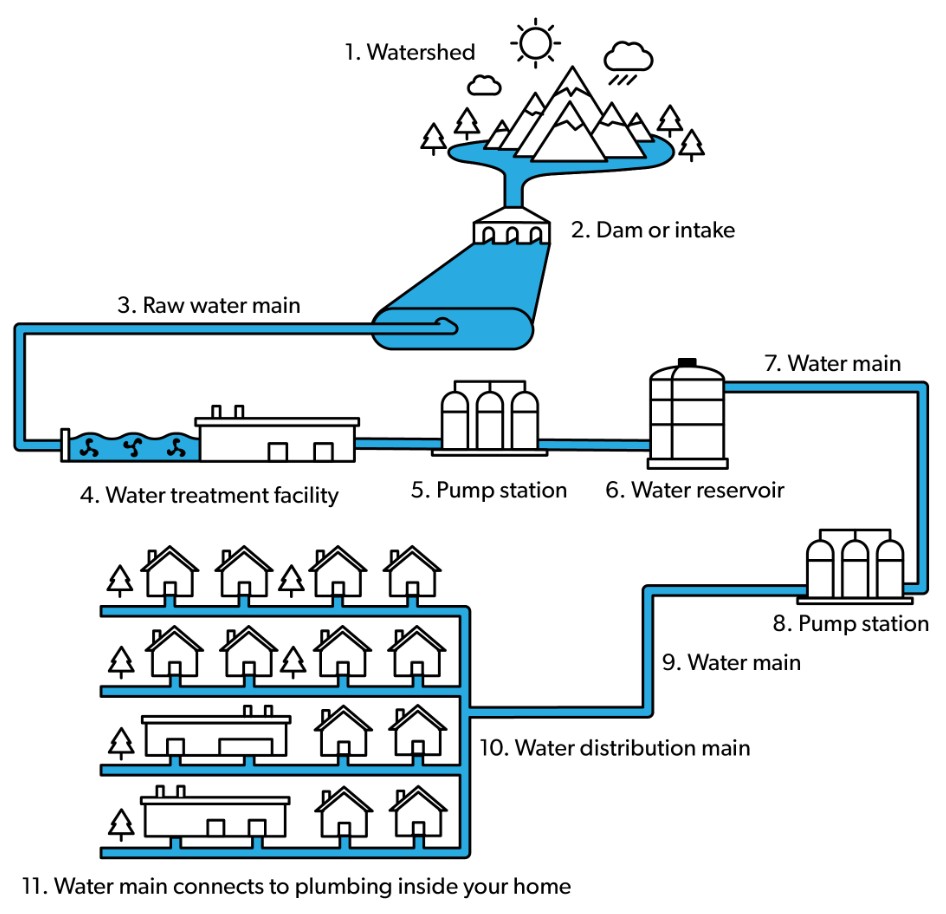
A typical water supply distribution system consists of several interconnected components that work together to deliver water from the source to consumers.

Major components include:

  • Water sources such as rivers, lakes, groundwater wells, or reservoirs
  • Water treatment plants
  • Transmission mains
  • Distribution pipelines
  • Pumping stations
  • Storage reservoirs or overhead tanks
  • Valves and fittings
  • Consumer service connections

Each of these components requires detailed specifications to ensure proper design, construction, and operation.


2. Detailed Specifications for Water Supply Pipelines

Pipelines are the primary elements of water distribution systems. They transport treated water from treatment plants or storage reservoirs to consumers.

Materials

Pipelines should be constructed using approved materials such as:

  • Ductile iron pipes
  • Cast iron pipes
  • Mild steel pipes
  • PVC (Polyvinyl Chloride) pipes
  • HDPE (High-Density Polyethylene) pipes

The choice of material depends on factors such as water pressure, soil conditions, corrosion resistance, and project cost.

Pipe Quality

Pipes must satisfy the following requirements:

  • Pipes should be strong, durable, and resistant to internal water pressure.
  • They should be free from cracks, defects, or manufacturing faults.
  • Pipes should have smooth internal surfaces to minimize friction losses.
  • Protective coatings or linings should be applied where necessary to prevent corrosion.

Pipe Diameter

The diameter of pipelines should be determined based on:

  • Population demand
  • Peak water consumption
  • Hydraulic calculations
  • Pressure requirements

The design should ensure adequate flow capacity and maintain sufficient pressure throughout the network.


3. Pipe Laying and Installation

Proper pipe laying is critical to the performance and durability of water supply systems.

Trenching

  • Trenches should be excavated according to the required depth and width specified in the design drawings.
  • The bottom of the trench should be leveled and free from stones or sharp objects.
  • Adequate bedding materials such as sand or fine soil should be provided to support the pipeline.

Pipe Alignment

  • Pipes should be laid in straight alignment unless changes in direction are required.
  • Bends and fittings should be used where directional changes occur.
  • Pipes should be properly supported and aligned to prevent displacement.

Jointing

Different types of pipe joints may be used depending on the pipe material.

Common jointing methods include:

  • Rubber ring joints
  • Flanged joints
  • Welded joints for steel pipes
  • Solvent cement joints for PVC pipes

All joints must be watertight to prevent leakage.


4. Valves and Fittings

Valves and fittings are installed within the distribution network to control water flow and facilitate maintenance operations.

Types of Valves

Common valves used in water supply systems include:

  • Gate valves for controlling flow
  • Air valves for releasing trapped air
  • Pressure reducing valves
  • Check valves to prevent backflow
  • Scour valves for draining pipelines

Installation Requirements

  • Valves should be installed at strategic locations such as pipeline intersections and high points.
  • Valve chambers should be constructed to allow easy access for operation and maintenance.
  • All valves should be tested before installation.

5. Storage Reservoirs and Overhead Tanks

Storage reservoirs are used to store treated water and maintain consistent supply during peak demand periods.

Types of Storage Structures

Water storage facilities may include:

  • Ground-level reservoirs
  • Elevated service reservoirs (overhead tanks)
  • Underground storage tanks

Construction Specifications

  • Reservoirs should be constructed using reinforced cement concrete.
  • The structure should be watertight and resistant to leakage.
  • Proper ventilation, access ladders, and inspection openings should be provided.
  • The reservoir should be protected against contamination by covering and sealing.

Storage reservoirs help maintain pressure in the distribution system and ensure continuous supply even during pump failures.


6. Pumping Stations

Pumping stations are required when water needs to be lifted from lower elevations to higher storage reservoirs or distribution networks.

Pump Installation

  • Pumps should be selected based on required discharge and head.
  • Pumping equipment should be installed on stable foundations.
  • Proper alignment between pump and motor should be ensured.

Mechanical and Electrical Systems

  • Electrical systems should include control panels, backup power supply, and safety devices.
  • Pumping stations should have proper ventilation and drainage.

Regular inspection and maintenance are necessary to ensure reliable operation.


7. Service Connections

Service connections provide water supply from the distribution pipeline to individual consumers.

Connection Components

A typical service connection includes:

  • Service pipe
  • Stop valve
  • Water meter
  • Consumer tap

Installation Requirements

  • Service pipes should be made of corrosion-resistant materials such as PVC or HDPE.
  • Water meters should be installed in accessible locations for reading and maintenance.
  • Connections should be leak-proof to prevent water losses.

8. Testing and Commissioning

Before commissioning the water supply network, several tests must be conducted to ensure system reliability.

Pressure Testing

Pipelines should be tested for leakage by applying hydraulic pressure greater than the normal operating pressure.

Flushing and Cleaning

Pipelines should be flushed with clean water to remove debris and contaminants before use.

Disinfection

Disinfection using chlorine or other approved chemicals should be carried out to eliminate harmful microorganisms.

These procedures ensure that the water supply system is safe for public use.


9. Operation and Maintenance

Proper maintenance is essential for the long-term performance of water supply systems.

Maintenance activities include:

  • Regular inspection of pipelines and valves
  • Leak detection and repair
  • Cleaning of storage reservoirs
  • Monitoring water pressure and flow
  • Replacement of damaged components

Effective maintenance reduces water losses and improves system efficiency.


10. Design Considerations for Distribution Systems

When designing water distribution systems, planners and engineers must consider several factors:

  • Population growth and future demand
  • Peak water consumption rates
  • Pressure requirements across the network
  • Fire-fighting requirements
  • Reliability and redundancy of the system

Different types of distribution layouts may be adopted such as:

  • Grid or loop system
  • Radial system
  • Ring system
  • Dead-end system

The selection of distribution pattern depends on the layout of the urban area and infrastructure requirements.


Conclusion

Detailed specifications for water supply networks and distribution systems ensure that urban water infrastructure is designed and constructed to meet technical standards and public health requirements. These specifications cover all aspects of the system including pipelines, pipe laying procedures, valves, storage reservoirs, pumping stations, and service connections.

Proper construction practices, testing procedures, and maintenance programs are essential to ensure reliable water delivery, maintain water quality, and reduce losses due to leakage or system failures. In rapidly growing urban areas, efficient water distribution systems are critical for supporting population growth, economic activities, and sustainable urban development.

Therefore, detailed specifications serve as a technical guideline for engineers, planners, contractors, and infrastructure agencies to develop water supply systems that are safe, durable, and capable of meeting present and future water demands.

Daily writing prompt
What movies or TV series have you watched more than 5 times?

Classifications of Specifications and Sources of Specifications

Daily writing prompt
What movies or TV series have you watched more than 5 times?

Specifications are an essential component of engineering, construction, and planning projects. They provide detailed written instructions that define the quality, materials, workmanship, and methods required for the execution of a project. While drawings represent the graphical aspects of a project, specifications explain the technical requirements that cannot be fully represented through drawings alone. In quantity surveying, construction management, and planning practice, specifications act as a contractual document between the client, architect/planner, engineer, and contractor. They help avoid ambiguity, ensure uniform quality, and establish standards for materials and workmanship.

Specifications play a significant role in ensuring that construction work meets design intent, safety standards, and regulatory guidelines. They also assist in preparing cost estimates, evaluating tenders, and supervising construction. Broadly, specifications can be classified into different types based on their purpose, level of detail, and method of description. In addition, specifications may originate from several sources such as standard codes, government manuals, technical literature, and project-specific documents.


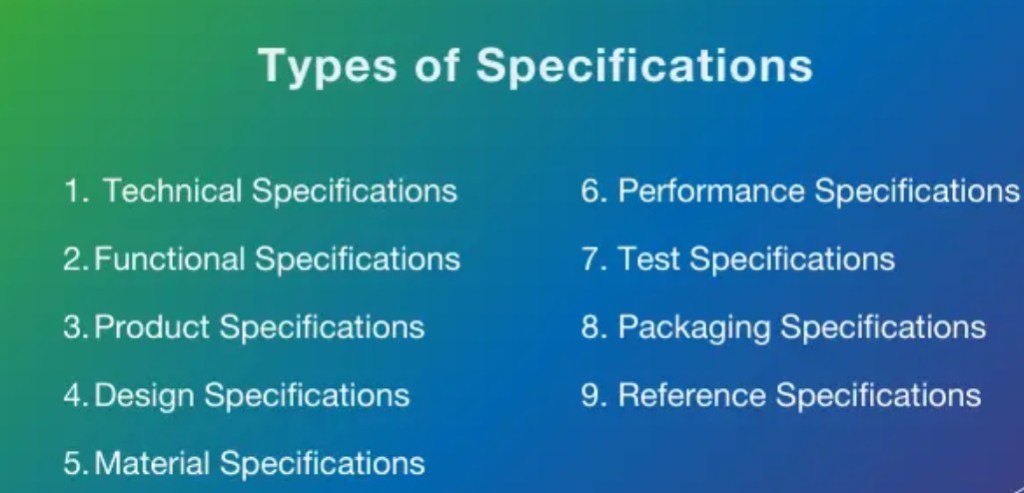
1. Classifications of Specifications

Specifications are generally classified according to the level of detail and the manner in which the work requirements are described. The main classifications are as follows:

1.1 General Specifications

General specifications describe the nature and class of work without providing detailed instructions regarding materials, workmanship, or methods. They give a broad idea of the quality of materials and the type of construction required for a project. These specifications are usually included in preliminary project reports or during the early stages of project planning when detailed information is not yet available.

General specifications mainly serve the following purposes:

  • To indicate the general quality of materials and construction.
  • To provide a rough understanding of the work involved.
  • To assist in preparing approximate cost estimates.
  • To provide guidelines for planning and feasibility analysis.

For example, a general specification for brick masonry may state that the masonry should be constructed using good-quality burnt clay bricks with cement mortar of suitable proportion. However, it will not mention the exact brick size, mortar mix ratio, curing methods, or testing procedures.

Because of their limited detail, general specifications are not suitable for contract agreements or detailed project execution. Instead, they are mostly used for preliminary estimates, feasibility studies, and conceptual planning.


1.2 Detailed Specifications

Detailed specifications provide comprehensive information about every component of construction work. They describe the materials, quality standards, proportions, workmanship, construction methods, equipment, and testing procedures required for the project.

These specifications form a vital part of contract documents and are used during tendering and construction stages. A detailed specification clearly explains:

  • Quality and type of materials to be used.
  • Proportions and mix design of construction materials.
  • Workmanship and execution methods.
  • Required equipment and tools.
  • Testing procedures and quality control.
  • Measurement methods for payment.

For instance, a detailed specification for cement concrete would mention the type of cement (such as Ordinary Portland Cement), the grade of concrete (e.g., M20), the proportion of materials, mixing procedure, compaction method, curing duration, and acceptance criteria.

Detailed specifications eliminate confusion and ensure that the contractor follows the required standards. They also enable engineers or supervisors to monitor the quality of work during construction.


1.3 Standard Specifications

Standard specifications are prepared by government departments, professional organizations, and standard-setting institutions. These specifications provide uniform guidelines for materials, workmanship, and construction methods. They are widely used in public works and infrastructure projects to maintain consistency and quality across projects.

Standard specifications are usually developed based on extensive research, field experience, and engineering best practices. They define the minimum acceptable standards for construction work.

Some commonly used standard specifications include:

  • Specifications issued by Public Works Departments (PWD)
  • Standards published by the Bureau of Indian Standards (BIS)
  • Specifications of the Central Public Works Department (CPWD)
  • Indian Roads Congress (IRC) standards for road construction
  • National Building Code (NBC) guidelines

Standard specifications simplify the preparation of project documents because engineers can refer to established codes rather than writing specifications from scratch. They also ensure that construction practices follow nationally accepted engineering standards.


1.4 Special Specifications

Special specifications are prepared for specific projects or unique construction requirements that are not covered by standard specifications. These specifications supplement the standard guidelines and address particular conditions or design requirements.

Special specifications may include:

  • Unique construction techniques
  • Special materials or equipment
  • Site-specific conditions
  • Environmental protection measures
  • Advanced technologies

For example, a metro rail project may require specialized tunneling techniques, vibration control measures, or advanced structural systems that are not included in standard specifications. In such cases, special specifications are prepared to define these unique requirements.

These specifications ensure that the project meets its specific design objectives while maintaining safety and quality.


1.5 Performance Specifications

Performance specifications describe the expected performance or outcome of a construction component rather than prescribing the exact materials or methods. In this approach, the contractor has flexibility in choosing materials and construction techniques as long as the final performance meets the required standards.

For example, instead of specifying the exact type of insulation material, a performance specification may require that the building envelope achieve a certain thermal resistance value.

Performance specifications are commonly used in modern construction projects because they encourage innovation and allow contractors to adopt efficient technologies while still meeting performance requirements.


1.6 Prescriptive Specifications

Prescriptive specifications provide detailed instructions about the materials, dimensions, and construction methods to be used in a project. Unlike performance specifications, prescriptive specifications do not allow much flexibility to contractors.

These specifications clearly state:

  • Exact material types
  • Construction procedures
  • Dimensions and tolerances
  • Quality standards

For instance, a prescriptive specification for concrete might require a specific cement type, aggregate size, waterโ€“cement ratio, and mixing method.

Prescriptive specifications are widely used in traditional construction projects because they ensure strict compliance with engineering standards and reduce the risk of construction errors.


2. Sources of Specifications

Specifications used in engineering and construction projects are derived from several reliable sources. These sources provide technical guidelines, quality standards, and construction practices that ensure safety and durability.

2.1 Bureau of Indian Standards (BIS)

The Bureau of Indian Standards is the national standard-setting body in India. It publishes Indian Standards (IS codes) that define specifications for materials, testing methods, structural design, and construction practices.

Examples include standards related to:

  • Cement and concrete
  • Structural steel
  • Bricks and masonry
  • Building materials
  • Environmental safety

BIS standards ensure that construction materials and practices meet nationally accepted quality benchmarks.


2.2 Public Works Department (PWD) Manuals

Public Works Departments at both central and state levels publish manuals and specifications for government construction projects. These manuals include standard specifications for various types of works such as buildings, roads, bridges, drainage systems, and water supply infrastructure.

PWD specifications typically include:

  • Standard construction procedures
  • Material quality requirements
  • Measurement and payment rules
  • Maintenance guidelines

These manuals are widely used for public infrastructure projects and serve as an important reference for engineers and planners.


2.3 Central Public Works Department (CPWD) Specifications

The Central Public Works Department publishes comprehensive specifications for construction works undertaken by central government agencies. CPWD specifications cover a wide range of building and infrastructure activities.

They include detailed guidelines for:

  • Civil works
  • Electrical installations
  • Plumbing and sanitation
  • Landscaping
  • Finishing works

CPWD specifications are widely regarded as authoritative and are often adopted by other government departments and institutions.


2.4 National Building Code (NBC)

The National Building Code of India provides guidelines for building design, construction practices, fire safety, structural safety, and building services. Although it is primarily a regulatory document, it also contains specifications related to building materials, safety standards, and construction practices.

NBC serves as an important source of specifications for architects, planners, engineers, and construction professionals.


2.5 Indian Roads Congress (IRC) Standards

For road and highway construction, the Indian Roads Congress provides detailed specifications and guidelines. IRC standards cover aspects such as pavement design, road materials, traffic engineering, and highway safety.

These specifications are widely used in national and state highway projects.


2.6 Technical Literature and Manufacturer Specifications

Manufacturers of construction materials and equipment often provide technical specifications for their products. These documents describe:

  • Product properties
  • Installation methods
  • Performance characteristics
  • Maintenance requirements

Examples include specifications for tiles, paints, waterproofing materials, insulation products, and mechanical equipment.

These manufacturer specifications help engineers select suitable materials and ensure proper installation.


2.7 Project-Specific Design Documents

In many projects, architects, planners, or consulting engineers prepare custom specifications tailored to the design requirements of the project. These specifications combine information from standard codes, technical manuals, and project-specific conditions.

Project-specific specifications are usually included in the tender documents and form part of the contract agreement.


Conclusion

Specifications are a crucial element of engineering and construction documentation. They define the quality of materials, standards of workmanship, and procedures required for the successful execution of a project. Properly prepared specifications ensure clarity, consistency, and accountability in construction projects.

Specifications can be classified into several types such as general specifications, detailed specifications, standard specifications, special specifications, performance specifications, and prescriptive specifications. Each type serves a specific purpose depending on the stage of project development and the level of detail required.

The preparation of specifications relies on multiple reliable sources including BIS standards, CPWD manuals, PWD specifications, National Building Code guidelines, Indian Roads Congress standards, manufacturer documents, and project-specific design requirements. By integrating these sources, engineers and planners can ensure that construction projects meet technical standards, safety requirements, and functional objectives.

Thus, specifications play a fundamental role in bridging the gap between design and execution, ensuring that infrastructure and building projects are constructed efficiently, safely, and according to established engineering standards.

Planning Process and Levels of Planning in India

1. Introduction

Planning is a systematic process used to guide the development of cities, regions, and the nation in an organized and sustainable manner. In a developing country like India, planning is essential to address challenges such as rapid urbanization, population growth, economic disparities, infrastructure shortages, and environmental degradation.

The planning system in India involves a structured planning process and operates at different levels of governance and spatial scales. The planning process includes stages such as data collection, analysis, plan formulation, implementation, and monitoring. At the same time, planning activities are carried out at various levels including national, regional, state, metropolitan, district, and local levels to ensure coordinated development across the country.

Photo by Pavel Danilyuk on Pexels.com

2. Planning Process

The planning process refers to the systematic steps followed to prepare and implement development plans. It ensures that planning decisions are based on careful analysis and future projections.

2.1 Survey and Data Collection

The first step in the planning process is collecting data about the existing conditions of the area. This includes information related to:

  • Population and demographic characteristics
  • Land use patterns
  • Economic activities
  • Housing conditions
  • Transportation systems
  • Infrastructure and public services
  • Environmental resources

Both primary data (field surveys, interviews) and secondary data (census reports, government publications) are used in this stage.


2.2 Analysis of Existing Conditions

After data collection, planners analyze the information to understand the current situation and identify major issues and opportunities. This analysis helps in identifying problems such as:

  • Housing shortages
  • Traffic congestion
  • Lack of infrastructure
  • Environmental degradation

It also highlights strengths such as economic potential or available land resources.


2.3 Forecasting

Forecasting involves predicting future trends based on current data. Planners estimate future needs related to:

  • Population growth
  • Housing demand
  • Infrastructure requirements
  • Transportation demand
  • Economic development

These projections help planners design long-term development strategies.


2.4 Setting Goals and Objectives

At this stage, planners define clear goals and objectives for development. These objectives may include:

  • Balanced regional development
  • Improved infrastructure and services
  • Environmental sustainability
  • Social equity and inclusive growth

The goals provide direction for the preparation of development plans.


2.5 Plan Formulation

In this stage, planners prepare detailed development proposals. These proposals may include:

  • Land-use plans
  • Transportation networks
  • Housing strategies
  • Infrastructure development plans
  • Environmental conservation measures

Different types of plans such as master plans, regional plans, and sectoral plans are prepared.


2.6 Implementation

The implementation stage involves executing the proposals of the development plan through:

  • Government policies
  • Infrastructure projects
  • Development regulations
  • Public and private investments

Various government agencies and planning authorities participate in this stage.


2.7 Monitoring and Evaluation

Planning is a continuous process, so development plans must be regularly monitored and evaluated. Monitoring helps ensure that projects are implemented effectively and allows planners to make necessary adjustments based on changing conditions.


3. Levels of Planning in India

Planning in India operates at several levels to address development needs at different spatial and administrative scales.


3.1 National Level Planning

At the national level, planning focuses on the overall economic and social development of the country.

National planning is responsible for:

  • Formulating national development policies
  • Setting economic growth targets
  • Allocating resources among different sectors
  • Coordinating development programs across states

Previously, the Planning Commission played a central role in national planning through the preparation of Five-Year Plans. Today, national development strategies are guided by institutions such as NITI Aayog.


3.2 Regional Planning

Regional planning focuses on development across large geographic areas that may include multiple states or districts.

Objectives of regional planning include:

  • Balanced regional development
  • Reduction of regional disparities
  • Efficient use of natural resources
  • Coordination between urban and rural development

Examples include regional development initiatives such as the National Capital Region (NCR) planning.


3.3 State Level Planning

State governments are responsible for planning and development within their respective states.

State-level planning focuses on:

  • State economic development
  • Infrastructure projects
  • Urban and rural development programs
  • Resource management

Each state prepares its own development plans and policies in accordance with national objectives.


3.4 Metropolitan Planning

Metropolitan planning addresses the development of large urban regions that include multiple cities and surrounding areas.

Metropolitan planning authorities coordinate:

  • Transportation systems
  • Land-use planning
  • Infrastructure development
  • Environmental management

Examples include metropolitan development authorities in major cities.


3.5 District Level Planning

District planning focuses on development within a district administrative boundary.

District planning committees prepare integrated development plans for both urban and rural areas within the district.

This level of planning helps promote balanced development between towns and villages.


3.6 Local Level Planning

Local planning takes place at the city, town, or village level.

Urban local bodies such as municipal corporations, municipalities, and town councils prepare local development plans such as:

  • Master plans
  • Local area plans
  • Zonal plans

These plans guide land use, infrastructure development, and service delivery at the local level.


4. Importance of Multi-Level Planning

Planning at multiple levels ensures coordination and balanced development across the country.

Balanced Development

Different regions and communities have unique needs, so multi-level planning allows tailored solutions.

Efficient Resource Allocation

Resources can be distributed effectively across different regions and sectors.

Improved Governance

Coordination between national, state, and local authorities improves decision-making and policy implementation.

Sustainable Development

Integrated planning across levels helps ensure environmental protection and long-term sustainability.


5. Conclusion

The planning process provides a systematic framework for guiding development through stages such as data collection, analysis, forecasting, plan formulation, implementation, and monitoring. This structured approach ensures that development decisions are based on careful analysis and long-term vision.

In India, planning operates at multiple levels including national, regional, state, metropolitan, district, and local levels. Each level plays an important role in addressing development challenges and promoting balanced growth.

Effective coordination among these levels of planning is essential for achieving sustainable development, improving infrastructure, and enhancing the quality of life for citizens.

Daily writing prompt
What movies or TV series have you watched more than 5 times?

Concepts of Scales and Proportions: Sketching of Human Figures, Activities, Natural and Man-Made Elements

Sketching is an essential skill in architecture, urban planning, landscape design, and visual communication. Through sketches, planners and designers can quickly express ideas, visualize spatial relationships, and communicate design concepts effectively. One of the most important principles in sketching is the understanding of scale and proportion. These concepts help maintain realistic relationships between objects, people, and spaces within a drawing.

Photo by Tae Fuller on Pexels.com

When planners or designers create sketches of urban spaces, parks, streets, or buildings, they must represent not only the built environment but also the human activities and natural elements that make these spaces functional and lively. Proper understanding of scale and proportion ensures that all elements in the drawingโ€”such as buildings, trees, vehicles, and peopleโ€”appear balanced and realistic.

This tutorial explains the fundamental concepts of scale and proportion and their application in sketching human figures, activities, natural elements, and man-made structures.


1. Understanding Scale

Scale refers to the relationship between the size of an object in a drawing and its actual size in reality. Since it is impossible to represent real-world spaces at full size on paper, drawings are reduced using a specific scale.

For example:

  • 1:100 scale means that 1 unit in the drawing represents 100 units in reality.
  • 1:50 scale is commonly used for building plans.
  • 1:500 or 1:1000 scales are used for urban layouts and site plans.

In conceptual sketching, scale may not always be mathematically exact, but designers still maintain relative scale between elements. For example, a human figure must appear smaller than a building but larger than small street furniture.

Maintaining proper scale helps viewers understand the actual size and spatial relationships in a design.


2. Understanding Proportion

Proportion refers to the relative size and relationship between different parts of an object or between different objects in a drawing. While scale relates a drawing to reality, proportion ensures that elements within the drawing look visually correct.

For example:

  • The height of a door should be proportionate to the height of a person.
  • Trees should be taller than people but smaller than large buildings.
  • Street furniture such as benches or lamps should align with human dimensions.

Incorrect proportions can make a drawing appear unrealistic or confusing.

In architectural and planning sketches, proportion helps represent human-scale environments, ensuring that spaces appear comfortable and usable.


3. Human Scale in Design

Human scale is a fundamental concept in planning and architecture. It refers to designing spaces that relate to the size, movement, and activities of people.

Sketching human figures in drawings helps designers evaluate whether spaces are appropriate for human use. For example:

  • A plaza sketch may include people walking, sitting, or interacting.
  • A street design may include pedestrians, cyclists, and vehicles.
  • A park sketch may include people relaxing under trees or children playing.

Human figures also add life and context to design drawings, making them easier to understand.


4. Sketching Human Figures

Human figures are commonly used in planning and architectural sketches to show scale and activity. These figures do not need to be highly detailed; simple outlines are sufficient.

Basic Human Proportions

In general sketching, the average human body can be divided into proportions:

  • The total height is roughly 7 to 8 head lengths.
  • The shoulders are about two head widths.
  • The arms reach approximately to the mid-thigh.
  • The legs make up nearly half the body height.

However, for quick planning sketches, simplified figures are often used.

Simple Human Figure Sketch

A quick human figure can be drawn using basic shapes:

  1. Draw a small circle for the head.
  2. Draw a vertical line for the body.
  3. Add lines for arms and legs.
  4. Slightly bend the lines to indicate movement.

These simple figures are commonly used in urban design sketches because they are quick to draw and clearly indicate scale.


5. Sketching Human Activities

In addition to static figures, planners often sketch activities to show how spaces are used. Activities help illustrate the function and liveliness of a place.

Common activities represented in sketches include:

  • Walking and jogging
  • Sitting on benches
  • Cycling
  • Talking or gathering in groups
  • Children playing
  • Vendors selling goods

To represent activities, the posture of the human figure is slightly modified. For example:

  • A forward-leaning figure suggests walking.
  • Bent knees may indicate sitting.
  • Raised arms can show interaction or conversation.

Activity sketches help communicate how a public space will function in real life.


6. Sketching Natural Elements

Natural elements are essential components of environmental and landscape sketches. These include trees, shrubs, water bodies, mountains, and terrain features.

Trees

Trees are commonly used in site plans and urban sketches to represent greenery and environmental quality. A simple tree can be drawn using:

  • A vertical line for the trunk
  • Rounded or irregular shapes for the canopy

Different tree shapes may represent different species or landscape characteristics.

Shrubs and Plants

Shrubs can be represented by small circular or irregular shapes placed near pathways or buildings.

Water Elements

Water features such as rivers, lakes, or ponds can be represented with curved lines or wavy patterns to indicate flowing water.

Natural elements provide environmental context and help illustrate the ecological character of a site.


7. Sketching Man-Made Elements

Man-made elements form the built environment and include buildings, infrastructure, and urban furniture.

Buildings

Buildings are often represented using simple geometric shapes such as rectangles and cubes. Windows, doors, and roof lines can be added to give more character.

When sketching buildings, planners should ensure that:

  • The building height is proportionate to human figures.
  • Adjacent structures maintain consistent scale relationships.

Streets and Pathways

Streets can be represented with parallel lines indicating road edges. Additional details such as sidewalks, streetlights, and trees can enhance the sketch.

Street Furniture

Urban elements such as benches, street lamps, bus stops, and signboards help make a sketch more realistic.

These elements should be drawn at appropriate proportions relative to human figures.


8. Composition in Environmental Sketching

Good sketches combine human figures, natural elements, and built structures in a balanced composition.

For example, a street scene sketch may include:

  • Buildings along the road
  • Trees lining the sidewalks
  • People walking or cycling
  • Street furniture such as benches and lamps

Combining these elements creates a lively representation of the environment and helps viewers understand the design concept.


9. Importance for Planners and Designers

Understanding scale and proportion is particularly important for students and professionals in architecture and planning.

These skills help in:

  • Visualizing spatial relationships in urban design
  • Communicating ideas during presentations
  • Developing conceptual designs quickly
  • Evaluating human comfort and usability of spaces
  • Illustrating planning proposals effectively

Hand sketching remains valuable even in the digital era because it allows designers to explore ideas rapidly before developing detailed computer drawings.


10. Practice Exercises

To develop confidence in sketching scale and proportion, students can practice the following exercises:

Exercise 1: Human Figure Practice

Draw several human figures in different postures such as standing, walking, and sitting.

Exercise 2: Street Scene Sketch

Sketch a simple street with buildings, trees, and pedestrians.

Exercise 3: Park Environment

Draw a small park scene including trees, benches, pathways, and people engaged in recreational activities.

Exercise 4: Built Environment Composition

Create a sketch combining buildings, roads, vehicles, and human activities.

These exercises improve observational skills and help students understand how different elements interact within a space.


Conclusion

The concepts of scale and proportion are fundamental to effective sketching in architecture, planning, and design. They ensure that human figures, natural elements, and built structures are represented realistically and harmoniously.

By learning how to sketch human figures, activities, natural landscapes, and man-made elements, planners can communicate spatial ideas more effectively. These sketches help illustrate how people interact with spaces and how the built environment integrates with nature.

Regular practice in observational drawing and conceptual sketching enables designers to develop stronger visualization skills, making them better equipped to design human-centered and environmentally responsive spaces.

Daily writing prompt
What movies or TV series have you watched more than 5 times?

Understanding Functional Structuralism in Sociology

Daily writing prompt
What movies or TV series have you watched more than 5 times?

Functional Structuralism is a sociological theory that merges insights from both structuralism and functionalism to explain how societies function and maintain stability. This theory is concerned with how societal structures shape human behavior and how each part of society contributes to overall social stability.

Origins and Development

Functional Structuralism draws from two major theoretical traditions:

Structuralism โ€“ Emphasized by scholars like Claude Lรฉvi-Strauss, structuralism focuses on the deep structures underlying human thought, language, and culture. It asserts that social reality is constructed through hidden, universal structures that shape people’s behavior.

    Functionalism โ€“ Popularized by ร‰mile Durkheim and later advanced by Talcott Parsons and Robert K. Merton, functionalism views society as a complex system whose parts work together to promote stability and social order.

      The synthesis of these two traditions resulted in Functional Structuralism, which examines both how social structures shape behavior and how those structures function to maintain society.

      Key Concepts of Functional Structuralism

      1. Social Structure

      • Society consists of interconnected institutions (e.g., family, economy, education, religion) that provide a framework for social interactions.
      • These structures influence individual behavior by establishing norms, roles, and expectations.

      2. Functions of Social Institutions

      • Each institution in society has specific functions (manifest and latent) that contribute to societal stability.
      • Example: The education system not only imparts knowledge (manifest function) but also reinforces social norms and prepares individuals for labor markets (latent function).

      3. Equilibrium and Social Stability

      • Functional Structuralism assumes that societies tend to maintain equilibrium.
      • When a disruption occurs (e.g., a major economic crisis), other institutions adjust to restore stability.

      4. Social Roles and Norms

      • People occupy social roles within a structured system.
      • These roles come with expectations that guide individual behavior and contribute to the stability of the social order.

      5. Latent and Manifest Functions (Robert K. Merton)

      • Manifest Functions: Direct, intended outcomes of social institutions (e.g., schools educating students).
      • Latent Functions: Unintended, hidden consequences (e.g., schools promoting social networking).

      6. Social Change and Dysfunction

      • While the theory primarily focuses on stability, it also acknowledges dysfunctionsโ€”elements that disrupt social order.
      • Example: Unemployment can be dysfunctional for economic stability, requiring new policies or structural adjustments.

      Criticism of Functional Structuralism

      Despite its contributions, Functional Structuralism has been criticized for:

      1. Overemphasizing Social Stability โ€“ Critics argue that it neglects the role of conflict, power struggles, and radical social change (e.g., Karl Marxโ€™s conflict theory).
      2. Determinism โ€“ It assumes individuals are shaped by structures, downplaying human agency and free will.
      3. Neglecting Micro-Level Interactions โ€“ The theory focuses on large-scale structures rather than individual interactions (unlike symbolic interactionism).

      Comparison of Structuralism and Functionalism in Sociology

      AspectStructuralismFunctionalism
      DefinitionFocuses on the underlying structures that shape human behavior and culture.Views society as a system of interconnected parts working together to maintain stability.
      Key ScholarsClaude Lรฉvi-Strauss, Ferdinand de Saussure (in linguistics), Louis Althusserร‰mile Durkheim, Talcott Parsons, Robert K. Merton
      FocusDeep, hidden structures (e.g., language, myths, ideologies) that shape social life.Social functions of institutions and their contribution to societal stability.
      Unit of AnalysisStructures such as language, kinship systems, and cultural codes.Social institutions (e.g., family, education, religion, economy).
      ApproachTheoretical and abstract; focuses on how deep structures organize society.Practical and empirical; examines real-world social functions and institutions.
      View of SocietyA network of symbolic and cognitive structures that influence behavior.A system of interdependent parts that function together to maintain equilibrium.
      MethodologyQualitative analysis, semiotics, discourse analysis.Empirical research, statistical analysis, social surveys.
      Role of the IndividualIndividuals are shaped by pre-existing structures; human agency is secondary.Individuals play roles within institutions, but their behaviors are influenced by social norms.
      Social ChangeChange occurs when structural contradictions or shifts in deep structures take place.Change occurs gradually as institutions adapt to maintain social order.
      CriticismToo abstract, neglects practical social interactions and conflicts.Overemphasizes stability, underestimates power struggles and inequalities.

      This table provides a clear comparative view of both theories.

      Conclusion

      Functional Structuralism provides a macro-level perspective on how societies maintain order and how institutions function interdependently. It remains a significant framework in sociology, particularly in understanding how social structures contribute to stability and continuity. However, contemporary sociologists often integrate insights from other perspectives, such as conflict theory and symbolic interactionism, to provide a more comprehensive understanding of society.