
This the first post I have ever written about females in technology. A few recent incidents got me thinking about this issue. First, I attended/presented at an educational technology conference that had the mission of giving women voices as keynote presenters, yet the major presenters (who were given more time and press) were males. Second, I am spending the day watching TedxWomen and there are male presenters.
These incidents reminded of a powerful experience that happened to me as a college teacher in a face-to-face undergraduate course on Psychology of Adjustment . . .
There were about 150 students in the lecture hall where I taught Psychology of Adjustment. The topic of this week was communication and power differences between genders. My goal for all of my classes was to involve the students in the course topics through experiential, interactive activities. On this particular day, I planned a panel discussion. I asked for five females volunteers and five male volunteers from the student audience. The males were asked to take a seat in the five chairs set up in a row, the women stood in a line facing them. My rationale for this physical set-up was to give the women power “over”. Typically men are larger and taller than women, so just their physical presence gives power over.
Next, I asked to the women to tell the men those things that they believe infers with communication between the two genders. The males were instructed to just listen and that the only verbal communications that they could give were questions for clarification. My purpose for this part of the exercise was to give women a forum/venue to have a voice, to get the opportunity to have the males really listen to them.
The exercise was powerful. The women expressed their concerns, mostly about not being heard. The males sat listening, really listening, in a non-defensive poster, to what the women had to say, asking a few questions for clarification. Both sides of the panel did great.
I indicated that it was the end of the exercise . The women emphatically stated that it was now time to give the males the opportunity to tell them what interferes with communication with females. I again stated, “No, this is the end of this exercise.” Two of the women, older in their 40s and 50s, got visibly upset and agitated stating that the males need to have their turn, their say. I asked the males if they were okay ending the exercise as is and they said that they were. The two women were not okay with this and remained very agitated. I saw in their actions a strong need to give back the power to the males.
I thought, “Wow, these women are seeking to give the male back their voices and power; and don’t even realize it.” I did not anticipate nor expect this strong of a reaction from the women. (Note: It was noted in the comments that maybe this was just the two women’s need for fair play. It is difficult to convey observations via words. First, as I stated I did not anticipate nor expect this reaction. I was actually shocked at its intensity. Second, these two women were fairly “traditional” in that they were mothers and wives, returning to school. Third, their visibly being shaken up even after the guys stated they were fine demonstrated that it went much deeper than fair play.)
I realized these beliefs were so ingrained and unconscious that even if I had brought it to the women’s attention, they could not/would not be able to own them. I made the connection between this experience and internalized oppression.
What this experience reinforced is that we live in world where power differentials exist on many levels. I am a strong supporter of affirmative action. I believe that when power differentials exist, proactive and what appears to some to be extreme, “unfair” actions need to be taken.
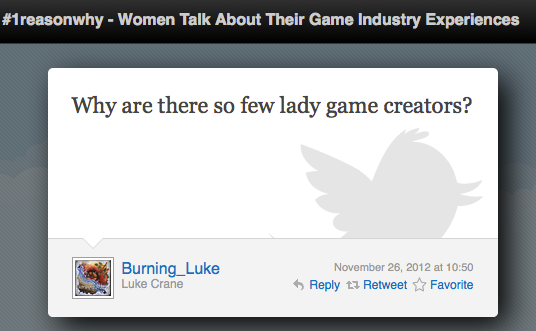
As I examine who are the keynote speakers at technology conferences, who are making online games, the educational technology individuals who are being followed and retweeted on Twitter, the balance of power appears to be in favor of males. Others have noticed and discussed this . . .
- It’s Time to Find the Women in Tech “Where are all the women?” is common refrain in tech circles. Plenty of executives and investors, male and female, are seeking to advance more women in technology. But how? We need to take a three-pronged approach, bolstering education, opportunity, and visibility for women in technology.
- Shifting the Base of Competition A bias against women has existed for centuries, and unfortunately, that bias continues to exist in industries such as IT. This bias, according to Hagel, is amplified by a concept he identifies as the masculine archetype.
- Women In Technology: 4 Reasons Why Females Will Rule The Future Women have been flagrantly underrepresented in technology fields since the Internet first changed the way we interact with the world nearly two decades ago. Only 8 percent of venture-backed start-ups have female leaders, and few women sit on the boards of Web 2.0’s most prominent companies.
This post, in essence, is a call to action for both genders to invite in and provide opportunities for females to become fully engaged, have equal opportunities. and have voices in the field of technology/educational technology. There are some powerful initiatives to get girls and women involved in this field:
- Girls Who Code Together with leading educators, engineers, and entrepreneurs, Girls Who Code has developed a new model for computer science education, pairing intensive instruction in robotics, web design, and mobile development with high-touch mentorship led by the industry’s top female developers and entrepreneurs.
- The FemTech Project came out of a conversation between four women who feel passionately about women in technology careers. They wanted to create a space for women to share their stories about how they got involved in tech careers. The project is also a place for girls to share their passions for technology and connect with other girls with similar passions.
 Track2Training
You must be logged in to post a comment.