
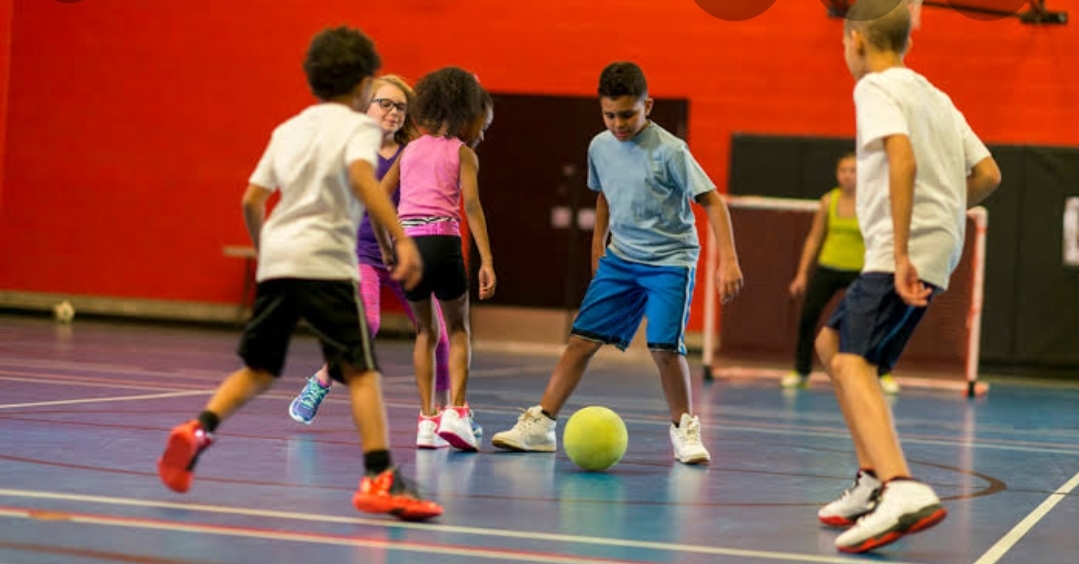
Adaptive Physical Education (APE) is a direct service that can be provided to a special needs child, should the Committee on Preschool Special Education (CPSE) or the Committee on Special Education (CSE) determine that the child is in need of such service. In many cases, if a child is identified as visually impaired, physically handicapped, severely multiply impaired, or other health impaired, he or she will be warranted APE services.
Adaptive Physical Education (APE) is an adapted, or modified, physical education program designed to meet the individualized gross motor needs, or other disability-related challenges, of an identified student. The program can be provided one-on-one, in a small group, or within the general physical education setting. The APE instructor needs to be trained in assessing and working with special needs children. Lesson plans, rubrics, and worksheets need to be adapted for the needs of the children.
The need for Adaptive Physical Education (APE) is determined by the CPSE or CSE. The APE instructor assesses the child and presents the information to the committee. The assessment must include diagnostic and curriculum-based data, observations, and input by the child’s general physical education teacher. If the child is receiving OT, PT or Vision Therapy (VT), then input should be obtained by these providers as well.
Based on the assessment and any other information provided by committee members, the committee determines whether or not APE services are needed. If the committee recommends such services, then APE becomes a part of the child’s Individualized Education Plan (IEP). The plan must include the assessment information, the amount of APE to be received, whether or not the child will be in the general physical education setting, and goals with measurable objectives/benchmarks.
It’s important to note that APE should not be viewed as a related service. Because physical education is federally mandated for all students, the APE teacher is a direct service provider. The APE teacher is to provide adaptations or modifications that will allow the special needs child to participate in age-appropriate physical educational activities. Adaptations or modifications can be made in four areas:
1. Instruction. Rules, lesson plans, strategies, etc. can be modified or included to help the child be successful in physical education. For example, a down’s syndrome child may respond to one word signs as reminders for doing a summersault correctly.
2. Rules. A rule can be adapted or changed if it allows the special needs child to be successful. For example, if the students are working on volley ball skills, a wheelchair bound student is allowed to serve the volley ball from four feet ahead of the serving line.
3. Equipment. Standard gym equipment can be replaced with other objects that vary in shape, color, size, etc. For example, when playing kickball, provide a large bright orange ball for a visually impaired child to kick.
4. Environment. If need be, change the size of the playing area or use tape to define the area. For example, if the general education students are pitching softballs back and forth, work with a severely mentally handicapped child on rolling a ball back and forth by starting out being two feet apart and gradually increasing the space.
For some special needs students, Adaptive Physical Education may be needed every school year. For other students, as they continue to make gains with their gross motor skills, APE services might be tapered back and at some point no longer needed. APE students need to be encouraged to do their best. Programs, such as the Special Olympics, have provided a wonderful and positive opportunity for APE students to experience competing just like their non-disabled peers.
Adapted games for disabilities
The adaptation and development of games for children with disabilities is fundamental for the progression and stimulation of children with disabilities. Apart from adapting the games and toys design according to certain standards to comply with the needs of children with disabilities, we should not forget, that adapting them to the universal standards will benefit, not only children with disabilities, put also children without them, so they can share moments together while playing, favouring social inclusion.
Games and toys for children with disability: inclusion, encouragement and development
Games for children are a synonym with psychomotor activity, development and stimulation. They are a source of assertiveness, motivation, satisfaction and social interaction.
In the case of children with disability, games are more than that. All these benefits mentioned above are duplicated when disabilities are present, so that the game turns to be an occupational area which is a very basic element for their social, cognitive, sensory, prescriptive, affective and communicative development.
We need to take into account that games for children with disabilities are also essential tools to accomplish educational objectives. Nevertheless, children with disabilities usually find obstacles in the game, not only if toys are not adapted to their own needs, but also when interacting with other children.
Furthermore, since there is not only a type of disability (there could be motor, cognitive, sensory, perceptive, relational disabilities), it is hard to set global patterns to define games for every kind of disability. Professionals (doctors and specialists) and family members are the ones who need to be in charge of spotting the features each child needs.
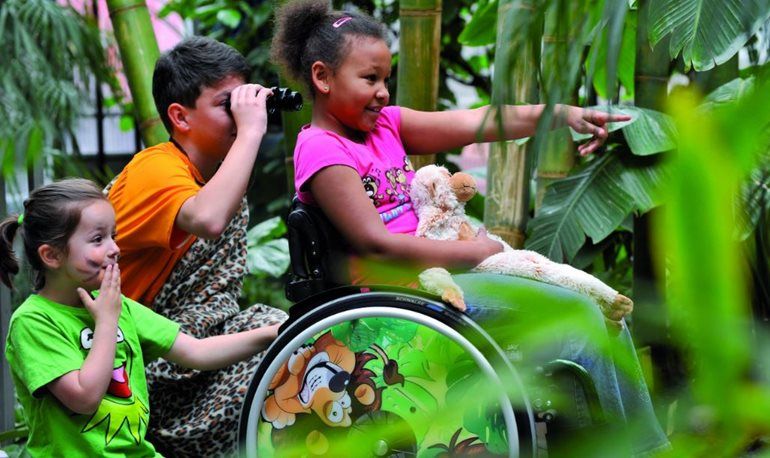
Some of the esential things we need to take into account when choosing a toy or a game for children with disabilities are the age and type of disability. For instance, in cases of motor disability, adaptations in toys for babies is quite high per se. This is due to the fact that at an early age the mobility of babies with or without disabilities is practically the same, but the differences in motor activity are more notable as children grow.
But not only the age and the type of disability are key when choosing any toy or game, children (not only the ones with disabilities), usually have different learning rhythms, so it is important to call certain specifications into question with regard to the age, depending on the case.
Even so, when talking about games for children with disabilities, we can establish the following general guidelines.
- Look for toys with different visual designs, use and play (characteristics of toys with universal design)
- Choose those that allow you to change the rules so you can easily adapt them.
- Encourage them to explore and participate so that they realise what they are or not able to do, and get to know their preferences too
- Don’t forget that stimulation through games for the disabled is both an individual and group experience. The former reinforces personal autonomy while the latter promotes communication and teamwork.
- Adapted toys are those that, in a group of children with and without disabilities, all of them can play with it and none feels excluded.
- “Dirty game” (using sand, water, finger paints, play dough, kneading, wax, modelling clay…) stimulates sensory and motor development.
- If you suggest games for disabled children, try to mix tradition and innovation together. Traditional games (clapping games, songs, etc.) promote the sensorimotor development and enhance social relations. On the contrary, innovative toys use interesting and useful programmes and technological adjustments for children with disabilities.
Games for children with physical disabilities: challenges and basic modifications
Children with motor disabilities usually start their physical therapy when their first months of life are taking place and their parents moving their efforts and eagerness into it. In this phase, play is presented as a major element for physical development.
Among the main obstacles that children with physical disabilities may find when playing, are problems with moving certain parts of their body, reaching the elements, and the precision of movement and coordination.
One of the usual elements for adapting games for children with disabilities is the use of push buttons. They, apart from stimulating the game, are used in some day-to-day devices such as computers, controls, switches or keys. Getting to have autonomy with push buttons, will make easier for them the fact of controlling those devices in the future.
Some other basic elements to take into account when choosing accessible games for children with phisical disabilities are:
- Children can handle them without needing the help from others.
- Push buttons (and other elements which they need to interact with) are adapted, distinguishable and easy to run.
- Large structures like kitchen sets, little tables, etc. need to be large enough to allow the entrance of a wheelchair. In the absence of this possibility, the structure should be detachable.
- The need to perform multiple actions at the same time is excluded (for example, the need of pressing two buttons simultaneously).
 Track2Training
You must be logged in to post a comment.