
The citizenship amendment act was passed by parliament on 11 December 2019, signed by Ram Nath Kovind and it was amended by the citizens in 1995. This law provides a pathway to Indians citizens for persecuted religious minorities coming from Afghanistan, Bangladesh, and Pakistan who are Hindus, Sikhs, Buddhists, Jain, Parsis, and Christians and have arrived in India before December 2014. It grants no eligibility to Muslims coming from these countries whereas the Muslims are in majority there. In Indian law, this is happening for the first time that religion had been overtly used as a criterion for citizenship. The office of the United Nations high commission for human rights called this law Fundamentally Discriminatory. This citizenship bill will be used along with NRC i.e National Register of Citizens which will render Muslim citizens stateless, as they need to prove their identity and will require documents. Even the Hindus who came to India before December 2014 will have to prove their well-founded fear and the circumstances in which they came to India. Each claim requires examination on its merit based on the individual situation.
CAA + NRC
By the 2003 amendment of the citizenship act, the National Register of Citizens is a registry of all legal citizens. In Jan 2020, Assam had implemented NRC but the BJP has promised its implementation for the whole of India following the 2019 election manifesto. So the concerns of people are that it provides a shield only to non-Muslims, but they too have to prove that they came to India because of Religious Persecution. Many leaders say that the CAA – NRC package is targeted at Muslims by considering documents as insufficient and leaving out all the Non-Muslims.
PROTEST
The citizenship act had a great impact on Indian citizens and there were large protests in India. The protests were first held in Assam and the other North-Eastern States which witnessed violent demonstrations against the bill fearing that granting Indians citizenship to refugees and immigrants can cause loss to their political rights, culture, and Land Rights. The protest was also held in the top universities of India i.e Aligarh Muslim University, Jamia Millia University. The Protest at Jamia Millia University led to brutal suppression by the police, detention of hundreds of people, and the death of several protesters. The protest also caused the suspension of local internet connectivity in certain areas. The Protest was started at Shaheen Bagh but when Bilkis Dadi, an 82-year-old woman who became the Face of the Anti-CAA Protest gave strength to all the Muslim women, and then the Muslim women came out of their houses and there was a 24/7 sit-in peaceful protest. The activists against this act are Yogendra Yadav, Kanhaiya Kumar, Akhil Gogoi (Arrested), Safoora Zargar (Arrested), Umar Khalid etc. Scholars who were against the law are Ramachandra Guha, Arundhati Roy, Varun Grover, Anurag Kashyap, etc. The bill was opposed by the INC and said that it may raise communal tensions in the country. The bill was even opposed by the CM of different states such as Punjab, Kerala, Rajasthan, Puducherry. There were even protests in foreign countries such as New York, Washington, Melbourne, Paris, Berlin, Tokyo, Amsterdam, Geneva, San Francisco, Helsinki, and Barcelona against the citizenship amendment Act and the police brutality faced by the Indian protestors.
International reactions:-
There was a report of the United States Commission on Interreligious Freedom that says that in the world there is a downward trend in religious persecution. 61% of countries out of 196 countries have religious persecution. In India, there are ⅓ states that have anti-conversion laws which are enforced against religious minorities and Dalits. According to the report, India has been put in tier 2 list which means country of particular concern. In the last decade, there is a rise in religious persecution, and religious freedom is being deteriorated.
Can the State Government Refuse the law?
The citizenship lies in the union list of the seventh schedule where Parliament can make laws on it. The state government cannot make law under the citizenship act but as 7 to 8 States are opposing this act they can pass a resolution against it which can act as a political statement.
Is this Citizenship Act Fair enough?
Back then in 2014, BJP’s Manifesto included a natural home for Persecuted Hindu refugees but if the manifesto is in contradiction with the constitution then there is no value for such a manifesto. Citizenship shouldn’t be given based on religion because it shows that there is some sort of inequality in the country. Such laws can raise communal riots between two groups of society. As we can see that due to the citizenship amendment Act there were protests which led to Delhi Riots. Using religion as a criterion for citizenship was “inconsistent with the basic structure of the constitution”. The historian Neeti Nair also commented that the Citizenship amendment act and the national register of citizens is a step towards being a “Hindu Rashtra”.
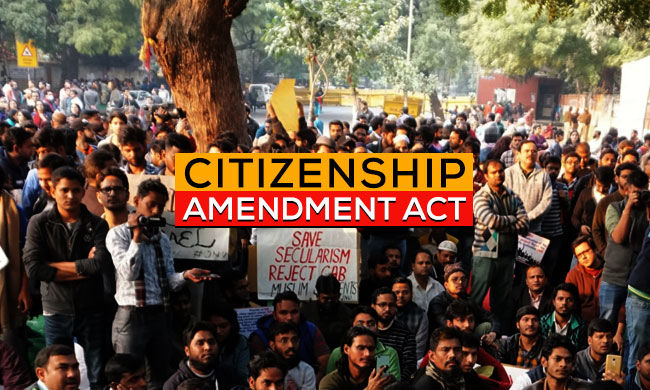
#CAA Protest
 Track2Training
You must be logged in to post a comment.