
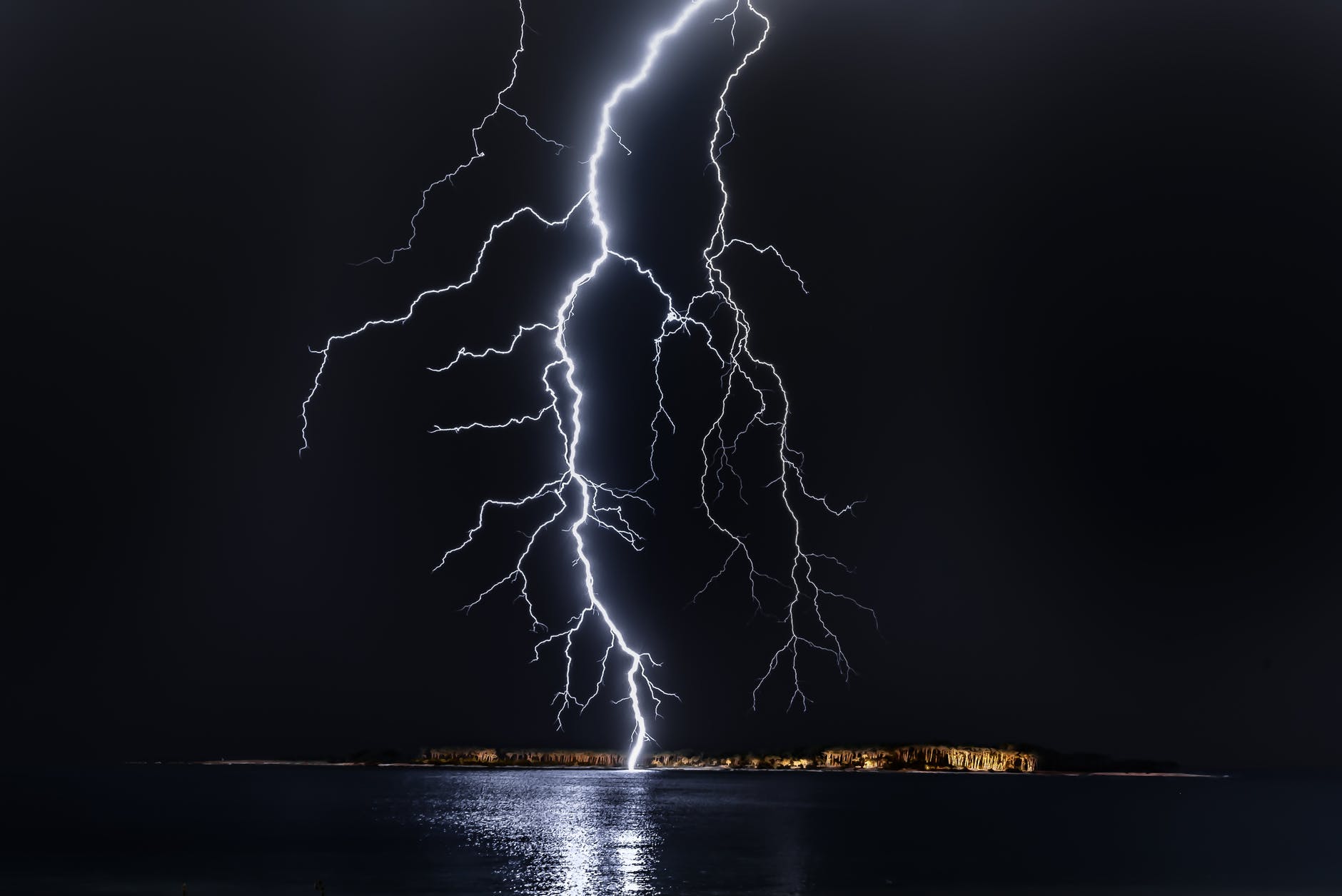
Lightning claimed many lives in India. Recently in West Bengal lightning death toll rose to 27. With an increasing number of tropical cyclones and the coming of monsoon the threat due to lightning has also increased. According to a report published by the climate resilient observing systems promotion council (CROPC), a non-profit organization that works closely with the India Metrological Department (IMD), there were 1,771 deaths due to lightning between April 1, 2019 and March 31, 2020. However, there was a reduction of 37% compared to the previous year. Uttar Pradesh saw the maximum death toll, followed by Madhya Pradesh, Bihar, Odisha and Jharkhand. These are also the areas that fall under the influence of Norwesters (Kalbaisakhi).
Why lightning kills?
Lightning is defined as a natural electric discharge of high voltage between a cloud and the ground or within a cloud. It occurs within a few milliseconds. Hence it is an electric discharge of very short duration. Bright flash and sound due to shock waves are observed with lightning. Intra and inter cloud (IC) lightning do not cause any problem. Cloud to ground (CG) lightning is responsible for death and destruction.
Electrification of clouds occurs then warm air mixes with cool air. A fast upward movement of air during the thunderstorm (updraft) carries humid air that turns into super cooled water and ice as it moves upwards through the freezing clouds (Altitude of 10 km where the temperature is -40°C). Larger crystals (Graupel) are heavy and are present in the clouds. Moving water droplets (positively charged) and ice collide (positively charged) with each other and the Graupel (negatively charged) producing a potential difference that is, the top of the clouds are positively charged and lower parts are negatively charged. The Earth/ground is neutral (no charge) and a good conductor of electricity. However, in comparison to the middle layer of the cloud, it becomes positively charged. Hence the current gets directed towards the earth as well.
Most of the death are a result of people taking shelter below tree during rain. A side flash occurs when lightning strikes a nearby tall object like a tree and then jumps from the tree to a human. This happens within a radius of 2 feet from the object.
Though rarely but when a person is directly struck by lightning it can heat and burn the skin and travel to the ground through the nervous system.
Ground current is the electricity traveling along the ground especially in the presence of conductive materials like water when lightning strikes an object. This can kill a large number of humans and animals. In rural India where farmers are working in their fields drenched with irrigated waters fall victim to it.
Mitigation
The best way to prevent death due to lightning is through early warning systems that can alarm the people to take shelter before thunder storm. An application named Damini was developed by IITM to disseminate lightening alert. Other applications like Mausam and Meghadoot also help in early warning dissemination. Apart from this lightening as a disaster and the do’s and don’ts are taught in schools under disaster management. These initiatives by the government to improve early warning systems and establishment of monitors in vulnerable areas are commendable. It has resulted in reduction of death tolls. However, there is a scope for further improvement.
 Track2Training
You must be logged in to post a comment.