
• India met with an economic crisis relating to
its external debt.
Unable to make repayments on its borrowings from abroad.
Foreign exchange reserves had dropped to
very low levels.
Further compounded by rising prices of
essential goods.
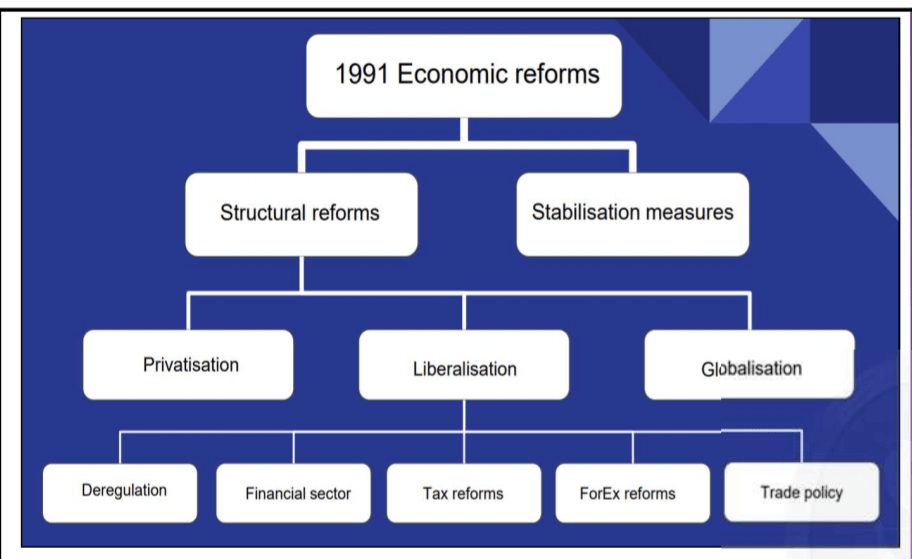
• Origin of the financial crisis – from the
inefficient management of the Indian economy
in the 1980s.
Foreign exchange was spent on meeting
consumption needs.
Minimal effort to reduce such profligate
spending or boosting export.
• India approached the World Bank and the
International Monetary Fund.
• Agreed to the conditionalities of WB and IMF-
announced the New Economic Policy (NEP).
A wide-ranging economic reforms.
Initiated a variety of policies based on
liberalisation, privatisation and globalization.
• Post 1991 reforms- India’s export sector has
not changed much.
• Huge foreign exchange reserve- a result of
huge financial inflows, not export surpluses.
• Key elements to improve a country’s export
competitiveness.
publicly provided infrastructure, private R&D
and a facilitating government machinery.
• Mostly available in India’s software services-
exporters, not for exporters of goods.
India’s trade in services generally has a
surplus; deficit is mostly in trade of tangible
goods.
• Need for strong export performance- cannot rely on volatile portfolio capital against balance of payments stress.
• Way forward:
Need serious structural revisions to ensure necessary infrastructure in our country.
 Track2Training
You must be logged in to post a comment.