“Suvidha, Suraksha, Samman” to women

Last 9 years the Union Government under Prime Minister Narendra Modi has provided “Suvidha, Suraksha, Samman” to women. Thoughtfully planned schemes like Ujjwala for Gas connections, Swachhta for female toilets and Jal Jeevan for tap water in households not only provided Ease of Living to women but also gave them a sense of self-confidence with self-esteem.

This was stated by the Union Minister of State (Independent Charge) for Science and Technology, MoS PMO, Department of Atomic Energy and Department of Space and MoS Personnel, Public Grievances and Pensions, Dr Jitendra Singh at Sambhal, Uttar Pradesh while addressing a congregation of Modi scheme beneficiaries, majority of whom comprised women.
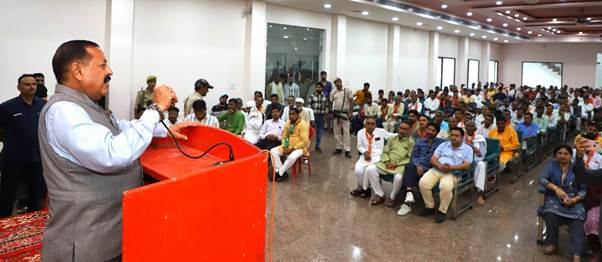
The Minister said there has been a paradigm shift in Public Service Delivery and the implementation of Government schemes in the last 9 years. “Be it DBT, or provision of basic facilities like electricity, water, toilets to poor people, all these have brought a revolution at the grassroots level,” he said.

Dr Jitendra  Singh said Prime Minister Narendra Modi has put Nari Shakti at the forefront of India’s development journey. Mission Shakti comprises two sub-schemes ‘Sambal’ and ‘Samarthya’ for the safety, security and empowerment of women. The impact of this approach has been evident in the outcomes, such as an improved sex ratio at birth which is now for the first time 1020 women per 1000 men, a rise in institutional deliveries, declining infant mortality, and a lower maternal mortality rate.

With a promise to remove drudgery from the daily life of Women, Dr Jitendra Singh said the increased usage of LPG cylinders under the Ujjwala Yojana has saved crores of women from chronic respiratory disorders through smoke-free kitchens. With the success of Swachh Bharat Abhiyan, crores of women are now able to access toilets in their homes without any fear of safety or violation of dignity. Walking long distances to fetch water for daily consumption is becoming a thing of the past as households across the country are getting tap water connections under the Jal Jeevan Mission. Over 27 crore sanitary pads have been sold at One Rupee at Jan Aushadhi Kendras.

He said Women Empowerment is contingent upon the economic empowerment of women. Programmes such as MUDRA Yojana in which 68% of loans have been extended to more than 27 crore women, have enabled crores of women across the country to pursue micro-level entrepreneurship and become financially independent. 3.18 crore Sukanya Samriddhi Yojana accounts have been created. To promote financial inclusion among women, Mahila Samman Savings Certificate was introduced as part of the Union Budget 2023-24, which is a small savings scheme exclusively for female investors.

Under PM Awas Yojana, women are being made owners of the family home thus becoming active participants in household decision-making. In the 9 years of the Modi government, women have grown from strength to strength. Their success can be seen in the significant increase in the numbers of female police personnel, laurels won by sportswomen for the country and enrolment of women in the fields of Science, Technology, Engineering & Maths.

The government has transformed Women from being targets of welfare to agents of empowerment. “Today it is no longer women development, but women-led development,” he said.

*******
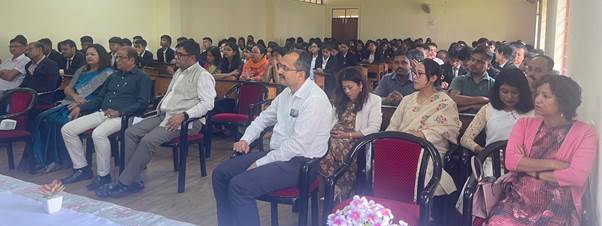
Enlightening session  on RTI Act, of 2005 organized by Pro Bono Club

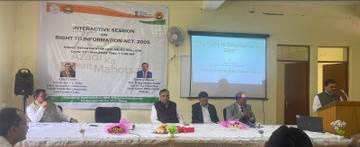
Under Department of Justice’s Nyaya Bandhu, the Pro Bono Club of NEHU, Shillong organised an enlightening session on the RTI Act, of 2005. It highlighted the significance of the Act, educating citizens about their right to access vital public information.

Image

Led by Dr. Ravi Kant Mishra, the esteemed guests Heimonglang Nongpluh & Prof. Prabha Shankar Shukla stressed the importance of employing this right when necessary, empowering individuals, and  promoting awareness in rural Meghalaya. It shed light on the Act’s numerous benefits and  its role in ensuring public authorities’ accountability.

Image

Swachh Jal Se Suraksha Campaign Report Under Jal Jeevan Mission

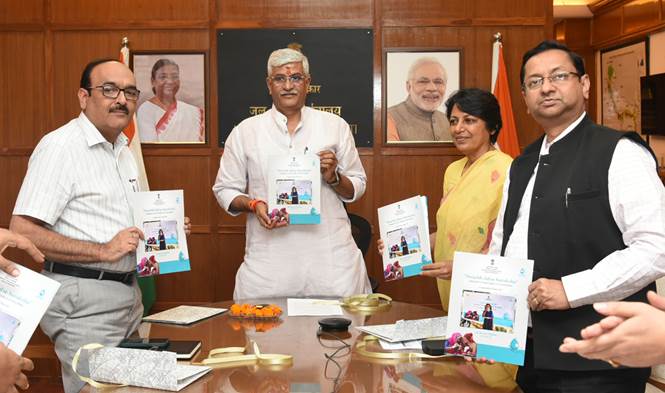
The Union Minister For Jal Shakti, Shri Gajendra Singh Shekhawat today released the report on progress under the Jal Jeevan Mission: Swachh Jal se Suraksha (SJSS) Campaign which was organised from 2nd October, 2022 to 31st March, 2023 to impress upon the States/ UTs to make concerted efforts towards taking up water quality monitoring and surveillance activities as ‘Supply of Safe Water’ has been one of the key considerations under JJM. Under the campaign, several activities had been taken up including Testing of PWS sources in all villages for chemical parameters and bacteriological parameters (post monsoon); Water quality testing at household level in villages; Water quality testing in Schools and Anganwadi Centres; Remedial action taken for contaminated samples; and Training of women for water quality testing using FTK/ H2S vials at village level.

As a result of concerted efforts made by States/ UTs for water quality monitoring and surveillance during campaign period and progress reported on WQMIS portal, the activity-wise overall progress is as under:

Water quality testing has been reported in 5.39 lakh (89.69 %) villages for chemical and in 4.47 lakh (74.46 %) villages for bacteriological contamination (post monsoon).

Drinking water samples were tested in 6.58 lakh (67.63 %) schools and 7.16 lakh (67.43 %) anganwadi centres.

21.80 lakh women have been trained from 4.59 lakh (76.41 %) villages for water quality testing using Field Testing Kits (FTKs).

Remedial action has been taken for 90.34% of contaminated sample reported.

Performance of states/UTs was also measured during the Campaign. The states of Tamil Nadu, Andhra Pradesh, Karnataka and Madhya Pradesh emerged as the best performing states during the Campaign.

Jal Jeevan Mission (JJM) was announced by Prime Minister, Shri Narendra Modi on 15 August, 2019 to make provision of potable tap water supply in adequate quantity, of prescribed quality on regular & long-term basis to every rural household. Access to assured and safe drinking water is a basic life need. The Objective of the campaign was to ensure drinking water quality and create awareness among representatives of the Panchayati Raj institutions and rural communities about quality of drinking water in their respective villages, water quality issues, water borne diseases & health impacts and avoiding use of water from quality-affected sources.

The desired outcome of the campaign was wide participation at Village, district and State level for water quality testing, building confidence and create awareness among people about quality of water being supplied through piped water supply. States/ UTs PHE/ RWS Department, being ‘Nodal Department’ implemented Swachh Jal se Suraksha campaign in respective States/ UTs by actively involving all the stakeholders viz. Gram Panchayat and/ or its sub-committees/ local community to take up water quality monitoring and surveillance and awareness activities.

*****

NHPC and VUCL, Nepal sign MoU for development of Phukot Karnali Hydro Electric Project (480MW) in Nepal

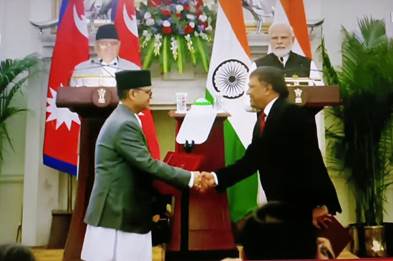
NHPC Limited (A Govt. of India Enterprise) and Vidhyut Utpadan Company Limited (VUCL), Nepal signed an MoU (Memorandum of Understanding) in New Delhi today for development of Phukot Karnali Hydro Electric Project (480MW) in Nepal. The MoU was signed in the presence of Prime Minister of India Shri Narendra Modi and Prime Minister of Nepal Shri Pushpa Kamal Dahal ‘Prachanda’ at Hyderabad House in New Delhi.

Shri R.K. Vishnoi, CMD, NHPC and Shri Surya Prasad Rijal, MD, VUCL, Nepal exchanging MOU documents for development of Phukot Karnali Hydro Electric Project (480MW) in Nepal in  presence of Prime Minister of India Shri Narendra Modi and  Prime Minister of Nepal Shri Pushpa Kamal Dahal ‘Prachanda’ at Hyderabad House, New Delhi.

NHPC Limited, a Schedule ‘A’ Enterprise of the Government of India with ‘MINI RATNA’ status, is a premier PSU in India for development of hydropower and Vidhyut Utpadan Company Limited (VUCL), Nepal is responsible to develop, build, own and operate large-scale hydropower projects in public-private partnership model in Nepal.

The MOU was exchanged by Sh. R.K. Vishnoi, Chairman & Managing Director, NHPC and Shri Surya Prasad Rijal, Managing Director, VUCL. Signing of this MOU is a landmark step towards India-Nepal Joint Vision on Power Sector Cooperation.

The project will use the flow from the Karnali River for power generation and the generated power will be fed into integrated power system of Nepal. The installed capacity of the project shall be 480 MW with average annual generation of about 2448 GWh. The key features of the project are a 109 metre high RCC dam and an underground power house where the 06 turbines of 79 MW each shall be housed. Additionally, to utilize minimum environmental release one Surface Power House of 6 MW capacity i.e. two machines of 3 MW each is also planned. This project is conceived as a Peaking Run-of-River (PRoR) type scheme.

****