
By Shashikant Nishant Sharma
Geographic Information Systems (GIS) have emerged as indispensable tools in the field of urban and regional planning. GIS leverages spatial data to analyze, visualize, and interpret patterns and trends that inform decision-making processes. In the realm of planning education, integrating GIS technology into curricula transforms how students learn about and engage with the planning of cities, regions, and the environment.
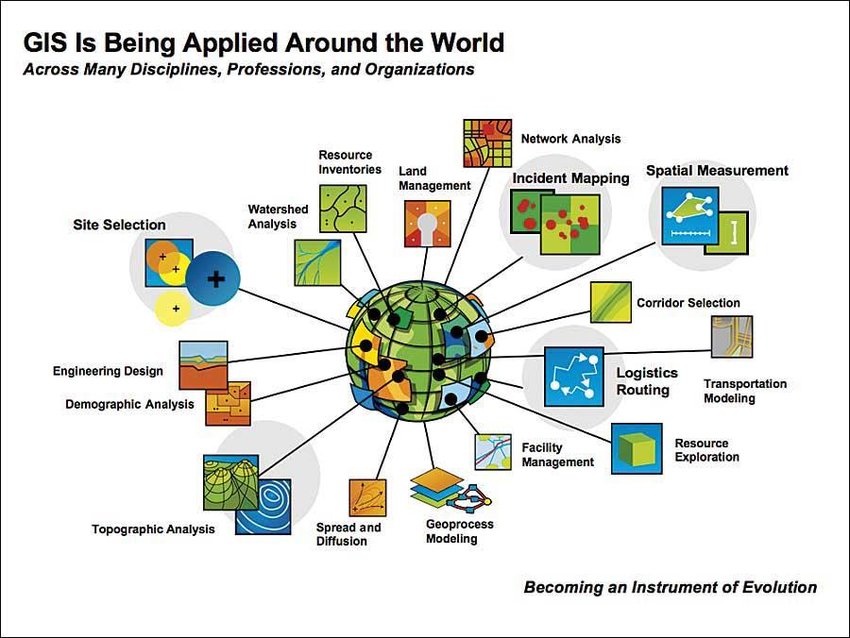
1. Real-World Data Visualization:
GIS allows students to interact with real-world data by visualizing geographic features and their attributes. Maps created using GIS display diverse information, from population densities to land use patterns, enabling students to comprehend complex spatial relationships and patterns. These visualizations bring theoretical concepts to life, making learning more engaging and effective.
Geographic Information Systems (GIS) play a pivotal role in planning education by offering a dynamic platform for students to interact with real-world data and visualize geographical features and their associated attributes. GIS technology enables the creation of informative and visually captivating maps that convey a wealth of information, ranging from population densities to land use patterns and beyond.
Through GIS-generated maps, students can explore and interpret complex spatial relationships and patterns that are fundamental to understanding the dynamics of urban and regional planning. For instance, they can visually represent the distribution of residential, commercial, and industrial zones within a city, gaining insights into urban sprawl, segregation, or potential areas for revitalization. These visualizations provide a tangible representation of theoretical concepts, making learning more engaging, memorable, and effective.
The ability to visualize real-world data in GIS empowers students to observe trends and patterns over time. By overlaying historical data onto current maps, students can discern trends in urban growth, land use changes, or environmental degradation. This historical perspective is vital in forecasting future trends and planning sustainable urban development strategies.
Moreover, GIS allows students to integrate various data layers, enabling a comprehensive understanding of multifaceted issues. For instance, they can overlay population data with transportation networks, identifying areas with high population density and inadequate transportation infrastructure. This spatial integration fosters a holistic understanding of the interdependencies between different elements in the urban landscape, a crucial aspect of modern planning.
By immersing themselves in GIS-generated visualizations, students not only understand the theoretical principles of planning but also develop a keen eye for patterns and trends that inform effective decision-making. This hands-on experience enhances their spatial analytical skills, critical thinking, and problem-solving abilities, preparing them for the challenges and complexities of planning in the real world.
The power of GIS in real-world data visualization transforms planning education by bridging the gap between theoretical concepts and practical application. The ability to create visually appealing and informative maps empowers students to delve deeper into the intricacies of urban and regional planning, setting the stage for a generation of planners well-equipped to tackle the pressing issues of our cities and regions.
2. Data Analysis and Spatial Modeling:
One of the key benefits of GIS in planning education is its ability to perform sophisticated spatial analysis. Students can analyze data to derive meaningful insights, such as identifying optimal locations for facilities, assessing environmental impacts, or predicting future growth. This fosters critical thinking and problem-solving skills crucial for effective planning.
In the realm of planning education, Geographic Information Systems (GIS) offer a transformative edge by facilitating advanced spatial analysis, a cornerstone of effective planning. GIS equips students with the ability to dissect complex data sets, extract meaningful insights, and model spatial relationships. These analytical capabilities are pivotal for addressing contemporary urban and regional planning challenges.
GIS provides a robust toolkit for students to conduct intricate data analyses. For instance, they can determine optimal locations for facilities like schools, hospitals, or public transportation hubs by considering factors such as population density, accessibility, and proximity to other essential amenities. Through spatial analysis, students can unravel intricate patterns in data, aiding in informed decision-making regarding infrastructure placement and resource allocation.
Furthermore, GIS enables the assessment of environmental impacts, an integral aspect of sustainable planning. Students can model potential effects of urbanization or industrial activities on the environment, predicting outcomes and suggesting mitigation strategies. This hands-on experience fosters an understanding of the intricate interplay between human activities and the environment, promoting environmentally conscious planning practices.
Predicting future growth and development is another critical application of GIS in planning education. By analyzing historical data and current trends, students can model and forecast urban expansion, enabling proactive planning for infrastructure, housing, and public services. This forward-thinking approach helps in devising strategies to accommodate population growth and prevent potential urban sprawl issues.
The process of analyzing data and creating spatial models using GIS encourages critical thinking and problem-solving skills. Students learn to approach planning challenges systematically, evaluate various factors, and develop evidence-based solutions. They develop the ability to weigh multiple variables and consider their spatial implications, enhancing their analytical prowess.
By immersing students in data analysis and spatial modeling, GIS facilitates a comprehensive understanding of the complexities of urban and regional planning. It prepares them to navigate the data-rich environment of modern planning, empowering them to make informed decisions that account for diverse factors, from social equity to environmental sustainability. Ultimately, this capability ensures that future planners are well-prepared to shape vibrant, resilient, and sustainable communities.
3. Scenario Planning and Simulation:
GIS facilitates scenario planning, enabling students to explore multiple planning alternatives and their potential outcomes. By altering parameters like zoning regulations or transportation networks, students can simulate and evaluate the impact on communities and the environment. This practical experimentation enhances their understanding of the consequences of various planning decisions.
In the realm of urban and regional planning education, the integration of Geographic Information Systems (GIS) introduces students to the transformative practice of scenario planning and simulation. GIS empowers students to envision and analyze multiple planning scenarios, allowing them to experiment with various parameters such as zoning regulations, transportation networks, or land use patterns. This interactive experimentation facilitates a deeper understanding of the potential outcomes and consequences of diverse planning decisions.
Scenario planning involves creating plausible future scenarios based on different assumptions and variables. GIS acts as a dynamic canvas for students to craft these scenarios by altering key planning parameters. For instance, they can modify zoning regulations to encourage mixed-use developments or adjust transportation networks to prioritize sustainable modes of transport. These changes can then be simulated using GIS, generating visual representations of how the modifications might impact communities and the environment.
The ability to visualize and simulate these scenarios enhances the learning experience by providing a glimpse into the complex dynamics of urban planning. Students can observe how alterations in urban design affect accessibility, congestion, environmental quality, and community well-being. This practical experimentation bridges the gap between theoretical knowledge and its practical application, equipping students with a nuanced understanding of the multifaceted nature of planning decisions.
Moreover, GIS-based scenario planning encourages students to think critically and foresee potential challenges and opportunities associated with different planning strategies. By envisioning diverse futures, they learn to anticipate the implications of their decisions and adapt plans to mitigate negative consequences. This cultivates a proactive mindset, essential for effective planning in an ever-changing urban landscape.
Scenario planning also fosters interdisciplinary thinking, encouraging students to collaborate and integrate insights from various domains such as transportation, environment, and social equity. It emphasizes the interconnectedness of urban systems, instilling an appreciation for the importance of holistic and inclusive planning approaches.
The scenario planning and simulation with GIS enrich planning education by transforming theoretical concepts into practical, interactive learning experiences. Through this process, students gain valuable insights into the complexities of planning decisions and are better prepared to navigate the uncertainties of urban and regional development. GIS emerges as a powerful tool, empowering future planners to envision resilient and sustainable communities by considering a multitude of scenarios and making informed choices.
4. Community Engagement and Participation:
GIS offers a platform for collaborative planning by incorporating community input. Students can utilize GIS to create interactive maps for public engagement, soliciting feedback and integrating community preferences into planning proposals. In doing so, students learn the importance of inclusivity and the role of public participation in the planning process.
5. Interdisciplinary Learning:
GIS is inherently interdisciplinary, incorporating elements of geography, environmental science, sociology, and more. Planning education enhanced by GIS exposes students to this interdisciplinary nature, providing a holistic understanding of urban systems and fostering a collaborative approach to problem-solving.
6. Spatial Decision Support Systems (SDSS):
Integrating GIS into planning education allows students to engage with SDSS, assisting in complex decision-making. SDSS combines GIS capabilities with decision models, enabling students to evaluate various criteria and constraints when proposing solutions to planning challenges.
7. Career Readiness:
Proficiency in GIS is highly valued in the job market for planners. Incorporating GIS into planning education ensures students are equipped with practical skills sought after by employers. It enhances their employability and prepares them to contribute effectively in the field upon graduation.
Conclusion:
GIS has revolutionized planning education by offering a dynamic platform for students to explore, analyze, and understand the complexities of urban and regional systems. By integrating GIS into curricula, academic institutions empower students to develop a nuanced understanding of spatial data analysis, fostering a new generation of planners equipped with innovative tools and approaches to tackle contemporary urban challenges. The future of planning education lies in leveraging GIS to create sustainable, resilient, and inclusive communities.
References:
Bansal, V. K. “Use of GIS and topology in the identification and resolution of space conflicts.” Journal of Computing in Civil Engineering 25.2 (2011): 159-171.
Charlton, Martin, and Simon Ellis. “GIS in planning.” Planning Outlook 34.1 (1991): 20-26.
Göçmen, Z. Aslıgül, and Stephen J. Ventura. “Barriers to GIS use in planning.” Journal of the American Planning Association 76.2 (2010): 172-183.
Innes, Judith E., and David M. Simpson. “Implementing GIS for planning lessons from the history of technological innovation.” Journal of the American Planning Association 59.2 (1993): 230-236.
Resch, Bernd, et al. “GIS-based planning and modeling for renewable energy: Challenges and future research avenues.” ISPRS International Journal of Geo-Information 3.2 (2014): 662-692.
Sharma, Shashikant N., and Dungar Singh. “Understanding mid-block traffic analysis: A crucial tool for road safety.” Think India Journal 26.3 (2023): 5-9.
Yeh, Anthony GO. “Urban planning and GIS.” Geographical information systems 2.877-888 (1999): 1.
 Track2Training
You must be logged in to post a comment.