
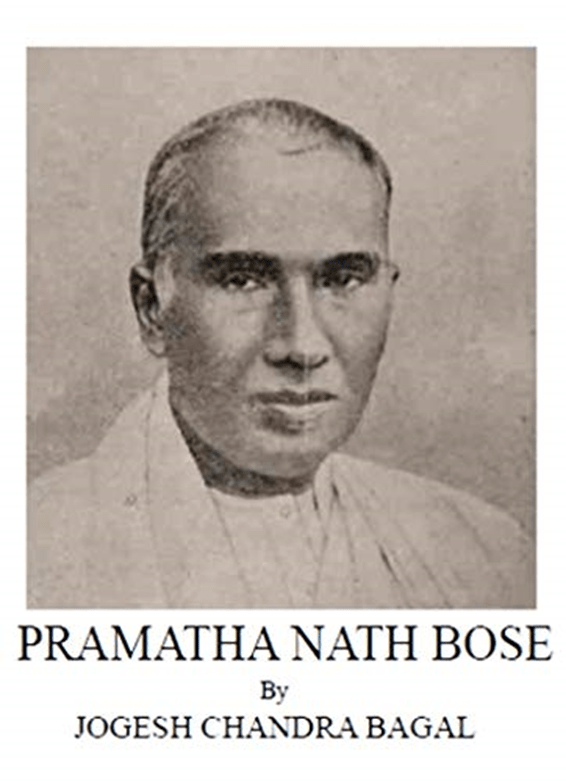
Pramatha Nath Bose (1855 – 1934) was a great Indian geologist also a key person for the success of Tata Group as he wrote a letter to JN Tata on February 24, 1904, which led to the establishment of Tata Iron and Steel Company at Sakchi, Jamshedpur. Unfortunately, his contribution is not highlighted in the country, even by the West Bengal Government, whether in the present or previous government. Notably, he was born on May 12, 1855, in a remote village of Gaipur, near Gobardanga, in 24 Parganas district, West Bengal. I consider Pramatha Nath Bose (henceforth, I will mention him as Bose) one of the stalwarts, as he was the architect of industrial development in British India. The great soul, Bose was educated at Krishnagar Government College and later at St. Xavier’s College of the University of Calcutta when he obtained a Gilchrist scholarship to study in London in 1874. He graduated in 1877, studied at the Royal School of Mines in London, and excelled in biology and palaeontology. He was one of the early Indians to join the Geological Survey of India as an officer. His initial work was on the Siwalik fossils. During his tenure as a geologist, he discovered iron ore mines in Dhulli and Rajhara in Madhya Pradesh. The most outstanding achievement of his life was the discovery of iron ore deposits in the hills of Gorumahisani in Mayurbhanj. Following the discovery, Bose wrote a letter to JN Tata on February 24, 1904, which led to the establishment of Tata Iron and Steel Company at Sakchi, Jamshedpur.
Bose has several great achievements to his credit. He was the first Indian graduate in science from a British University, the first to discover petroleum in Assam, the first to set up a soap factory in India, and the first to introduce micro sections to aid petrological work. He was also the first Indian to hold a graded position in the Geological Survey of India, where he served with distinction. As a man of science, he constantly took up the cause of technical education in the country. His efforts also catalyzed the foundation of the Bengal Technical Institute, presently known as the Jadavpur University. Bose was the first honorary principal there.
During his service period while he was in the Geological Survey, the following praiseworthy activities were carried out, inter alia, with other activities:
· a) Bose conducted surveys of the Narmada Valley of Rewa State, Central India.
· b) He examined metalliferous indications in the northern part of the Darjeeling district.
· c) Bose made several traverses in Lower Burma when doing Geological research in the region.
· d) Bose was the first person to report the occurrence of trachyte from the Narmada region.
· e) He discovered iron ores in Gurumahisini and the Mayurbhanj, which led to the foundation of the Tata Iron Works.
· f) Bose reported the presence of Lameta and Bagh beds for correlating similar sequences in other parts of India.
· g) Filled gaps in the geological map in the Mandla district, including the greater part of the Bastar State.
· h)He examined coal out-crops east of Teendaria and successfully identified exposures of coal that were excavated under his direction.
· i)He was the first to identify distinct volcanic centers around Mandaleshwar in the Narmada Valley.
· j) He discovered coal deposits in the Assam region.
· k) He Discovered petroleum deposits in the Khasimar Valley
During his time at the Geological Survey of India, Bose was repeatedly praised by the Director, William King, for his excellent and economic work in his reports.
I salute the great soul of the country for whom our country is at its zenith in industrial development.
Also, I request that our Union Government and the West Bengal Government highlight his massive contribution to the country’s industrial development, which should be included in the school textbooks so our children can learn about him.
Prof Shankar Chatterjee, Hyderabad

 Track2Training
You must be logged in to post a comment.