
By Shashikant Nishant Sharma
The multi-nuclei model of urban planning, proposed by Chauncy Harris and Edward Ullman in 1945, is an influential theory that describes the structure and organization of cities. It challenges the earlier, more linear models of urban development, such as the Concentric Zone Model and the Sector Model, by suggesting that cities grow not around a single central business district (CBD) but around multiple centers, or “nuclei,” which serve as hubs for different types of activities.

Key Concepts of the Multi-Nuclei Model
- Multiple Centers of Growth (Nuclei):
- The multi-nuclei model posits that instead of having a single CBD, a city develops multiple nuclei that serve as focal points for different activities. These nuclei can include business districts, industrial zones, residential areas, and more.
- Each nucleus may develop based on specific needs, such as proximity to transportation hubs, natural resources, or land availability. Over time, these nuclei attract certain types of activities and industries, further reinforcing their roles.
- Decentralization:
- This model reflects the decentralization of urban areas, where various functions like shopping, industry, and residential zones move away from the traditional city center.
- This decentralization is driven by factors such as increased automobile use, which allows people and businesses to spread out over larger areas, and the development of new technologies that make it less necessary to concentrate activities in a single location.
- Specialization of Areas:
- Different nuclei often become specialized in certain types of activities. For instance, one area might develop as a financial district, another as a manufacturing hub, and yet another as a residential suburb.
- This specialization occurs as industries and businesses seek to optimize their operations by locating close to suppliers, customers, and related industries.
- Urban Sprawl and Connectivity:
- The multi-nuclei model is associated with urban sprawl, where the city expands outward in various directions. This growth leads to the development of suburbs and the spread of residential, commercial, and industrial zones.
- The connectivity between these nuclei is crucial, as transportation networks (roads, railways, etc.) play a significant role in linking these different areas and facilitating movement.
- Impact on Land Use and Zoning:
- The presence of multiple nuclei influences land use patterns, leading to distinct zones with varying levels of density and types of development.
- Zoning laws and regulations may develop around these nuclei to control and guide growth, often leading to distinct industrial, commercial, and residential districts.
- Social and Economic Diversity:
- The multi-nuclei model also reflects the social and economic diversity within a city. Different nuclei may attract different demographic groups based on income, occupation, and lifestyle preferences.
- This can lead to a mix of high-income and low-income areas, ethnic enclaves, and areas with varying levels of amenities and services.
Application and Examples
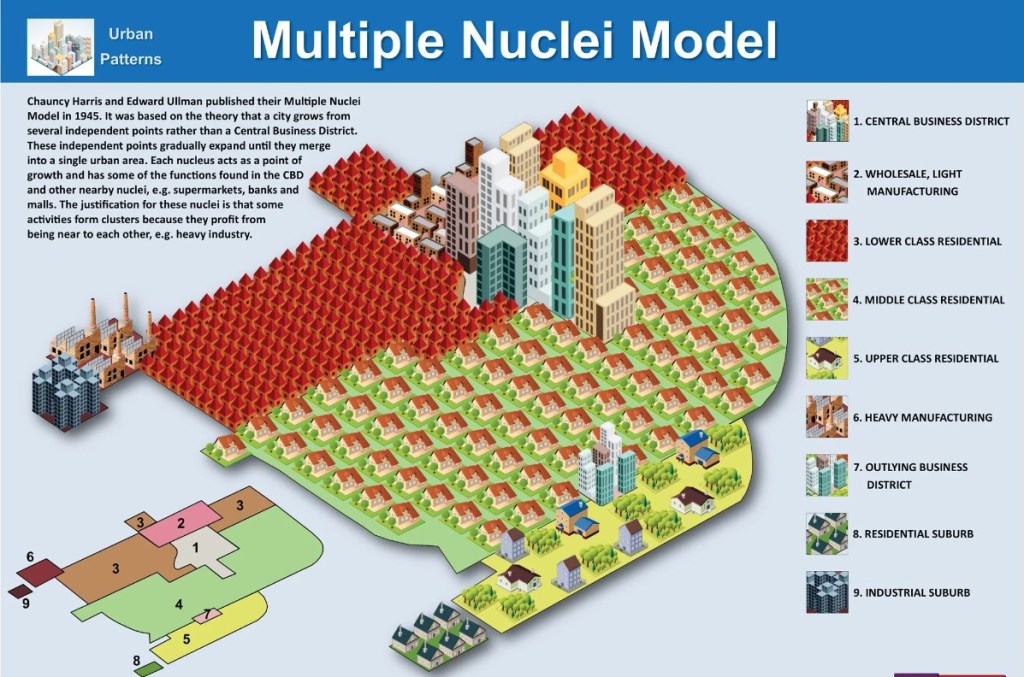
The multi-nuclei model is evident in many modern cities, especially those that have experienced rapid growth and suburbanization. Examples include:
- Los Angeles, California: Los Angeles is a prime example of a multi-nuclei city. It has multiple business districts, such as Downtown LA, Hollywood, Century City, and others, each serving different functions. The city has developed in a decentralized manner, with various industries and residential areas spread across a wide geographic area.
- Chicago, Illinois: Chicago has multiple business and industrial centers, including the Loop (central business district), the O’Hare area (focused on transportation and logistics), and various suburban hubs that have developed over time.
- Mumbai, India: Mumbai has several nuclei, including Nariman Point and Bandra-Kurla Complex as financial centers, Andheri as a commercial hub, and various industrial areas and residential suburbs that have developed around them.
Strengths of the Multi-Nuclei Model
- Flexibility: The model reflects the complex and varied nature of modern cities, allowing for a more accurate representation of urban growth.
- Realistic Representation: It acknowledges that cities do not grow uniformly around a single center but develop multiple focal points, making it more applicable to large, sprawling urban areas.
- Economic Efficiency: By allowing for specialization, the model can lead to more efficient land use, as businesses and industries can cluster in areas that best meet their needs.
Criticisms of the Multi-Nuclei Model
- Complexity: The model can be overly complex and difficult to apply to smaller cities or those with more linear growth patterns.
- Fragmentation: The decentralization of cities can lead to social and economic fragmentation, with different nuclei serving different populations, sometimes leading to inequality and segregation.
- Urban Sprawl: The model can encourage urban sprawl, leading to increased transportation costs, environmental degradation, and challenges in providing public services.
Conclusion
The multi-nuclei model is a comprehensive and flexible framework for understanding urban development, particularly in large, modern cities. It recognizes that urban growth is not confined to a single center but is influenced by multiple factors that lead to the development of various hubs or nuclei. While the model has its strengths, it also presents challenges, particularly in managing the complexities and potential inequalities that can arise in decentralized urban areas.
References
Cong, G., & Parvin, B. (2000). Model-based segmentation of nuclei. Pattern recognition, 33(8), 1383-1393.
Guerrieri, P. M. (2023). Delhi: Rethinking Indian urbanism through the capital’s multi-nuclei development. In Routledge Handbook of Asian Cities (pp. 213-224). Routledge.
Mehaffy, M., Porta, S., Rofe, Y., & Salingaros, N. (2010). Urban nuclei and the geometry of streets: The ‘emergent neighborhoods’ model. Urban Design International, 15, 22-46.
Sharma, S. N. (2019). Review of most used urban growth models. International Journal of Advanced Research in Engineering and Technology (IJARET), 10(3), 397-405.
Sharma, S. N., Dehalwar, K., & Singh, J. (2023). Cellular Automata Model for Smart Urban Growth Management.
 Track2Training
You must be logged in to post a comment.