


By Shashikant Nishant Sharma
The Core-Periphery Model, developed by John Friedmann in 1966, is a framework used to understand the spatial structure of economic development and regional disparities. It explores how economic activities, resources, and development tend to concentrate in certain areas (the core), leaving other areas (the periphery) less developed. The model is particularly significant in the fields of geography, regional planning, and development economics, as it highlights the unequal distribution of economic power and resources across different regions.
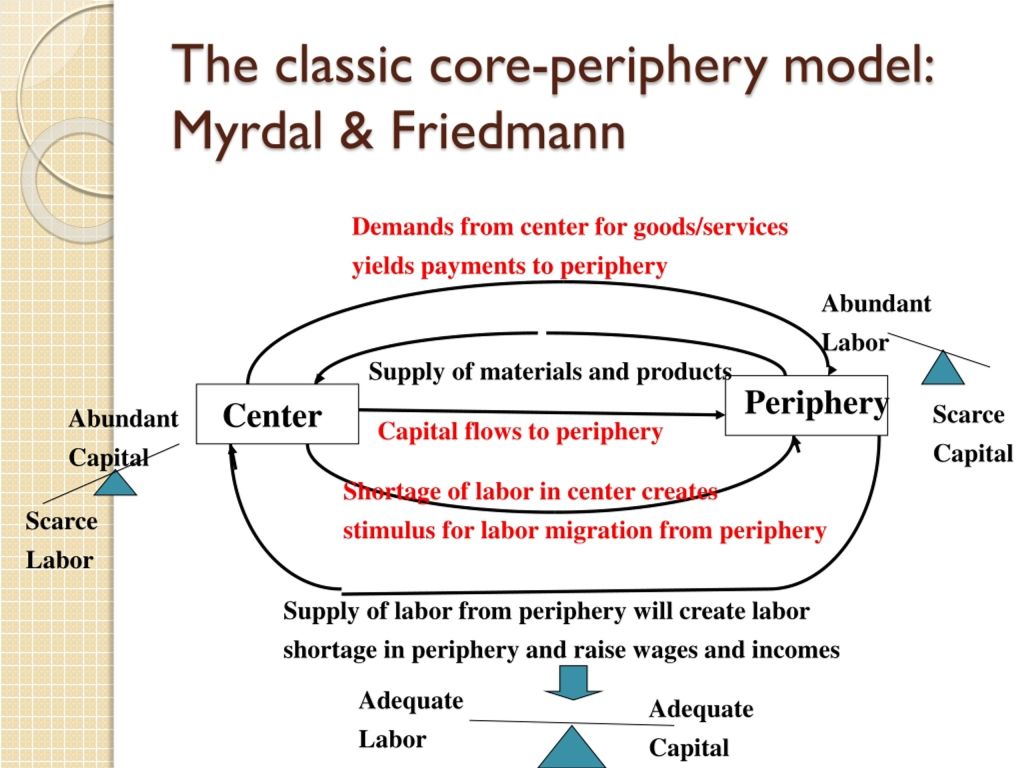
Key Concepts of the Core-Periphery Model
- Core Region:
- The core is the center of economic, political, and social power.
- It is characterized by high levels of industrialization, urbanization, and infrastructure development.
- The core regions typically have a concentration of capital, technology, skilled labor, and investment.
- Examples include major metropolitan cities or developed countries (e.g., New York, London, Tokyo).
- Periphery Region:
- The periphery consists of areas that are less economically developed, with lower levels of industrialization and urbanization.
- These regions often depend on primary economic activities like agriculture, mining, or raw material extraction.
- Peripheral regions tend to have lower levels of income, education, and infrastructure.
- Examples include rural areas or developing countries that are economically dependent on the core.
- Semi-Periphery Region (added in later refinements of the model):
- These are transitional regions that lie between the core and periphery.
- They exhibit some characteristics of the core but still face challenges similar to those in the periphery.
- Semi-peripheral regions may be emerging economies or rapidly developing cities (e.g., India, Brazil, South Africa).
Stages of Development According to Friedmann
Friedmann’s model identifies four stages in the spatial development of regions:
- Pre-Industrial Society:
- Economic activities are widely dispersed with little concentration.
- Traditional economies dominate, with a focus on agriculture and subsistence activities.
- There is minimal differentiation between core and periphery regions.
- Emergence of the Core:
- Industrialization leads to the growth of certain regions, creating a core area.
- The core attracts investments, industries, and skilled labor, becoming an economic hub.
- Peripheral areas remain underdeveloped, leading to a spatial economic imbalance.
- Core-Dominated Economy:
- The core continues to expand, accumulating more economic power and resources.
- The periphery becomes increasingly dependent on the core for economic activities, capital, and technology.
- This dependence creates a hierarchical relationship, reinforcing regional disparities.
- Spatial Integration:
- Over time, development policies, infrastructure projects, and technological advancements may reduce regional disparities.
- The economic benefits of the core can spill over to the periphery, promoting regional integration.
- This stage aims for a more balanced spatial distribution of economic activities.
Mechanisms of Core-Periphery Dynamics
- Polarization Effect:
- Economic growth tends to concentrate in the core, attracting more resources, investments, and skilled labor.
- This process, known as “cumulative causation,” leads to the growth of core regions at the expense of peripheral regions.
- Backwash Effect:
- The core extracts resources, labor, and capital from the periphery, further weakening the peripheral regions.
- This can lead to a drain of talent and resources from rural or underdeveloped areas to more prosperous urban centers.
- Spread Effect:
- The core’s growth may eventually lead to positive spillover effects in the periphery, such as increased investments, technology transfer, and job creation.
- This can happen through policies aimed at decentralization, regional development, and infrastructure improvements.
Implications of the Core-Periphery Model
- Economic Inequality:
- The model highlights the uneven economic development between core and peripheral regions, which can lead to social and economic inequalities.
- Policy Formulation:
- Policymakers can use this model to devise strategies for balanced regional development, such as promoting investment in peripheral areas, decentralizing industries, and improving infrastructure.
- Urbanization Trends:
- It explains the rapid urbanization and concentration of population in metropolitan areas, as people migrate from rural peripheries to urban cores in search of better economic opportunities.
Criticisms of the Core-Periphery Model
- Over-Simplification:
- The model is criticized for being too simplistic, as it divides regions into binary categories of core and periphery without accounting for the complexities of regional dynamics.
- Lack of Consideration for Globalization:
- The model was developed in the 1960s, before the rise of globalization and digital technologies, which have altered the spatial distribution of economic activities.
- Limited Applicability:
- The model may not be fully applicable to all regions, especially in the context of modern economies where multiple cores and decentralized economic activities exist.
Applications of the Core-Periphery Model
- Regional Planning and Development:
- The model is used to guide regional development policies, focusing on reducing disparities between core and peripheral areas.
- Urban Studies:
- It helps in analyzing urbanization patterns, city growth, and migration trends.
- Economic Geography:
- The model provides insights into the spatial distribution of economic activities, helping economists understand the factors driving regional disparities.
Example: Application in India
- Core Regions:
- Major metropolitan areas like Mumbai, Delhi, and Bengaluru serve as economic cores, with high levels of industrialization, services, and technology.
- Peripheral Regions:
- Rural areas in states like Bihar, Odisha, and parts of Northeast India remain less developed, with economies primarily dependent on agriculture and limited industrialization.
- Semi-Periphery Regions:
- States like Gujarat, Tamil Nadu, and Maharashtra show mixed characteristics, with both developed urban centers and underdeveloped rural areas.
Conclusion
The Core-Periphery Model by Friedmann offers a valuable framework for understanding the spatial dynamics of economic development. While it has limitations, it provides a useful lens for examining regional disparities, informing policy interventions aimed at promoting balanced development and reducing economic inequality.
References
Baldwin, R. E. (2001). Core-periphery model with forward-looking expectations. Regional science and urban economics, 31(1), 21-49.
Borgatti, S. P., & Everett, M. G. (2000). Models of core/periphery structures. Social networks, 21(4), 375-395.
Castro, S. B., Correia‐da‐Silva, J., & Mossay, P. (2012). The core‐periphery model with three regions and more. Papers in Regional Science, 91(2), 401-419.
Forslid, R., & Ottaviano, G. I. (2003). An analytically solvable core‐periphery model. Journal of Economic Geography, 3(3), 229-240.
Klimczuk, A., & Klimczuk-Kochańska, M. (2023). Core-periphery model. In The palgrave encyclopedia of global security studies (pp. 239-245). Cham: Springer International Publishing.
Sharma, S. N. Exploring the Urban Growth Pole Theory.
Sharma, S. N., Dehalwar, K., Kumar, G., & Vyas, S. (2023). Redefining Peri-urban Urban Areas. Thematics Journal of Geography, 12(3), 7-13.
 Track2Training
You must be logged in to post a comment.