


Difference Between Growth Pole Theory and Central Place Theory
| Feature | Growth Pole Theory | Central Place Theory |
|---|---|---|
| Proposed By | François Perroux (1955) | Walter Christaller (1933) |
| Concept | Economic development occurs around specific “growth poles” or urban centers that stimulate regional growth. | Settlements are organized in a hierarchical pattern to provide goods and services to surrounding areas. |
| Focus | Industrial and economic growth | Spatial distribution of settlements and services |
| Key Elements | Growth poles, industries, agglomeration economies, spread effects | Market areas, range, threshold, hierarchical organization |
| Process | Growth starts at a pole (a major urban center or industry) and spreads outward. | Larger settlements serve more specialized functions, while smaller ones provide basic services. |
| Growth Pattern | Uneven growth, concentrated in specific locations | Balanced distribution of services based on population demand |
| Applicability | Regional economic planning, industrial development policies | Urban and regional planning, location of retail and service centers |
| Example | Development of IT hubs like Bengaluru in India, leading to regional economic growth. | Distribution of towns and cities based on service provision, such as tiered settlement hierarchy in Germany. |
Key Differences in Their Approach
- Growth Pole Theory is economic-centric, emphasizing how specific industries or urban centers drive regional development.
- Central Place Theory is spatial-centric, focusing on the arrangement and hierarchy of settlements based on service provision.
You said:
show graphically
ChatGPT said:
Here are graphical representations of Growth Pole Theory and Central Place Theory to illustrate their differences:
1. Growth Pole Theory (François Perroux)
- Growth occurs around a dominant urban or industrial center.
- Economic activities are concentrated in a few key locations.
- Development spreads outward from these poles.
Graphical Representation

📍 Growth Pole → 🔄 Spillover Effects → 🌍 Regional Development
javaCopyEdit     Growth Pole (City/Industry)
             ⬇️
     Economic Activities
        ↙️  ⬇️  ↘️
   Nearby Towns/Villages
         ⬇️
    Spread Effects

(Illustration: The growth pole (central circle) influences nearby areas, leading to economic expansion.)
2. Central Place Theory (Walter Christaller)
- Settlements form a hierarchical network based on their function.
- Higher-order centers provide specialized services, while lower-order centers provide basic services.
- Market areas are hexagonal to maximize coverage and minimize overlap.
Graphical Representation
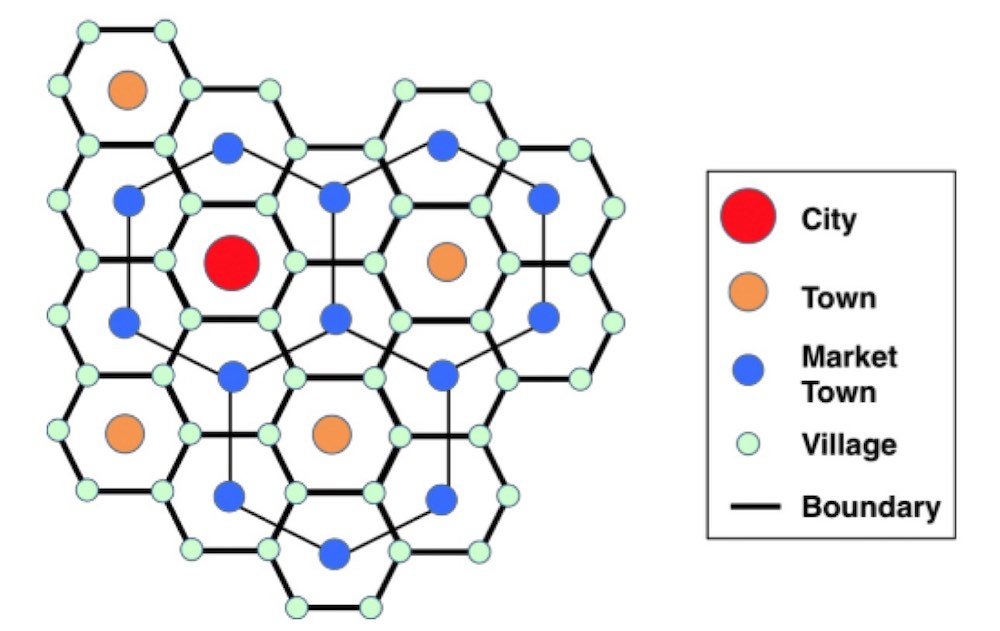
🏙 Central Place (City) → 🏘 Towns → 🏠 Villages → 🚜 Hamlets
markdownCopyEdit       Central City
       🏙 (Top-tier)
        /  |  \
  Towns (Mid-tier)
   🏘    🏘    🏘
  / | \  / | \  / | \
Villages (Lower-tier)
🏠 🏠 🏠 🏠 🏠 🏠

(Illustration: Settlements follow a hexagonal hierarchy, with larger centers serving as hubs for smaller ones.)
Key Takeaways
- Growth Pole Theory → Economic development is concentrated and spreads from a central hub.
- Central Place Theory → Settlements are distributed in a hierarchical pattern, serving different functions.
 Track2Training