
In social science, education, health, marketing, and development research, one of the most common questions is:
Does awareness about a particular scheme, service, or product vary across demographic groups such as age, education, income, or occupation?
To answer this, researchers often use the Chi-square test of independence. It is a non-parametric test that determines whether two categorical variables are related or independent of each other. For example, we may want to know if:
- Awareness of digital banking varies by education level.
- Awareness of government health insurance differs across income categories.
- Awareness of renewable energy schemes depends on location (urban/rural).
What is the Chi-square Test of Independence?
The Chi-square test checks whether the distribution of one categorical variable depends on another categorical variable. It compares:
- Observed frequencies (O): Actual counts from the survey or data.
- Expected frequencies (E): Counts we would expect if there were no relationship between the variables.
If the difference between O and E is large, the test shows a significant relationship.
Application in Awareness Studies
Step 1: Collect Data
Suppose a researcher wants to test whether awareness of a government scheme is related to education level. The data from 200 respondents may look like this:
| Education Level | Aware | Not Aware | Total |
|---|---|---|---|
| Illiterate | 20 | 30 | 50 |
| Primary Education | 30 | 20 | 50 |
| Secondary Education | 40 | 10 | 50 |
| Higher Education | 45 | 5 | 50 |
| Total | 135 | 65 | 200 |
Step 2: Set Hypotheses
- H₀ (Null Hypothesis): Awareness is independent of education level.
- H₁ (Alternative Hypothesis): Awareness is associated with education level.
Step 3: Calculate Expected Frequencies

Step 4: Apply Chi-square Formula

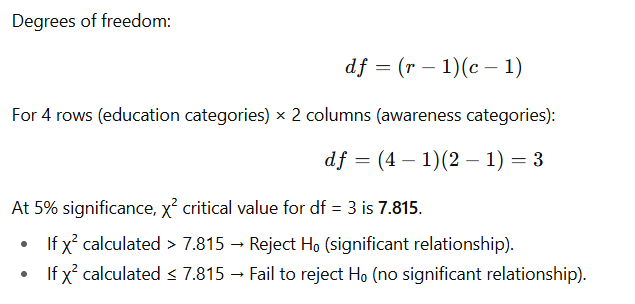
Step 5: Degrees of Freedom and Significance
Interpretation of Results
- A significant result means awareness is not evenly distributed across demographic categories. For example, education might strongly influence awareness levels.
- A non-significant result means awareness is independent of that demographic factor.
Importance of the Chi-square Test in Awareness Studies
- Identifies influencing factors – shows which demographic groups have higher or lower awareness.
- Guides policy and planning – awareness campaigns can be targeted at groups with low awareness.
- Simple yet powerful – works well with survey data and categorical variables.
Limitations
- Does not measure the strength of the relationship, only whether it exists.
- Requires a sufficiently large sample size (expected frequency in each cell ≥ 5).
- Works only with categorical data, not continuous variables.
Conclusion
The Chi-square test of independence is a widely used statistical tool for analyzing whether awareness of a scheme, product, or program is associated with demographic variables. It provides researchers and policymakers with valuable insights into which groups are better informed and which require more attention. By applying this test, organizations can design targeted interventions, awareness drives, and policy measures that effectively reach the intended beneficiaries.
 Track2Training
You must be logged in to post a comment.