
By Divyanshi Chawla
Introduction
Migration is the movement of individuals from their regular abode to another, with a temporary or permanent relocation in a place of abode. A key demographic process with immense consequences for societies across the world, migration occurs in several forms, with the main ones being internal migration, whereby individuals relocate within a nation, and international migration, whereby individuals cross international borders. Internal migration can take the form of rural-urban migration and interstate relocation, while international migration can be prompted by economic ambition, flight from hostilities, reunification with family, or environmental stress.
It is crucial to understand migration since it defines economic frameworks, social formations, political processes, and environmental regimes. It also affects labour markets, cultural interchanges, urbanization processes, demographic alignments, and policymaking processes. The report extends to deliver a detailed analysis on causes and multi-dimensional effects of human movement, with relevant country and worldwide illustrations. The main goals are to study the process of migration in a detailed manner and to showcase its economic-social and political effects.
Understanding Migration
It is a complex process with several major ideas:
- Emigration is the act of leaving one’s country or place of origin.
- Immigration is the act of settling into a new territory to live.
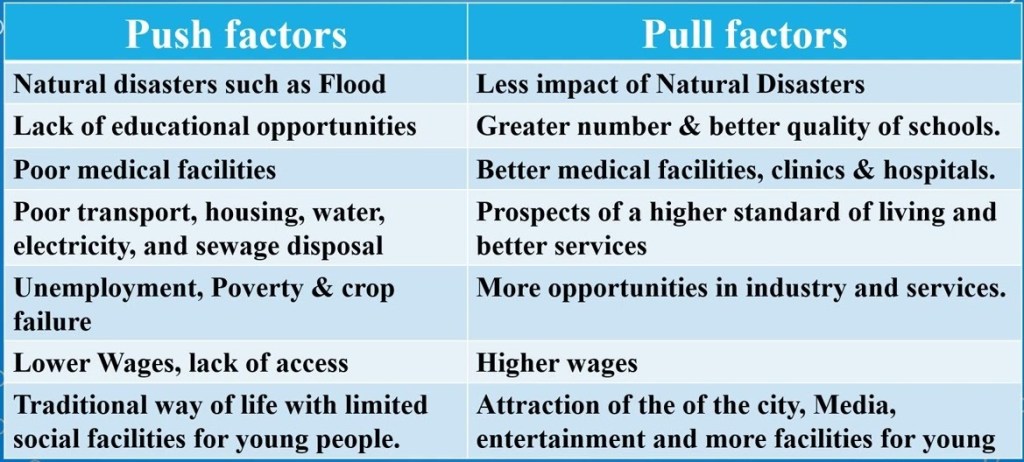
- Push–Pull Theory asserts that migrants are attracted by positive factors such as work, security, or schooling, and pushed by adverse factors such as poverty, joblessness, or war.
- The migration flows have specific patterns:
- Rural-urban movement is prevalent in developing nations, led primarily by industrialization and economic growth in urban areas.
- South-North migration, or migration from less prosperous developing countries to higher income developed countries, is extensive globally.
- Seasonal and circular migrants are frequent workers in construction and agriculture.
- It is deeply linked with globalization, which has developed inter-connected economies and societies; conflict and persecution are still powerful motivators; and the new challenge posed by climate change is ever more rendering environments inhospitable, compelling millions to move.
Causes Of Migration
Economic Causes
Economic impulses are prime motivators for migrants. A majority migrate in search of jobs to get away from unemployment, poverty, and underemployment in rural or economically stagnant areas. Significant interregional or international wage gaps are excellent motivators for migrants. In India, for example, vast rural poverty and farm modernization have reduced labor requirements, compelling many migrants to urban centres like Mumbai, Delhi, and Bengaluru, where industrial and service sectors have higher-wage opportunities. Urban industrialization, higher incomes, and increased occupational selection are the attractors. Remittances back home also significantly raise rural incomes, also highlighting economic imperatives to migrate.
Social Causes
Social motivations comprise improved education and health care, family reunification, as well as marriage. Cities have schools, higher-order medical facilities, and enhanced infrastructure that draw families and the young with ambitions for mobility. Improved telecommunication technologies have enabled migrants to sustain contact across distance, making social migration possible. In India, women mostly migrate for marriage, while men move mostly for work reasons, indicating gendered social motivations. Migration is also a consequence of a desire for a higher standard of living, social liberation, and enhanced personal security.
Political Reasons
Political unrest, violent conflicts, and persecution are main push factors. Wars such as the Syrian civil war, ethnic conflicts, and authoritarian repression have led millions to become refugees or asylum seekers. Political reasons leading to forced migration typically conclude in humanitarian crises, with displaced persons fleeing for asylum in proximal or distant countries. Geopolitical tensions and stringent immigration policies also spill into migration. Political refugees experience long displacement with challenging assimilation into receiving states.
Environmental Causes
Man-made and natural environmental changes like droughts, floods, cyclones, and long-term consequences of climate change like desertification and rising ocean levels have become significant migration forces. Coastal villages in Bangladesh, for example, are threatened with rising ocean levels rendering territories impassable, while drought in Africa and southern Asia has devastated farming communities, prompting migration. Environmental degradation often fosters economic frailties, creating compounding push forces. Migration is either seasonal or definitive based on the recovery potential. This side of migration is bound to escalate with climate change gathering steam.
Technological and Global Considerations
Technological advances in transport and communication make migration easier by cutting costs and risks. Greater mobility across the globe by air transport and road network, and the potential to sustain social networks across distance by internet and cellular phones, make migrating easier. Global labour markets are more linked together, with institutional and informal avenues assisting individuals to acquire work overseas. Social media also influence individuals’ aspirations and preferences, and inform migration flows more and more.
Effects of Migration
Economic Impacts
Economic consequences of migration are inconclusive:
- Benefits for origin regions: Reduced surplus labour, reduced unemployment, inflows of remittances augment family incomes, education budgets, and domestic investment. Returing migrants will usually bring enhanced skills and new technologies.
- Negative for origin jurisdictions: Brain drain or loss of skilled workers harms long-run potential and human capital, particularly in education and health facilities.
- Beneficial to destination regions: Immigrants fill key gaps in labour, support aging societies, activate goods and services, provide tax revenues, and boost economic growth.
- Negative for destination locations: Resource and service pressure (shelter, health facilities, schools), job competition above all in the low-skill segments, and exploitive or informal working arrangements are possible consequences.
Social Implications
Migrants bring with them cultural diversity, adding destination societies with new languages, cuisine, religions, and customs. Cultural diversity can promote tolerance and world awareness, and migrants can enjoy enhanced accessibility to higher-quality social services. Social problems can also be generated, such as social exclusion, discrimination, xenophobia, and cultural disputes. Migrants can experience identity crises or alienation, and rapid changes can also put pressure on social cohesion as well. Out-migration in the source regions can also change family structures and impose a greater social burden on staying family members, also primarily women.
Demographic Implications
It alters demographic outlines significantly. Urban centres bulge, at times, more than infrastructure can sustainably support. Rural areas are common with aging populations, as a consequence of their children moving away, slowing economic vigor and distorting dependency rates. Gender disparities can also result, in cases where migration is differential by sex. They have effects on electoral politics, resource distributions, and social planning at the region and national levels.
Abiotic Impacts
It contributes to a shortage of houses and more slums, increased pollution, sanitary problems with waste, water shortages, and green spaces degradation. Expansion due to migration frequently occurs without sufficient planning for cities, therefore putting stress on the environment. In contrast, depopulation in non-urban areas can leave room for natural regeneration while also lessening maintenance and care for farmed land, contributing further to degradation. Impacts on the environment are significantly dependent on both scale of migration and policy effectiveness.
Political and Policy Implications
Migration requires holistic policy responses with a focus on border control, integration, labour rights, and humanitarian protection. Recipient countries are torn between social cohesion and migrants’ inclusion. Global cooperation is critical for refugee protection and governing labour migration. Incompetent handling of migration in a balanced manner can lead to a risk of a nationalist backslash, social tensions, and a humanitarian disaster. Policies must focus on migrants’ rights, sustainable urbanisation, and climate resilience.
Case Studies / Examples
Internal Migration in India
India’s fast-paced rural-urban migration is a prime example of modern demographic transition. Approximately 30 million individuals migrate every year from rural interior districts to urban metropolises in response to economic emergencies and improved employments opportunities. Cities such as Mumbai, Delhi, and Bengaluru have witnessed infrastructure failure, widespread-slum expansion, and growing requirements for water supply and sanitation facilities. Migrants provide crucial labour force in construction, service, and manufacturing activities. Female migrants, under-represented and under-documented, experience problems such as under-employment and exposure to risk but also achieve new levels of autonomy. Policy measures have been responses such as affordable habitation schemes and urban renewal programs, though problems linger.
Syrian Refugee Crisis
Since 2011, Syria’s civil conflict ignited one of history’s biggest forced migrations. More than six million Syrians were made refugees in states within close proximity and far away, with millions internally displaced. The migration has had colossal humanitarian, political, and social effects on hosting states such as Turkey, Lebanon, and Germany. Barriers to assimilation are faced by refugees, and hosting states are exposed to tensions in accommodation, schooling, and health infrastructure. Depopulation and brain drainage afflict areas in Syria. Global responses are relief, resettlement, and rule-of-law regimes based on refugee protection, but the crisis is not solved.
Conclusion
It is a multifaceted and multidimensional process that is even driven by changing economic, social, political, and environmental forces. Even its outcomes reflect both opportunities — economic expansion, cultural diversity, and skill upgrading — and challenges — social friction, environmental pressure, and policy problems.
By dealing with migration, balanced territorial development, inclusive integration policies, migrants’ rights protection, and climate adaptation are key. Seeing migration as a dynamic force that shapes human geography offers key knowledge for sustainable development in a growingly interdependent world.
References
- Black, R., Biao, X., Collyer, M., Engbersen, G., Heering, L., & Markova, E. (2006). Migration and development: Causes and consequences. The Dynamics of International Migration and Settlement in Europe, 41, 41-63.
- Afsar, R. (1994). Internal migration and women: An insight into causes, consequences and policy implications. The Bangladesh Development Studies, 22(2/3), 217-243.
- Ritchey, P. N. (1976). Explanations of migration. Annual review of sociology, 2, 363-404.
- Drishti IAS. (2025).
- Reasons and effects of. UN DESA. (2023).
- World Migration Report. International Organization for Migration.
- Government of India.
- National Sample Survey: Patterns of Migration.
- UNHCR. 2025. Reports on Syria Refugee. European Parliament. (2024).
- Exploring Migration Causes. Internet Geography. 2022.
- Impacts of Migration Geographic Book. (2024).
 Track2Training
You must be logged in to post a comment.