


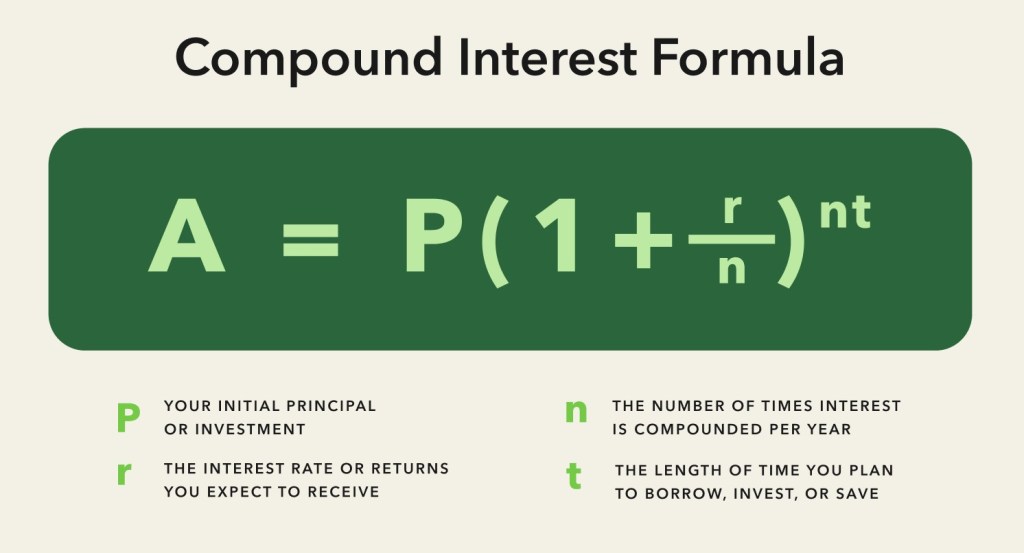
🔹 Meaning of Compound Interest (CI)
Compound Interest is interest calculated on:
- The original principal, and
- The accumulated interest from previous periods.
It reflects the time value of money, which is extremely important in long-term architecture, urban planning, and infrastructure projects.
🔹 Basic Formula
A=P(1+nr)nt
Where:
- A = Final Amount
- P = Principal investment
- r = Annual interest rate (decimal form)
- n = Number of compounding periods per year
- t = Time in years
If compounded annually:A=P(1+r)t
Compound Interest:CI=A−P
🔎 Why Compound Interest Matters in Architecture & Planning
Architecture and planning projects typically involve:
- Long project life cycles (10–50 years)
- Large capital investments
- Phased development
- Loan financing
- Land value appreciation
Compound interest helps evaluate:
✔ Project feasibility
✔ Real estate returns
✔ Infrastructure financing
✔ Urban land value growth
✔ Lifecycle costing
🏢 1. Application in Real Estate Development
Example:
An architect develops a commercial complex.
- Initial Investment = ₹2 Crore
- Annual appreciation = 10%
- Time = 5 years
Calculation:
A=2,00,00,000(1+0.10)5 A=2,00,00,000(1.6105) A=₹3,22,10,000
Compound Gain:
CI=3,22,10,000−2,00,00,000 CI=₹1,22,10,000
✅ Property value increased significantly due to compounding.
🚇 2. Application in Infrastructure Planning
Large-scale urban transport projects (Metro, BRT, TOD zones) require heavy borrowing.
Examples include projects like:
- Delhi Metro Rail Corporation
- Mumbai Metro
Loans are often repaid with compound interest.
Suppose:
Loan = ₹500 Crore
Interest Rate = 6%
Period = 10 yearsA=500(1.06)10 A=500(1.7908) A=₹895.4Crore
Interest Paid:895.4−500=₹395.4Crore
✔ This affects fare pricing
✔ Affects financial sustainability
✔ Influences Public-Private Partnership (PPP) decisions
🏙 3. Land Value Capture & TOD
In Transit-Oriented Development (TOD):
Land values increase near metro stations.
Example:
Land value = ₹10,000 per sq.m
Annual growth = 8%
Time = 7 yearsFuture Value=10,000(1.08)7 Future Value=10,000(1.7138) Future Value=₹17,138persq.m
✔ Used for Value Capture Financing
✔ Helps recover infrastructure cost
✔ Important in metropolitan planning
🏗 4. Lifecycle Costing in Building Design
Sustainable buildings consider:
- Initial construction cost
- Maintenance cost
- Energy savings
If energy savings are reinvested annually, benefits grow through compounding.
This is important for:
- Green buildings
- Net-zero architecture
- Smart city projects
🔹 Difference from Simple Interest in Planning Context
| Simple Interest | Compound Interest |
|---|---|
| Short-term loans | Long-term infrastructure |
| Flat returns | Exponential growth |
| Basic estimation | Real project appraisal |
| Not realistic for 20+ years | Essential for lifecycle planning |
📊 Importance in Urban Economics
Compound interest helps in:
- Discounted Cash Flow (DCF) analysis
- Net Present Value (NPV)
- Internal Rate of Return (IRR)
- Capital budgeting
- Financial modeling of TOD projects
Without compounding, financial evaluation of urban infrastructure becomes inaccurate.
✅ Conclusion
In architecture and planning projects, compound interest is fundamental because:
- Projects are long-term
- Investments are capital-intensive
- Land appreciates over time
- Loans accumulate interest
- Sustainability benefits grow over years
Thus, compound interest is not just a financial formula—it is a core tool in urban development economics and project feasibility analysis.
 Track2Training
You must be logged in to post a comment.