


1️⃣ What is Internal Rate of Return (IRR)?
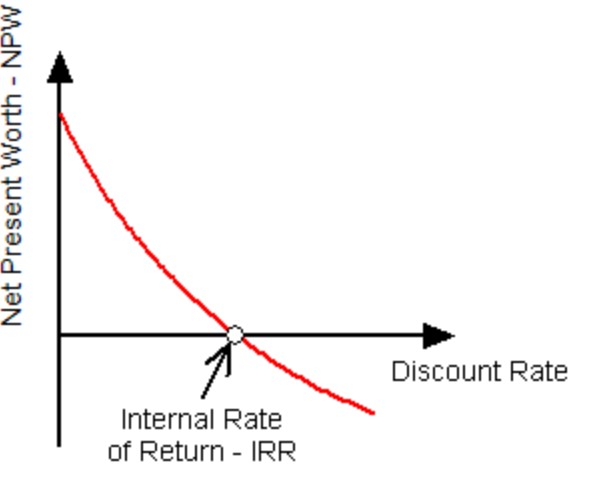
Internal Rate of Return (IRR) is the discount rate at which the Net Present Value (NPV) of a project becomes zero.
In simple terms:
IRR is the rate of return a project is expected to generate over its life.
It considers:
- Time value of money
- Multiple cash inflows and outflows
- Long-term project performance
IRR is widely used in:
- Real estate development
- Infrastructure planning
- PPP projects
- Urban redevelopment
- Sustainable building investments
2️⃣ IRR Formula
IRR is calculated using the NPV equation.
🔹 NPV Formula
NPV=−Initial Investment+∑(1+r)tCash Flowt
Where:
- r = discount rate
- t = time period
- IRR is the value of r when:
NPV=0
So,0=−Initial Investment+∑(1+IRR)tCash Flowt
Since the equation cannot be solved directly, IRR is found using:
- Trial and error
- Interpolation method
- Financial calculator
- Excel IRR function
3️⃣ Why IRR is Important in Architecture & Planning
IRR helps planners and architects:
- Compare multiple development proposals
- Evaluate long-term infrastructure investments
- Justify PPP concession models
- Assess sustainable building investments
- Decide between design alternatives
- Determine project viability
If:
- IRR > Required Rate of Return (Cost of Capital) → Project is acceptable
- IRR < Required Rate of Return → Project should be rejected
4️⃣ Step-by-Step IRR Calculation with Example
✅ Example 1: Small Commercial Building Project
Initial Investment (Year 0)
₹1,00,000
Expected Cash Inflows:
Year 1 = ₹60,000
Year 2 = ₹60,000
Step 1: Try 10% Discount Rate
NPV=−1,00,000+1.1060,000+1.10260,000 =−1,00,000+54,545+49,587 =+4,132
NPV is positive → IRR is higher than 10%
Step 2: Try 15%
NPV=−1,00,000+1.1560,000+1.15260,000 =−1,00,000+52,174+45,369 =−2,457
NPV is negative → IRR is between 10% and 15%
Step 3: Interpolation Formula
IRR=r1+NPV1−NPV2NPV1×(r2−r1)
Where:
- r1=10%
- r2=15%
- NPV1=4,132
- NPV2=−2,457
IRR=10+4132+24574132×5 IRR≈13.1%
✅ Example 2: Urban Parking Project
Initial Investment = ₹2,50,00,000
Annual Net Cash Flow = ₹40,00,000
Project Life = 8 years
Using financial approximation:
IRR ≈ 14–16%
If the required return is 12%, the project is financially viable.
✅ Example 3: Solar Panel Investment in Office Building
Installation Cost = ₹5,00,000
Annual Savings = ₹1,20,000
Life = 5 years
Using trial method or Excel:
IRR ≈ 18–20%
This supports sustainable investment decision-making.
5️⃣ Applications of IRR in Architecture & Urban Planning
🔹 1. Real Estate Feasibility Studies
- Apartment development
- Commercial complex
- Mixed-use buildings
Helps developers decide project scale and phasing.
🔹 2. Transit-Oriented Development (TOD)
IRR helps evaluate:
- Increased land value
- Higher rental income near transit
- Mixed-use density benefits
🔹 3. Public-Private Partnership (PPP)
IRR determines:
- Concession period
- Revenue sharing ratio
- Private investor attractiveness
🔹 4. Infrastructure Projects
Used for:
- Metro stations
- Bus terminals
- Multi-level parking
- Smart city infrastructure
🔹 5. Sustainable Building Investments
IRR justifies:
- Green roof systems
- Solar panels
- Energy-efficient façade
- Water recycling systems
6️⃣ Advantages of IRR
✔ Considers time value of money
✔ Useful for long-term projects
✔ Easy comparison between alternatives
✔ Widely accepted in financial markets
✔ Useful for PPP and infrastructure projects
7️⃣ Limitations of IRR
❌ Complex to calculate manually
❌ May give multiple IRRs in unusual cash flow patterns
❌ Does not show absolute profit amount
❌ Can mislead if project sizes differ
Therefore, IRR should be used along with:
- NPV
- ROI
- Payback Period
- Cost-Benefit Analysis
8️⃣ Difference Between ROI and IRR
| ROI | IRR |
|---|---|
| Simple profitability ratio | Time-adjusted return |
| Ignores time value | Considers time value |
| Easy to calculate | Requires iteration |
| Short-term focus | Long-term focus |
9️⃣ Practical Use in DPR Preparation
When preparing a Detailed Project Report:
- Estimate yearly cash flows
- Apply discounting
- Calculate IRR
- Compare with cost of capital
- Recommend project acceptance or rejection
🔟 Conclusion
Internal Rate of Return (IRR) is one of the most powerful financial tools in architecture and urban planning. It helps evaluate:
- Real estate viability
- Infrastructure feasibility
- TOD development returns
- Sustainable design investments
- PPP financial attractiveness
For architects and planners, understanding IRR ensures that projects are not only technically sound and aesthetically strong but also financially sustainable.
 Track2Training
You must be logged in to post a comment.