
🔹 What are Demographic Variables?
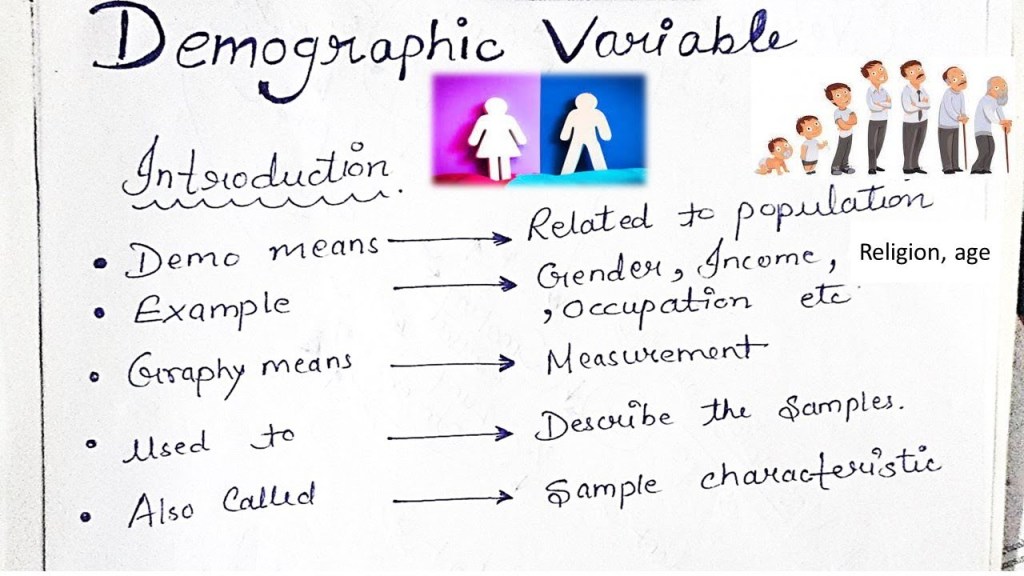
Demographic variables are statistical characteristics of populations that researchers, policymakers, and businesses use to understand groups of people. They provide quantifiable data about who people are in terms of age, gender, income, education, family structure, location, and other attributes.
In research, demographic variables are often used as independent variables (to study their effect on behavior, choices, or attitudes) or as control variables (to ensure fair comparisons across groups).
🔹 Why Are Demographic Variables Important?
- Social Research → Helps in understanding social structures, inequality, mobility, and population trends.
- Policy Making → Guides governments in designing education, healthcare, housing, and employment policies.
- Marketing & Business → Businesses use demographic profiling to identify target customers and segment markets.
- Urban Planning → Planners use demographics to design infrastructure, transport, housing, and public services.
- Public Health → Demographics like age, gender, and income influence health risks and healthcare needs.
🔹 Common Types of Demographic Variables
| Variable | Explanation | Examples |
|---|---|---|
| Age | One of the most basic variables, used to group populations by life stage. | Children (0–14), Youth (15–24), Adults (25–64), Elderly (65+) |
| Gender / Sex | Biological sex or gender identity, important for studying social roles, equality, and consumer behavior. | Male, Female, Non-binary |
| Income / Socioeconomic Status | Reflects purchasing power, lifestyle, and access to resources. | Low income (<$20,000), Middle income, High income |
| Education Level | Indicates skill levels, literacy, and career opportunities. | Primary, Secondary, Higher Education, Doctorate |
| Occupation / Employment Status | Shows economic activity and professional identity. | Student, Employed, Self-employed, Retired |
| Marital Status & Family Structure | Shapes household spending, housing needs, and social support. | Single, Married, Divorced, Nuclear/Joint family |
| Religion / Ethnicity | Cultural and social identity markers, often linked with traditions and practices. | Hindu, Muslim, Christian; Ethnic groups |
| Geographic Location | Determines accessibility, lifestyle, and opportunities. | Urban vs. Rural, Region, State, Country |
| Household Size | Impacts consumption patterns, housing needs, and mobility choices. | Single-person household vs. joint family |
| Language | Indicates communication needs and cultural identity. | Hindi, English, Spanish, Mandarin |
🔹 Applications of Demographic Variables
- In Academic Research
- Sociologists study inequality using income, caste, or gender.
- Psychologists examine how age affects learning or memory.
- Economists analyze how employment status influences consumption.
- In Business & Marketing
- A company selling baby products targets young parents (Age + Family Structure).
- Luxury brands market to high-income professionals (Income + Occupation).
- Regional ads use local language (Geographic Location + Language).
- In Public Policy & Planning
- Governments forecast school needs using child population data (Age + Location).
- Healthcare policies for elderly depend on aging population statistics.
- Urban planners use household size and migration patterns to plan housing.
- In Healthcare
- Age and gender are key for predicting disease risks.
- Income and education affect healthcare access and awareness.
🔹 Examples of Demographic Variables in Use
- Census Surveys: National censuses collect data on age, sex, literacy, occupation, and household structure.
- Market Segmentation: Amazon segments users based on age (tech-savvy youth vs. senior citizens) and income.
- Transportation Planning: Demographics help decide whether a city needs more public transport for working adults or cycling facilities for students.
- Elections: Political campaigns target voters using demographic categories like age, caste, religion, or income group.
🔹 Key Takeaways
- Demographic variables are the building blocks of population studies.
- They help in understanding diversity, predicting behavior, and designing policies and business strategies.
- A strong understanding of demographic variables enables researchers, businesses, and policymakers to make evidence-based decisions.
 Track2Training
You must be logged in to post a comment.