


Economically Weaker Section (EWS) housing plays a vital role in addressing the housing shortage among low-income urban households in India. EWS houses are primarily meant for families with limited income who are often excluded from the formal housing market and are forced to live in informal settlements or substandard conditions. The Design & Build (D&B) model has emerged as an effective project delivery mechanism for EWS housing, enabling faster construction, cost control, and better coordination between design and execution.
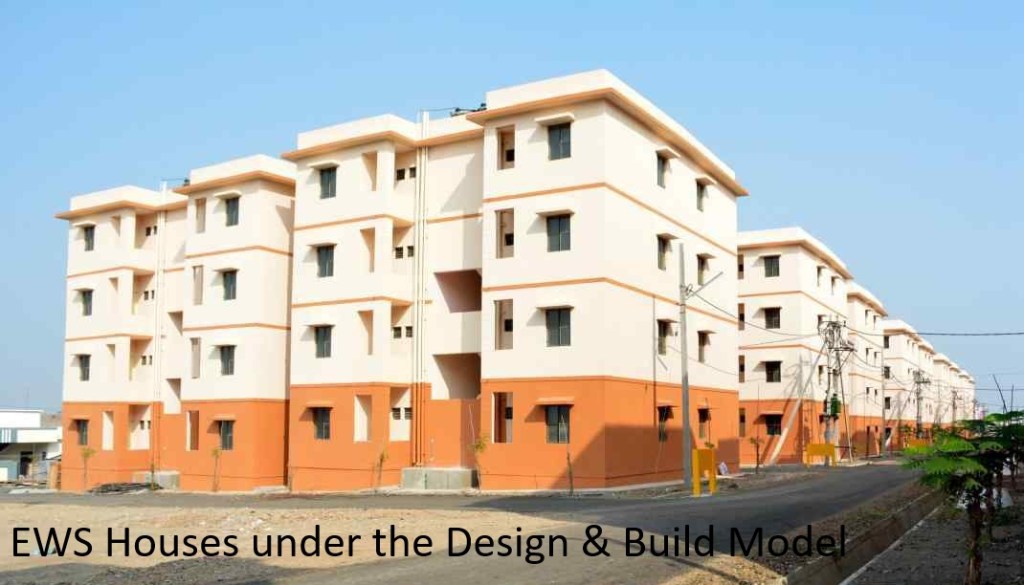
Understanding EWS Housing
EWS housing refers to dwelling units developed specifically for economically weaker sections of society, usually with a small unit size (generally 25–40 sq m carpet area) and basic but adequate living facilities. These houses typically include one multipurpose room, a small kitchen space, a toilet-bathroom, and provision for ventilation and natural light. The objective of EWS housing is not merely shelter provision but ensuring dignified, safe, and habitable living conditions with access to essential services such as water supply, sanitation, electricity, roads, and social infrastructure.
EWS housing projects are often developed by public authorities, urban local bodies, housing boards, or through public–private partnerships as part of affordable housing and slum rehabilitation initiatives.
Concept of the Design & Build Model
The Design & Build model is a project delivery system in which a single agency or contractor is responsible for both the design and construction of the housing project. Unlike the traditional model—where design and construction are handled by separate entities—the D&B model integrates both functions under one contract. This approach is particularly suitable for EWS housing due to its emphasis on speed, standardisation, and cost efficiency.
Under this model, the client or government agency specifies performance requirements, unit sizes, quality standards, timelines, and cost limits. The design-build contractor then prepares detailed designs and executes construction accordingly.
Design Principles for EWS Houses
Designing EWS houses under the D&B model requires a careful balance between affordability, functionality, and livability. Key design considerations include:
- Efficient space planning to maximise usability within limited carpet area. Multi-functional spaces are often adopted.
- Standardised layouts and modular design, which allow repetition and faster execution while maintaining quality.
- Adequate natural light and ventilation, achieved through window placement, orientation, and open corridors.
- Structural safety and durability, especially in multi-storey developments, using cost-effective but robust construction technologies.
- Provision of basic services, including water supply, sanitation, electricity, and drainage.
- Fire safety, accessibility, and disaster resilience, particularly important in high-density EWS housing clusters.
The D&B model allows contractors to optimise designs based on construction methods, materials, and sequencing, reducing wastage and cost overruns.
Construction Aspects under the Design & Build Model
Construction of EWS houses using the D&B model often employs mass housing techniques such as precast components, monolithic concrete construction, or other fast-track technologies. These methods help achieve uniform quality, reduce construction time, and ensure structural consistency.
Key construction features include:
- Rapid project execution, as design and construction phases overlap.
- Better coordination, since the same agency handles drawings, approvals, and on-site work.
- Cost control, achieved through bulk procurement, standard materials, and optimised construction processes.
- Quality assurance, as the contractor is accountable for both design performance and construction output.
Advantages of the Design & Build Model for EWS Housing
The D&B model offers several advantages when applied to EWS housing projects:
- Time efficiency – Faster project delivery helps meet urgent housing demand.
- Single-point responsibility – Reduces disputes between designers and contractors.
- Cost effectiveness – Better integration leads to optimised designs and reduced variations.
- Innovation potential – Contractors can introduce new materials and construction techniques.
- Scalability – Suitable for large-scale EWS housing developments.
Challenges and Limitations
Despite its benefits, the Design & Build model also presents certain challenges in EWS housing:
- Risk of compromised design quality if cost-cutting dominates decision-making.
- Limited community participation, as designs are often finalised quickly.
- Maintenance concerns, if post-construction management is not clearly defined.
- Need for strong monitoring, as public agencies must ensure compliance with quality and safety standards.
Addressing these challenges requires robust tender conditions, independent quality audits, and clear performance benchmarks.
Conclusion
EWS houses developed under the Design & Build model represent a pragmatic and efficient approach to affordable housing delivery in India. By integrating design and construction, the model ensures speed, cost control, and accountability—key factors in meeting the massive housing needs of economically weaker sections. However, the true success of EWS housing lies not just in numbers but in quality, livability, and long-term sustainability. When supported by thoughtful design guidelines, strong institutional oversight, and inclusive planning, the Design & Build model can significantly contribute to creating humane, dignified, and resilient housing solutions for the urban poor.


You must be logged in to post a comment.