


Specifications are an essential component of engineering, construction, and planning projects. They provide detailed written instructions that define the quality, materials, workmanship, and methods required for the execution of a project. While drawings represent the graphical aspects of a project, specifications explain the technical requirements that cannot be fully represented through drawings alone. In quantity surveying, construction management, and planning practice, specifications act as a contractual document between the client, architect/planner, engineer, and contractor. They help avoid ambiguity, ensure uniform quality, and establish standards for materials and workmanship.
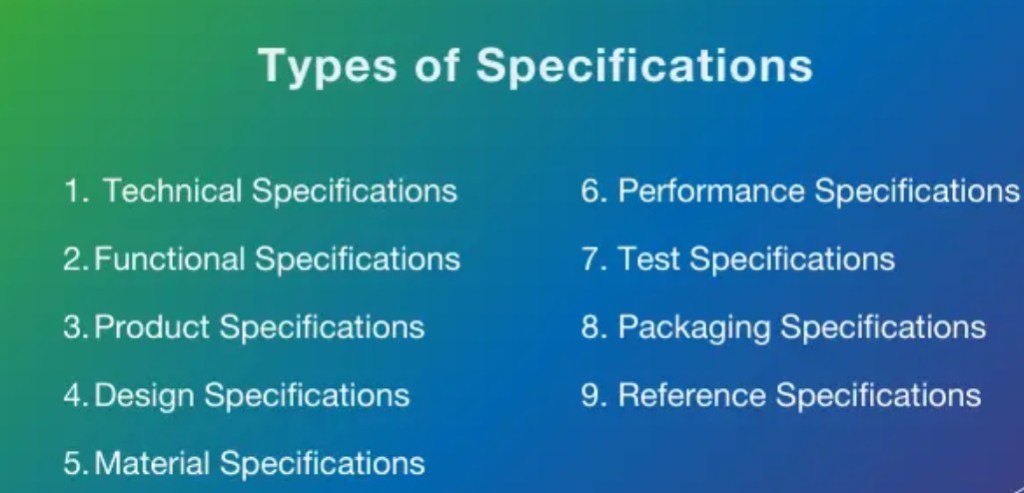
Specifications play a significant role in ensuring that construction work meets design intent, safety standards, and regulatory guidelines. They also assist in preparing cost estimates, evaluating tenders, and supervising construction. Broadly, specifications can be classified into different types based on their purpose, level of detail, and method of description. In addition, specifications may originate from several sources such as standard codes, government manuals, technical literature, and project-specific documents.
1. Classifications of Specifications
Specifications are generally classified according to the level of detail and the manner in which the work requirements are described. The main classifications are as follows:
1.1 General Specifications
General specifications describe the nature and class of work without providing detailed instructions regarding materials, workmanship, or methods. They give a broad idea of the quality of materials and the type of construction required for a project. These specifications are usually included in preliminary project reports or during the early stages of project planning when detailed information is not yet available.
General specifications mainly serve the following purposes:
- To indicate the general quality of materials and construction.
- To provide a rough understanding of the work involved.
- To assist in preparing approximate cost estimates.
- To provide guidelines for planning and feasibility analysis.
For example, a general specification for brick masonry may state that the masonry should be constructed using good-quality burnt clay bricks with cement mortar of suitable proportion. However, it will not mention the exact brick size, mortar mix ratio, curing methods, or testing procedures.
Because of their limited detail, general specifications are not suitable for contract agreements or detailed project execution. Instead, they are mostly used for preliminary estimates, feasibility studies, and conceptual planning.
1.2 Detailed Specifications
Detailed specifications provide comprehensive information about every component of construction work. They describe the materials, quality standards, proportions, workmanship, construction methods, equipment, and testing procedures required for the project.
These specifications form a vital part of contract documents and are used during tendering and construction stages. A detailed specification clearly explains:
- Quality and type of materials to be used.
- Proportions and mix design of construction materials.
- Workmanship and execution methods.
- Required equipment and tools.
- Testing procedures and quality control.
- Measurement methods for payment.
For instance, a detailed specification for cement concrete would mention the type of cement (such as Ordinary Portland Cement), the grade of concrete (e.g., M20), the proportion of materials, mixing procedure, compaction method, curing duration, and acceptance criteria.
Detailed specifications eliminate confusion and ensure that the contractor follows the required standards. They also enable engineers or supervisors to monitor the quality of work during construction.
1.3 Standard Specifications
Standard specifications are prepared by government departments, professional organizations, and standard-setting institutions. These specifications provide uniform guidelines for materials, workmanship, and construction methods. They are widely used in public works and infrastructure projects to maintain consistency and quality across projects.
Standard specifications are usually developed based on extensive research, field experience, and engineering best practices. They define the minimum acceptable standards for construction work.
Some commonly used standard specifications include:
- Specifications issued by Public Works Departments (PWD)
- Standards published by the Bureau of Indian Standards (BIS)
- Specifications of the Central Public Works Department (CPWD)
- Indian Roads Congress (IRC) standards for road construction
- National Building Code (NBC) guidelines
Standard specifications simplify the preparation of project documents because engineers can refer to established codes rather than writing specifications from scratch. They also ensure that construction practices follow nationally accepted engineering standards.
1.4 Special Specifications
Special specifications are prepared for specific projects or unique construction requirements that are not covered by standard specifications. These specifications supplement the standard guidelines and address particular conditions or design requirements.
Special specifications may include:
- Unique construction techniques
- Special materials or equipment
- Site-specific conditions
- Environmental protection measures
- Advanced technologies
For example, a metro rail project may require specialized tunneling techniques, vibration control measures, or advanced structural systems that are not included in standard specifications. In such cases, special specifications are prepared to define these unique requirements.
These specifications ensure that the project meets its specific design objectives while maintaining safety and quality.
1.5 Performance Specifications
Performance specifications describe the expected performance or outcome of a construction component rather than prescribing the exact materials or methods. In this approach, the contractor has flexibility in choosing materials and construction techniques as long as the final performance meets the required standards.
For example, instead of specifying the exact type of insulation material, a performance specification may require that the building envelope achieve a certain thermal resistance value.
Performance specifications are commonly used in modern construction projects because they encourage innovation and allow contractors to adopt efficient technologies while still meeting performance requirements.
1.6 Prescriptive Specifications
Prescriptive specifications provide detailed instructions about the materials, dimensions, and construction methods to be used in a project. Unlike performance specifications, prescriptive specifications do not allow much flexibility to contractors.
These specifications clearly state:
- Exact material types
- Construction procedures
- Dimensions and tolerances
- Quality standards
For instance, a prescriptive specification for concrete might require a specific cement type, aggregate size, water–cement ratio, and mixing method.
Prescriptive specifications are widely used in traditional construction projects because they ensure strict compliance with engineering standards and reduce the risk of construction errors.
2. Sources of Specifications
Specifications used in engineering and construction projects are derived from several reliable sources. These sources provide technical guidelines, quality standards, and construction practices that ensure safety and durability.
2.1 Bureau of Indian Standards (BIS)
The Bureau of Indian Standards is the national standard-setting body in India. It publishes Indian Standards (IS codes) that define specifications for materials, testing methods, structural design, and construction practices.
Examples include standards related to:
- Cement and concrete
- Structural steel
- Bricks and masonry
- Building materials
- Environmental safety
BIS standards ensure that construction materials and practices meet nationally accepted quality benchmarks.
2.2 Public Works Department (PWD) Manuals
Public Works Departments at both central and state levels publish manuals and specifications for government construction projects. These manuals include standard specifications for various types of works such as buildings, roads, bridges, drainage systems, and water supply infrastructure.
PWD specifications typically include:
- Standard construction procedures
- Material quality requirements
- Measurement and payment rules
- Maintenance guidelines
These manuals are widely used for public infrastructure projects and serve as an important reference for engineers and planners.
2.3 Central Public Works Department (CPWD) Specifications
The Central Public Works Department publishes comprehensive specifications for construction works undertaken by central government agencies. CPWD specifications cover a wide range of building and infrastructure activities.
They include detailed guidelines for:
- Civil works
- Electrical installations
- Plumbing and sanitation
- Landscaping
- Finishing works
CPWD specifications are widely regarded as authoritative and are often adopted by other government departments and institutions.
2.4 National Building Code (NBC)
The National Building Code of India provides guidelines for building design, construction practices, fire safety, structural safety, and building services. Although it is primarily a regulatory document, it also contains specifications related to building materials, safety standards, and construction practices.
NBC serves as an important source of specifications for architects, planners, engineers, and construction professionals.
2.5 Indian Roads Congress (IRC) Standards
For road and highway construction, the Indian Roads Congress provides detailed specifications and guidelines. IRC standards cover aspects such as pavement design, road materials, traffic engineering, and highway safety.
These specifications are widely used in national and state highway projects.
2.6 Technical Literature and Manufacturer Specifications
Manufacturers of construction materials and equipment often provide technical specifications for their products. These documents describe:
- Product properties
- Installation methods
- Performance characteristics
- Maintenance requirements
Examples include specifications for tiles, paints, waterproofing materials, insulation products, and mechanical equipment.
These manufacturer specifications help engineers select suitable materials and ensure proper installation.
2.7 Project-Specific Design Documents
In many projects, architects, planners, or consulting engineers prepare custom specifications tailored to the design requirements of the project. These specifications combine information from standard codes, technical manuals, and project-specific conditions.
Project-specific specifications are usually included in the tender documents and form part of the contract agreement.
Conclusion
Specifications are a crucial element of engineering and construction documentation. They define the quality of materials, standards of workmanship, and procedures required for the successful execution of a project. Properly prepared specifications ensure clarity, consistency, and accountability in construction projects.
Specifications can be classified into several types such as general specifications, detailed specifications, standard specifications, special specifications, performance specifications, and prescriptive specifications. Each type serves a specific purpose depending on the stage of project development and the level of detail required.
The preparation of specifications relies on multiple reliable sources including BIS standards, CPWD manuals, PWD specifications, National Building Code guidelines, Indian Roads Congress standards, manufacturer documents, and project-specific design requirements. By integrating these sources, engineers and planners can ensure that construction projects meet technical standards, safety requirements, and functional objectives.
Thus, specifications play a fundamental role in bridging the gap between design and execution, ensuring that infrastructure and building projects are constructed efficiently, safely, and according to established engineering standards.
 Track2Training
You must be logged in to post a comment.