
Integrated Rural–Urban Dynamics in Delta Regions: Sustainability, Resilience, and Transformative Planning
About the Book
Delta regions across the world are experiencing rapid transformations driven by urbanisation, climate change, migration, environmental degradation, infrastructure expansion, and socio-economic restructuring. These regions represent highly sensitive and interconnected landscapes where rural and urban systems continuously interact through mobility, resource flows, livelihoods, governance structures, and ecological processes.
The proposed edited volume, Integrated Rural–Urban Dynamics in Delta Regions, aims to provide a multidisciplinary platform for scholars, practitioners, policymakers, planners, and researchers to critically examine emerging rural–urban relationships in deltaic environments. The book seeks contributions addressing sustainability, resilience, climate adaptation, infrastructure development, mobility transitions, governance mechanisms, land-use transformations, environmental management, and socio-economic integration within delta regions.
The volume particularly encourages evidence-based chapters supported by detailed case studies, spatial analysis, empirical investigations, policy evaluations, and interdisciplinary approaches from both developing and developed regions.
The edited book is proposed for publication by Springer Nature and is intended to serve as an important academic and policy reference for researchers, professionals, and institutions working in urban and regional planning, environmental studies, sustainability science, transportation, geography, rural development, and climate resilience.
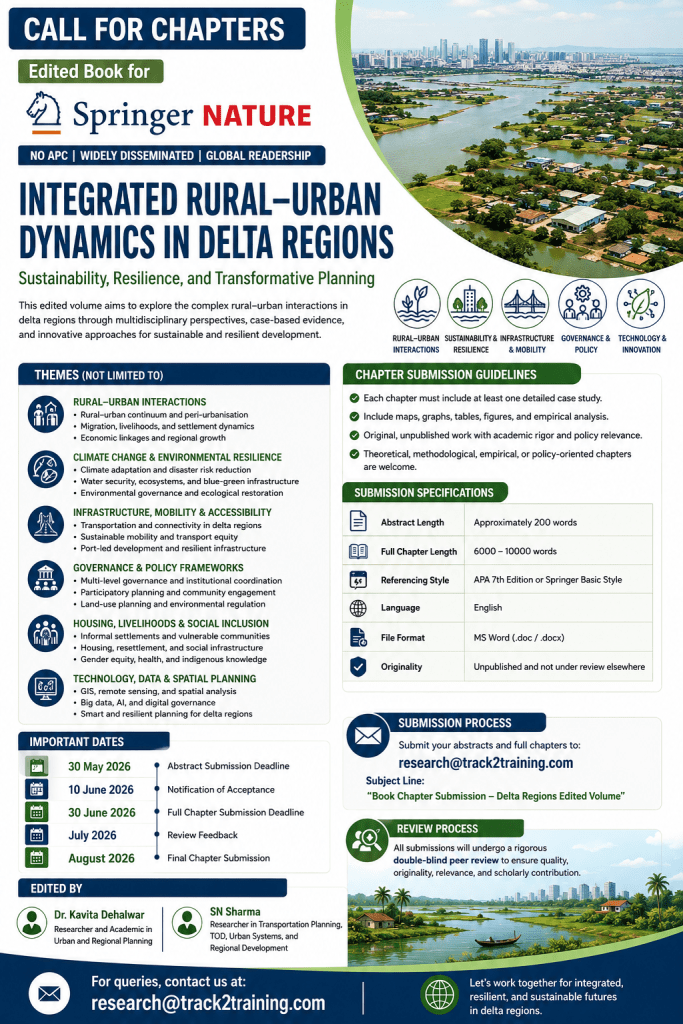
Suggested Themes and Sub-Themes
Contributors may submit chapters related to, but not limited to, the following areas:
Rural–Urban Interactions in Delta Regions
- Rural–urban continuum and spatial transformations
- Migration, demographic shifts, and settlement dynamics
- Changing livelihood systems in delta landscapes
- Peri-urbanisation and regional growth patterns
- Rural–urban economic linkages
Climate Change and Environmental Resilience
- Climate adaptation in delta settlements
- Flood resilience and disaster risk reduction
- Coastal and riverine ecosystem management
- Water security and environmental governance
- Blue-green infrastructure and ecological restoration
Infrastructure, Mobility, and Accessibility
- Transportation systems in delta regions
- Rural accessibility and regional connectivity
- Sustainable mobility and transport equity
- Port-led development and logistics systems
- Infrastructure resilience under climate stress
Governance and Policy Frameworks
- Multi-level governance in delta regions
- Decentralised planning and institutional coordination
- Participatory governance and community engagement
- Land-use policy and environmental regulation
- Regional planning approaches for integrated development
Housing, Livelihoods, and Social Inclusion
- Informal settlements and vulnerable communities
- Affordable housing and resettlement planning
- Gender and social equity in delta development
- Indigenous knowledge systems and adaptive practices
- Public health and social infrastructure
Technology, Data, and Spatial Planning
- GIS and remote sensing applications
- Smart and resilient delta planning
- Big data and digital governance
- Spatial modelling and decision-support systems
- AI applications in regional planning and environmental monitoring
Chapter Submission Guidelines
Researchers, academicians, planners, professionals, and policymakers are invited to submit original and unpublished chapters relevant to the scope of the book.
Important Requirements
- Each chapter must include at least one detailed case study.
- Chapters should incorporate appropriate:
- Maps
- Graphs
- Tables
- Figures
- Spatial or empirical analysis
- Chapters should demonstrate:
- Theoretical and methodological clarity
- Policy relevance
- Practical implications
- Academic originality and rigor
Submission Specifications
| Component | Details |
|---|---|
| Abstract Length | Approximately 200 words |
| Full Chapter Length | 6000–10000 words |
| Referencing Style | APA 7th Edition or Springer Basic Style |
| Language | English |
| Submission Format | MS Word (.doc/.docx) |
| Originality Requirement | Chapters must be original and not under review elsewhere |
Important Dates
| Activity | Date |
|---|---|
| Abstract Submission Deadline | 30 May 2026 |
| Notification of Acceptance | 10 June 2026 |
| Full Chapter Submission Deadline | 30 June 2026 |
| Review Feedback | July 2026 |
| Final Chapter Submission | August 2026 |
Submission Process
Authors are requested to submit abstracts and full chapters via email to:
Please mention “Book Chapter Submission – Delta Regions Edited Volume” in the subject line.
Review Process
All submitted abstracts and chapters will undergo a rigorous double-blind peer review process to ensure quality, originality, relevance, and scholarly contribution.
Publication Information
- Proposed Publisher: Springer Nature
- No Article Processing Charges (No APC)
- Accepted chapters will be published after successful peer review and editorial evaluation.
Editors
Dr. Kavita Dehalwar
Researcher and Academic in Urban and Regional Planning
SN Sharma
Researcher in Transportation Planning, TOD, Urban Systems, and Regional Development
For queries related to chapter preparation, thematic suitability, and submission guidelines, authors may contact:


Call for Chapters
@track2training.com
LikeLike