
Types and Methods of Cost Estimation for Different Types of Projects
Cost estimation is a fundamental activity in construction, planning, and infrastructure development. It involves predicting the probable cost of a project before its execution by evaluating quantities of materials, labour, equipment, and other resources required for the work. Accurate cost estimation helps planners, engineers, architects, and project managers in decision-making, budgeting, project feasibility assessment, and financial planning. In planning and construction projects such as buildings, roads, bridges, water supply systems, and urban infrastructure, cost estimation plays a vital role in determining whether a project is economically viable.
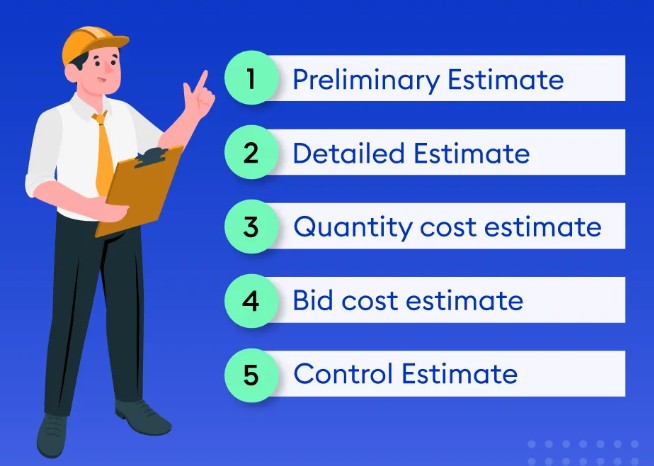
Cost estimation is used at different stages of project development. At the early planning stage, rough estimates are prepared to understand the approximate investment required. As the design becomes more detailed, more precise estimates are prepared using detailed drawings and specifications. Estimation is also important for tendering, cost control, and financial monitoring during project implementation.
Cost estimation can be classified into different types based on the stage of the project and the level of accuracy required. In addition, several methods are used to calculate the cost depending on the type and scale of the project.
1. Types of Cost Estimation
Cost estimation can be broadly classified into several categories depending on the level of detail and the purpose of the estimate.
1.1 Preliminary or Rough Cost Estimate
A preliminary estimate is prepared during the early stage of project planning when only basic information about the project is available. The main objective of this estimate is to determine the approximate cost of the project and assess its financial feasibility.
Preliminary estimates are commonly used for:
- Feasibility studies
- Budget allocation
- Project approval by authorities
- Comparison of alternative proposals
Since detailed drawings are not available at this stage, the estimate is based on approximate quantities and standard rates derived from previous similar projects.
Examples include:
- Estimating the cost of a proposed school building based on cost per square meter.
- Estimating the cost of a road project based on cost per kilometer.
Although rough estimates are less accurate, they are very useful for planning and decision-making during the initial stage of development.
1.2 Detailed Cost Estimate
A detailed estimate is prepared after the completion of detailed drawings and specifications. It involves calculating the exact quantities of materials and work items required for the project.
The steps involved in preparing a detailed estimate include:
- Studying drawings and specifications
- Calculating quantities of different items of work
- Determining the unit rates for each item
- Preparing an item-wise cost summary
Detailed estimates are highly accurate and are used for:
- Tendering and contract agreements
- Budget approval
- Cost control during construction
- Preparation of bills and payments
For example, in a building project, quantities of excavation, concrete, brick masonry, plastering, flooring, and finishing are calculated separately and multiplied by their respective rates to determine the total cost.
1.3 Revised Estimate
A revised estimate is prepared when the original estimated cost of a project is likely to exceed the sanctioned amount due to changes in design, increased quantities, rise in material costs, or unforeseen site conditions.
A revised estimate is necessary in the following situations:
- Change in project scope or design
- Increase in material or labour costs
- Modification of construction methods
- Discovery of unexpected ground conditions
Revised estimates are submitted for approval to the concerned authorities before continuing the work.
1.4 Supplementary Estimate
A supplementary estimate is prepared when additional work not included in the original estimate becomes necessary during project execution.
Examples include:
- Additional rooms in a building
- Extra drainage work in a road project
- Installation of new utilities
A supplementary estimate is prepared separately but is combined with the original estimate to determine the revised project cost.
1.5 Annual Repair and Maintenance Estimate
This estimate is prepared for regular maintenance and repair of existing structures such as buildings, roads, and infrastructure facilities. It includes routine activities such as painting, minor repairs, patchwork, and replacement of damaged components.
The purpose of maintenance estimates is to ensure that structures remain functional and safe throughout their service life.
1.6 Special Repair Estimate
Special repair estimates are prepared when major repairs are required to restore the structural stability or functionality of a structure. These repairs may include replacement of damaged structural components or rehabilitation of deteriorated infrastructure.
Examples include:
- Strengthening of old bridges
- Rehabilitation of damaged buildings
- Reconstruction of deteriorated roads
2. Methods of Cost Estimation
Various methods are used to estimate project costs depending on the type, scale, and stage of the project. These methods are widely used in building construction, infrastructure development, and urban planning projects.
2.1 Plinth Area Method
The plinth area method is one of the most commonly used methods for preliminary cost estimation of buildings. In this method, the cost of construction is calculated based on the plinth area of the building.
The plinth area refers to the covered built-up area measured at the floor level.
The estimated cost is calculated as:
Estimated Cost = Plinth Area × Plinth Area Rate
The plinth area rate is obtained from previous projects or standard schedules of rates. Adjustments may be made for location, design complexity, and quality of construction.
Advantages of this method include simplicity and quick estimation. However, it provides only approximate results.
2.2 Floor Area Method
In the floor area method, the cost of construction is calculated based on the total usable floor area of the building rather than the plinth area.
The floor area includes the internal usable space but excludes walls, corridors, and other non-usable areas.
Estimated Cost = Floor Area × Floor Area Rate
This method is often used in residential and commercial building projects where usable space is a key factor.
2.3 Cubical Content Method
The cubical content method estimates the cost of a building based on its volume rather than its area.
The building volume is calculated by multiplying the plinth area by the height of the building.
Estimated Cost = Building Volume × Rate per Cubic Meter
This method is particularly useful for buildings with varying heights such as warehouses, halls, and industrial buildings.
2.4 Unit Base Method
The unit base method estimates the cost of a project based on functional units such as number of beds, seats, rooms, or capacity.
Examples include:
- Hospitals: cost per bed
- Schools: cost per student capacity
- Hotels: cost per room
- Water supply projects: cost per capita
This method is widely used in planning large institutional projects where cost can be related to service capacity.
2.5 Approximate Quantity Method
The approximate quantity method involves calculating approximate quantities of major building components such as walls, floors, and roofs.
This method is more accurate than simple area-based methods and is often used during the early design stage when approximate dimensions are known.
2.6 Detailed Quantity Method
The detailed quantity method is the most accurate method of cost estimation. It involves calculating the exact quantities of all items of work based on detailed drawings.
Each item of work is measured according to standard measurement rules and multiplied by its unit rate.
This method is used for:
- Tender preparation
- Contract agreements
- Final project budgeting
Although this method requires significant time and effort, it provides highly reliable results.
3. Cost Estimation for Different Types of Projects
Different types of projects require different estimation approaches.
Building Projects
Building construction projects often use:
- Plinth area method for preliminary estimates
- Cubical content method for large buildings
- Detailed quantity method for final estimates
Road Projects
For road construction projects, estimation methods may include:
- Cost per kilometer method for preliminary estimates
- Detailed quantity estimation for pavement layers, earthwork, drainage, and structures
Water Supply and Sanitation Projects
In these projects, estimation is often based on:
- Cost per capita
- Capacity of treatment plants
- Length of pipelines and distribution networks
Infrastructure and Urban Development Projects
Urban infrastructure projects such as metro systems, public transport facilities, and smart city developments may use a combination of:
- Unit cost methods
- Parametric estimation techniques
- Detailed engineering estimates
Conclusion
Cost estimation is an essential component of planning, engineering, and construction management. It helps determine the financial feasibility of projects, allocate resources effectively, and control costs during project implementation. Different types of estimates such as preliminary estimates, detailed estimates, revised estimates, supplementary estimates, maintenance estimates, and special repair estimates serve different purposes throughout the project life cycle.
Various estimation methods such as the plinth area method, floor area method, cubical content method, unit base method, approximate quantity method, and detailed quantity method are used depending on the project stage and type. Building projects, road construction, water supply systems, and urban infrastructure projects each require specific estimation approaches to ensure accurate cost prediction.
Accurate cost estimation not only helps in financial planning but also supports efficient project management, transparent tendering processes, and successful project completion. Therefore, it remains a critical skill for planners, engineers, quantity surveyors, and project managers involved in the development of infrastructure and urban environments.


You must be logged in to post a comment.