
Water supply networks and distribution systems are essential components of urban infrastructure. They ensure the reliable delivery of safe and potable water from treatment plants or water sources to consumers such as residential areas, commercial establishments, industries, and public facilities. Detailed specifications for water supply networks describe the materials, design standards, installation procedures, testing requirements, and maintenance practices required to construct an efficient and durable distribution system.
In urban planning and infrastructure development, water distribution systems must be designed to provide adequate water pressure, maintain water quality, minimize leakage, and ensure equitable access across all parts of the service area. Detailed specifications ensure that the construction of pipelines, pumping stations, valves, storage tanks, and other components meets technical standards and operates efficiently throughout the system’s service life.
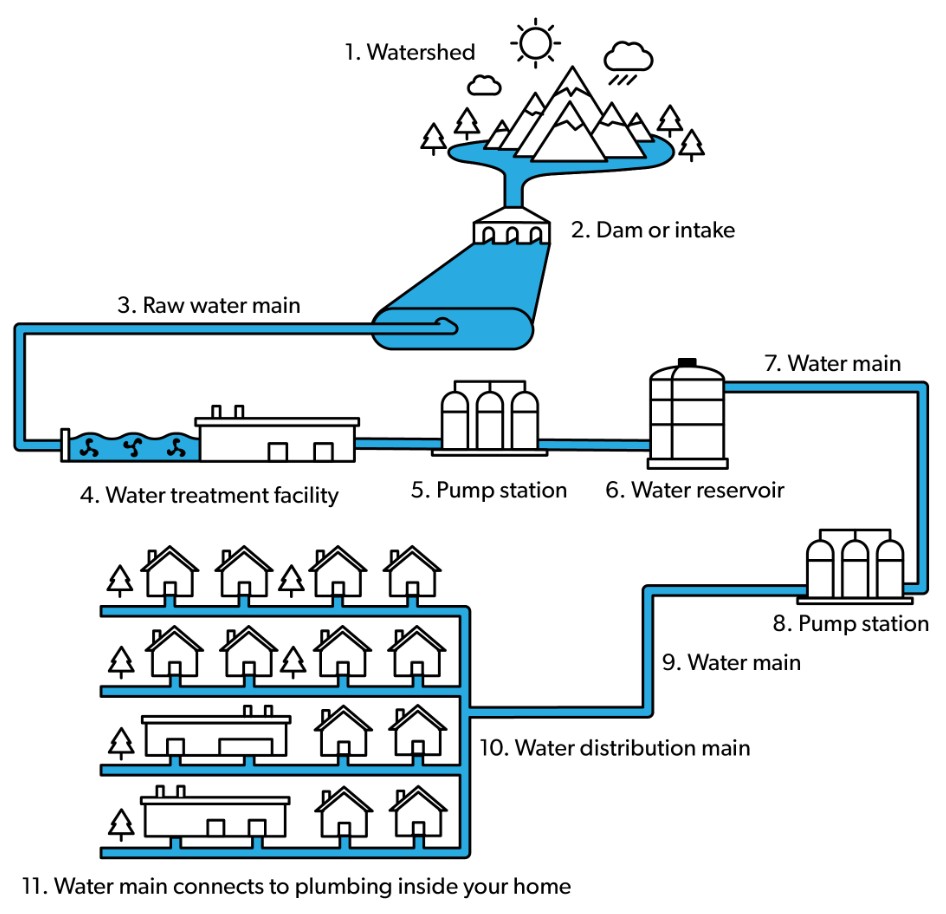
1. Components of Water Supply Network and Distribution Systems
A typical water supply distribution system consists of several interconnected components that work together to deliver water from the source to consumers.
Major components include:
- Water sources such as rivers, lakes, groundwater wells, or reservoirs
- Water treatment plants
- Transmission mains
- Distribution pipelines
- Pumping stations
- Storage reservoirs or overhead tanks
- Valves and fittings
- Consumer service connections
Each of these components requires detailed specifications to ensure proper design, construction, and operation.
2. Detailed Specifications for Water Supply Pipelines
Pipelines are the primary elements of water distribution systems. They transport treated water from treatment plants or storage reservoirs to consumers.
Materials
Pipelines should be constructed using approved materials such as:
- Ductile iron pipes
- Cast iron pipes
- Mild steel pipes
- PVC (Polyvinyl Chloride) pipes
- HDPE (High-Density Polyethylene) pipes
The choice of material depends on factors such as water pressure, soil conditions, corrosion resistance, and project cost.
Pipe Quality
Pipes must satisfy the following requirements:
- Pipes should be strong, durable, and resistant to internal water pressure.
- They should be free from cracks, defects, or manufacturing faults.
- Pipes should have smooth internal surfaces to minimize friction losses.
- Protective coatings or linings should be applied where necessary to prevent corrosion.
Pipe Diameter
The diameter of pipelines should be determined based on:
- Population demand
- Peak water consumption
- Hydraulic calculations
- Pressure requirements
The design should ensure adequate flow capacity and maintain sufficient pressure throughout the network.
3. Pipe Laying and Installation
Proper pipe laying is critical to the performance and durability of water supply systems.
Trenching
- Trenches should be excavated according to the required depth and width specified in the design drawings.
- The bottom of the trench should be leveled and free from stones or sharp objects.
- Adequate bedding materials such as sand or fine soil should be provided to support the pipeline.
Pipe Alignment
- Pipes should be laid in straight alignment unless changes in direction are required.
- Bends and fittings should be used where directional changes occur.
- Pipes should be properly supported and aligned to prevent displacement.
Jointing
Different types of pipe joints may be used depending on the pipe material.
Common jointing methods include:
- Rubber ring joints
- Flanged joints
- Welded joints for steel pipes
- Solvent cement joints for PVC pipes
All joints must be watertight to prevent leakage.
4. Valves and Fittings
Valves and fittings are installed within the distribution network to control water flow and facilitate maintenance operations.
Types of Valves
Common valves used in water supply systems include:
- Gate valves for controlling flow
- Air valves for releasing trapped air
- Pressure reducing valves
- Check valves to prevent backflow
- Scour valves for draining pipelines
Installation Requirements
- Valves should be installed at strategic locations such as pipeline intersections and high points.
- Valve chambers should be constructed to allow easy access for operation and maintenance.
- All valves should be tested before installation.
5. Storage Reservoirs and Overhead Tanks
Storage reservoirs are used to store treated water and maintain consistent supply during peak demand periods.
Types of Storage Structures
Water storage facilities may include:
- Ground-level reservoirs
- Elevated service reservoirs (overhead tanks)
- Underground storage tanks
Construction Specifications
- Reservoirs should be constructed using reinforced cement concrete.
- The structure should be watertight and resistant to leakage.
- Proper ventilation, access ladders, and inspection openings should be provided.
- The reservoir should be protected against contamination by covering and sealing.
Storage reservoirs help maintain pressure in the distribution system and ensure continuous supply even during pump failures.
6. Pumping Stations
Pumping stations are required when water needs to be lifted from lower elevations to higher storage reservoirs or distribution networks.
Pump Installation
- Pumps should be selected based on required discharge and head.
- Pumping equipment should be installed on stable foundations.
- Proper alignment between pump and motor should be ensured.
Mechanical and Electrical Systems
- Electrical systems should include control panels, backup power supply, and safety devices.
- Pumping stations should have proper ventilation and drainage.
Regular inspection and maintenance are necessary to ensure reliable operation.
7. Service Connections
Service connections provide water supply from the distribution pipeline to individual consumers.
Connection Components
A typical service connection includes:
- Service pipe
- Stop valve
- Water meter
- Consumer tap
Installation Requirements
- Service pipes should be made of corrosion-resistant materials such as PVC or HDPE.
- Water meters should be installed in accessible locations for reading and maintenance.
- Connections should be leak-proof to prevent water losses.
8. Testing and Commissioning
Before commissioning the water supply network, several tests must be conducted to ensure system reliability.
Pressure Testing
Pipelines should be tested for leakage by applying hydraulic pressure greater than the normal operating pressure.
Flushing and Cleaning
Pipelines should be flushed with clean water to remove debris and contaminants before use.
Disinfection
Disinfection using chlorine or other approved chemicals should be carried out to eliminate harmful microorganisms.
These procedures ensure that the water supply system is safe for public use.
9. Operation and Maintenance
Proper maintenance is essential for the long-term performance of water supply systems.
Maintenance activities include:
- Regular inspection of pipelines and valves
- Leak detection and repair
- Cleaning of storage reservoirs
- Monitoring water pressure and flow
- Replacement of damaged components
Effective maintenance reduces water losses and improves system efficiency.
10. Design Considerations for Distribution Systems
When designing water distribution systems, planners and engineers must consider several factors:
- Population growth and future demand
- Peak water consumption rates
- Pressure requirements across the network
- Fire-fighting requirements
- Reliability and redundancy of the system
Different types of distribution layouts may be adopted such as:
- Grid or loop system
- Radial system
- Ring system
- Dead-end system
The selection of distribution pattern depends on the layout of the urban area and infrastructure requirements.
Conclusion
Detailed specifications for water supply networks and distribution systems ensure that urban water infrastructure is designed and constructed to meet technical standards and public health requirements. These specifications cover all aspects of the system including pipelines, pipe laying procedures, valves, storage reservoirs, pumping stations, and service connections.
Proper construction practices, testing procedures, and maintenance programs are essential to ensure reliable water delivery, maintain water quality, and reduce losses due to leakage or system failures. In rapidly growing urban areas, efficient water distribution systems are critical for supporting population growth, economic activities, and sustainable urban development.
Therefore, detailed specifications serve as a technical guideline for engineers, planners, contractors, and infrastructure agencies to develop water supply systems that are safe, durable, and capable of meeting present and future water demands.


 Track2Training
You must be logged in to post a comment.