
Spirituality in India

The meaning of spirituality has developed and expanded over time, and various connotations can be found alongside each other. Traditionally, spirituality referred to a religious process of re-formation which “aims to recover the original shape of man”, oriented at “the image of God as exemplified by the founders and sacred texts of the religions of the world. The term was used within early Christianity to refer to a life oriented toward the Holy Spirit and broadened during the Late Middle Ages to include mental aspects of life. In modern times, the term both spread to other religious traditions and broadened to refer to a wider range of experiences, including a range of esoteric traditions and religious traditions. Modern usages tend to refer to a subjective experience of a sacred dimension and the “deepest values and meanings by which people live”, often in a context separate from organized religious institutions.

In the present age, we see that the whole of humanity is in disharmony owing to religious differences. This means that the present-day religious theologies and practices have outlived their spiritual efficacy to bring about peace and spiritual evolvement to humanity. It is for India to take up a leadership role in the spiritual renewal of humanity. Although it may be unconvincing to many, the reality is that India is the mother of spirituality, the inheritor of an ancient most spiritual culture.

As the global community becomes increasingly capitalistic, the quest for spirituality grows in urgency.  India, its people, its infrastructure, and indeed its very soil, encourage and breed Spiritualism, allowing religions to thrive, flourish and prosper.

India boasts the presence of every major religion in the world, as well many of their off-shoots and facets, all being supported, nourished, and living in comparative harmony. Many of these religions were conceived in India, and others have come to India seeking a haven from persecution after being created in their lands. The age-old environment has always supported such freedom of belief.

Spirituality and mystical charm have always drawn people from all over the world to India. As the world becomes increasingly capitalistic and materialist, the quest and urgency for spirituality grow more and more. The traditional Indian way of life has helped in the evolution and growth of Spiritualism. Numerous cultures and religions have thrived and flourished together for ages and resulted in the unique Indian way of life.

At different points in the history of our civilization, numerous spiritual leaders and saints have delivered the message of peace, brotherhood and co-existence that is so very well rooted in our culture. Arts like Yoga and Ayurveda coupled with religion have played an important role in the evolution and existence of spirituality in India.

Thus, Indian spirituality is all about showing respect to all living beings-animals trees, rocks and even water and lead a positive and healthy life. It is believed that the supreme Creator has put each one of us in this world for a purpose and that purpose is to be compassionate, caring and loving to one another. As mentioned earlier, the great Indian spiritual personalities and gurus have played an important role in spreading the message of love, care and the need for positive living all over the world. The presence of God as the supreme power, the concept of “Omnipresence of the Omnipotent” therefore finds a divine dimension amidst the concept of Indian philosophy. Indian philosophy suggests that all that exists in this universe is the ultimate manifestation of God. The words of Krishna further support this. As Krishna says:

“I am the original fragrance of earth and the heat of the fire. I am the life of all that lives and I am the penance of all seekers. I am the consciousness of all who have developed their consciousness. I am the splendor of all which is fine.”

This is the part where Indian philosophy ultimately offers a definite contour to the term “Spirituality”. This is when finally the emergence of that Ultimate Consciousness of the Greatest Knowledge happens which leads one towards felicity and towards that eternal bliss. This is the very halo of spiritualism in Indian philosophy, which finally binds the religiosity and the phantasmal elements with that sheer thread of tenet and feelings. Indian philosophy is therefore a religious tradition. The pride of the Indian philosophy again lies in that magical blend of the concept of reality or in that absolute reality with that of the existence of personal God which ultimately leads to a meaningful life. This immense fusion further crafts Indian philosophy as the most tolerant religion.

I would like to end these thoughts with a quote from the Gita: “Work done with anxiety about results is far inferior to work done without such anxiety, in the calm of self-surrender. Seek refuge in the knowledge of Brahma. They who work selfishly for results are miserable.”
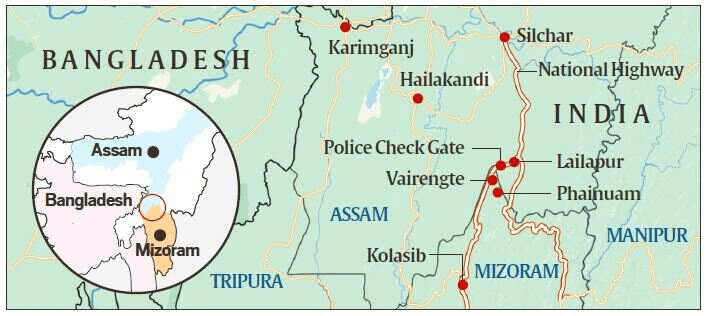
NORTH-EAST INDIA: FRAGILE PEACE

The boundary dispute between Assam and Mizoram dates back nearly a century and a half. While there have been several showdowns arising out of inter-state disputes between various states of the Northeast, the dispute between Assam and Mizoram has rarely culminated in violence. Yet, it escalated to unprecedented levels over the past week, as firing on the inter-state boundary left at least six Assam policemen dead and over 50 individuals injured.

Mizoram borders Assam’s Barak Valley, and both border Bangladesh. The boundary between the two states, which runs 165 km today, has a history dating back to the time when Mizoram was a district of Assam and known as Lushai Hills. Boundary demarcations in 1875 and 1933, particularly the second one, are at the heart of the dispute. The 1875 demarcation, notified on August 20 that year, derived from the Bengal Eastern Frontier Regulation (BEFR) Act, 1873. It differentiated Lushai Hills from the plains of Cachar in Assam’s Barak Valley. This was done in consultation with Mizo chiefs, and it became the basis for the Inner Line Reserve Forest demarcation in the Gazette two years later. The 1933 demarcation marks a boundary between Lushai Hills and Manipur, beginning at the tri-junction of Lushai Hills, Cachar district and Manipur. The Mizos do not accept this demarcation on the ground that their chiefs were not consulted at that time.

Places of tension between Assam & Mizoram

Which is boundary does Mizoram find acceptable?

According to Mizo leaders, the only acceptable boundary is the Inner Line of 1875 on the southern frontier of Cachar, notified as per the BEFR Act. (This was subsequently revised in 1878 as it sought to demarcate the Lushai Hills frontier from the plains of Assam). The Mizo leaders and a joint action committee on border issues submitted a memorandum to the PM claiming that the present demarcation between states is unacceptable because they were not consulted during the process.

The dispute has been simmering since Mizoram became a Union Territory in 1972 and then a state in the 1980s. The two states signed an agreement that the status quo should be maintained at no man’s land set up in the boundaries. While alleged transgressions have often happened over the decades, skirmishes have happened very frequently in recent months. Both the states claim that the other transgressed into their territory, and thereby triggering the violence.

Assam-Mizoram dispute: what led to such violence?                                                     

A team of around 200 Assam Police led by the IGP, Assam Police, and the DC, SP and DFO of Cachar travelled to the Vairengte autorickshaw stand on Monday. While Assam has reasoned that they went to “resolve matters”, Mizoram has said they “forced their way in”, overrunning security posts.

The Assam Home Minister, for his part, issued a statement: “In another breach of existing agreements and the existing status quo, Mizoram began constructing a road towards Rengti Basti in Assam, destroying the Inner Line Reserve Forest in Lailapur area. Simultaneously, the Mizoram side also set up a new armed camp on a hillock next to the camp of the neutral force, CRPF, in the same vicinity. A team of Assam officials including an IGP, DIG, DC Cachar, SP Cachar and DFO Cachar went to the area this morning to request the Mizoram side not to disturb the status quo.” 

What are the other border disputes in the region?

Assam, which shares its boundary with all other Northeast states, has been involved in disputes with several of its neighbours. Assam and Nagaland share has a 500-km boundary. Violent conflicts, some leading to deaths, have taken place in several phases since 1965.

With Arunachal Pradesh, Assam shares an around 800-km boundary. Here, the first clashes were reported in 1992. Each state has accused the other of boundary transgressions and illegal encroachment. These issues are now being heard in the Supreme Court.

With Meghalaya, Assam shares a boundary of 884 km. There has been a series of recent flare-ups here, too. The Meghalaya government claims it has 12 areas of disputes with Assam.

Where is this headed?

Following the intervention of Union Home Minister Amit Shah, who held closed-door meetings with the Northeast CMs in Shillong and discussed inter-state disputes and other issues — both sides have now retracted their forces.

In its statement, Mizoram has said it wants “that the inter-state border issue with Assam is resolved in an atmosphere of peace and understanding”. It has also called upon Assam to create a “congenial environment” for peaceful resolution of the dispute. Assam has asked Mizoram to “restrain its people and police personnel from indulging in wanton violence and work towards restoring peace”. It alleged that the fact that there was no casualty on Mizoram side was proof that Assam authorities had shown restraint. Assam Chief Minister Himanta Biswa Sarma and Mizoram Chief Minister Zoramthanga tagged each other in their tweets while calling for peace.

The Chief Ministers of these states had previously held talks in February this year and agreed on the need to maintain the status quo and peace.