In acoustics, dead spots (also called acoustic nulls or dead zones) are locations in a room or space where sound is noticeably weaker or almost inaudible compared to surrounding areas. These occur due to the cancellation of sound waves from reflections, standing waves, or interference patterns.
Causes of Dead Spots
Standing Waves (Room Modes): When sound waves reflect off walls, ceilings, and floors, they interact with the direct sound. At certain frequencies, destructive interference occurs, cancelling out sound energy at specific points in the room.
Phase Cancellation: If two sound waves of the same frequency but opposite phase overlap, they cancel each other out, creating a quiet or “dead” area.
Poor Speaker Placement: Placing speakers near walls or corners can create uneven sound distribution, with dead spots in the middle or edges of the room.
Room Shape and Materials: Odd-shaped rooms, parallel reflective walls, or materials that excessively absorb certain frequencies can all contribute to dead spots.
Examples
In a concert hall, some seats may have weaker bass response due to standing wave cancellation.
In a recording studio, a mix engineer sitting at the wrong spot may not hear certain frequencies accurately.
In a home theater, bass “disappears” at some seats while booming in others.
How to Minimize Dead Spots
Acoustic Treatment: Use bass traps, diffusers, and absorbers to reduce reflections and smooth out standing waves.
Speaker Placement: Experiment with moving speakers away from walls and corners.
Listener Positioning: Avoid sitting in the exact center of a room, where nulls are most common.
Multiple Subwoofers (for low frequencies): Helps distribute bass more evenly across the space.
Room Shape Design: Concert halls and auditoriums are carefully designed to reduce such effects.
👉 Dead spots aren’t complete silence—they’re frequency-dependent. A location might sound fine at midrange but have no bass, which is why they are particularly noticeable with low-frequency sounds.
Would you like me to also make a diagram showing how standing waves create dead spots in a room?
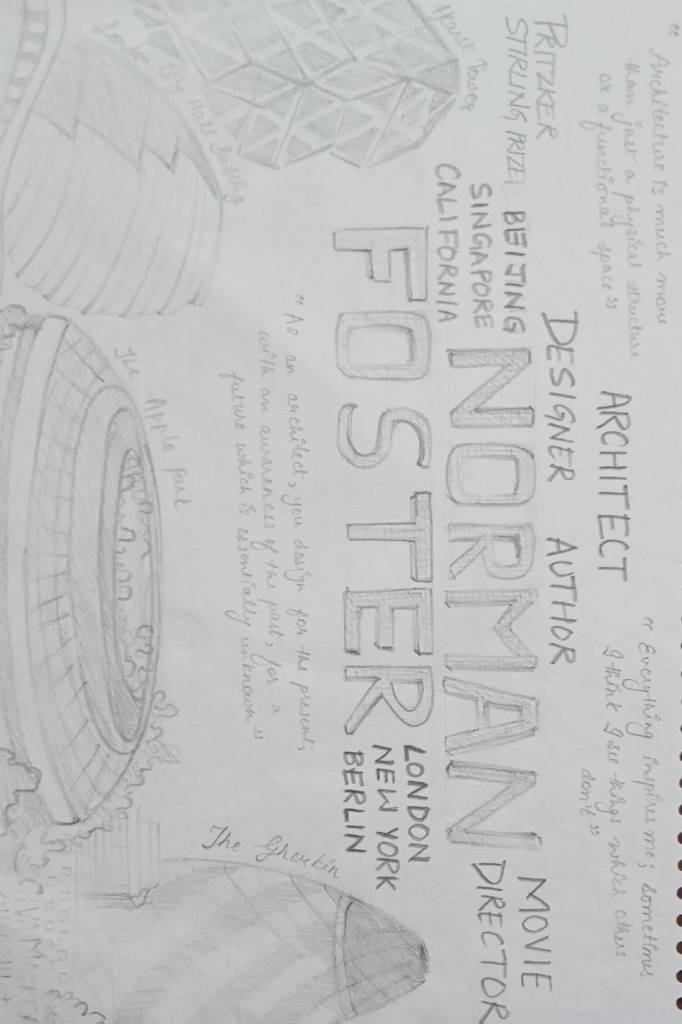
Norman Foster was born into a working-class family in Stockport, near Manchester, England. His father worked in a machine shop and his mother in a bakery. From an early age, Foster showed a fascination with engineering, airplanes, and design.
He studied architecture at the University of Manchester School of Architecture and City Planning, graduating in 1961. With a scholarship, he went on to pursue a Master’s degree at Yale University, where he studied under influential modernists such as Paul Rudolph and met Richard Rogers, who would later become a lifelong friend and colleague.
Career and Practice
Team 4 (1963–1967)
Foster co-founded Team 4 with Richard Rogers, Su Brumwell, and Wendy Cheesman (his future wife). The group became known for its high-tech, modernist approach to architecture.
After Team 4 dissolved, Foster founded his own practice, Foster Associates, which later became Foster + Partners. The firm grew into one of the most prestigious and globally recognized architecture firms, with projects on every continent.
Architectural Style and Philosophy
Norman Foster is known for a style that is:
High-tech and modernist
Focused on lightweight structures, transparency, and open space
Deeply rooted in sustainability and environmental responsibility
Highly influenced by aeronautical and industrial design
Foster’s work emphasizes technology, innovation, and efficiency, with a strong focus on integrating architecture with the surrounding environment.
Key Works and Projects
Here are some of Norman Foster’s most important and iconic buildings:
One of his first major successes, this office building was innovative in its open-plan design, green roof, and energy-conscious features.
2. HSBC Building (Hong Kong, 1985)
A breakthrough high-tech building featuring a modular design, steel skeleton, and services (like escalators and lifts) placed on the exterior for flexibility.
3. 30 St Mary Axe (The Gherkin) (London, UK, 2003)
One of London’s most recognizable buildings, known for its aerodynamic, eco-friendly design. It uses natural ventilation and passive solar heating.
4. Reichstag Renovation (Berlin, Germany, 1999)
Foster redesigned the German parliament building with a striking glass dome, symbolizing transparency in government. It’s one of the most admired adaptive reuse projects in history.
5. Millau Viaduct (Southern France, 2004)
The tallest bridge in the world at the time of completion. A marvel of engineering, built with elegance and structural clarity.
6. Apple Park (Cupertino, California, 2017)
Foster + Partners designed Apple’s corporate headquarters, a circular glass-clad building that integrates cutting-edge technology with sustainability and landscape design.
7. London Stansted Airport (UK, 1991)
An airport terminal designed with an open layout and natural light in mind. Revolutionized how airport spaces could be conceived.
Awards and Honors
Foster has received numerous international awards, including:
Pritzker Architecture Prize (1999)
RIBA Gold Medal (1983)
AIA Gold Medal (1994)
Stirling Prize (1998, 2004)
Knighted in 1990 and made a Life Peer in 1999 (Lord Foster of Thames Bank)
Order of Merit (OM) by Queen Elizabeth II in 2002
Contributions Beyond Buildings
Urban Planning and Sustainability
Foster is also deeply engaged in urban planning, smart cities, and sustainable infrastructure. His firm has proposed visionary projects such as:
Masdar City (UAE): A planned eco-city powered entirely by renewable energy
SkyCycle (London): Elevated cycling paths over railways to promote safe commuting
Foster Foundation
Founded in 1999, the Norman Foster Foundation in Madrid promotes interdisciplinary thinking in architecture, design, and sustainability. It holds archives of Foster’s work and supports education and research.
Personal Life
Foster has been married twice and has five children. He is an aviation enthusiast and a trained pilot. He overcame a serious bout of cancer in the 2000s, returning to work with renewed focus and vigor.
Legacy
Norman Foster is widely regarded as one of the most important architects of the modern age. His designs have reshaped skylines around the world, blending technology, aesthetics, and environmental consciousness in ways that continue to influence generations of architects.
His firm, Foster + Partners, remains a global leader in architecture, urbanism, and industrial design, with over 1,500 staff working on landmark projects globally.
Conclusion
Norman Foster’s architecture is a celebration of innovation, clarity, and progress. He has redefined what is possible in architecture—not just in terms of design and materials, but in how buildings can reflect and shape society. With a legacy that spans continents and decades, he is both a master builder and a visionary thinker.
Zaha Hadid (1950–2016) was a groundbreaking Iraqi-British architect, known for her bold, futuristic, and often gravity-defying architectural designs. She was the first woman to receive the Pritzker Architecture Prize in 2004—considered the Nobel Prize of architecture—and remains one of the most influential and iconic architects of the 21st century.
Early Life and Education
Full Name: Zaha Mohammad Hadid
Born: October 31, 1950, Baghdad, Iraq
Died: March 31, 2016, Miami, Florida, USA
Zaha Hadid was born into an upper-class family in Baghdad. Her father, Mohammed Hadid, was a liberal politician and industrialist who promoted Western ideals and education, and her mother was an artist. She grew up in a cosmopolitan environment, attended a Catholic school in Baghdad, and later studied mathematics at the American University of Beirut in Lebanon.
In 1972, she moved to London to study architecture at the Architectural Association School of Architecture, one of the most progressive architecture schools at the time. There she studied under visionary architects such as Rem Koolhaas and Elia Zenghelis, who became her mentors.
Career Highlights
Zaha Hadid Architects (ZHA)
In 1980, Hadid founded her own practice, Zaha Hadid Architects, based in London. However, during the early years of her career, she was often labeled a “paper architect” because many of her designs were considered too radical or complex to be built. Her drawings and paintings—often abstract and inspired by Russian Constructivism—were celebrated, but few of her designs were realized.
Her big break came in the 1990s and early 2000s when advances in digital technology enabled the construction of her complex, flowing, and sculptural forms.
Architectural Style and Philosophy
Hadid’s work is often described as:
Futuristic and avant-garde
Deconstructivist, though she resisted being labeled as such
Fluid, with curves, sharp angles, and fragmented geometries
Inspired by mathematics, nature, and landscape forms
She rejected traditional architectural constraints like symmetry, right angles, and uniformity. Her buildings often appear to float, twist, or ripple.
Major Works
Here are some of her most celebrated architectural achievements:
1. Vitra Fire Station (Weil am Rhein, Germany, 1993)
Her first major built project, made of sharp concrete planes and dramatic angles.
2. MAXXI – National Museum of the 21st Century Arts (Rome, Italy, 2010)
A striking structure with flowing corridors and dynamic interior spaces. Won the RIBA Stirling Prize.
3. London Aquatics Centre (London, UK, 2011)
Built for the 2012 Olympics, this wave-like structure features a sweeping roof inspired by the fluidity of water.
4. Heydar Aliyev Center (Baku, Azerbaijan, 2012)
A stunning, curved structure that appears to rise and fall like a wave—considered one of her greatest masterpieces.
5. Guangzhou Opera House (Guangzhou, China, 2010)
Inspired by river pebbles, this building is composed of interlocking, organic forms.
6. Galaxy SOHO (Beijing, China, 2012)
A commercial complex with seamless flowing volumes and bridges connecting domed structures.
Awards and Honors
Pritzker Architecture Prize (2004) – first woman to win
RIBA Stirling Prize (2010, 2011)
Dame Commander of the Order of the British Empire (DBE) (2012)
Royal Gold Medal from RIBA (2016) – first woman to be awarded in her own right
Honorary degrees and awards from institutions across the globe
Teaching and Influence
Zaha Hadid was also an academic and educator. She taught at prestigious institutions such as:
Harvard Graduate School of Design
Yale School of Architecture
Columbia University
University of Applied Arts, Vienna
Her influence has extended far beyond her own buildings, shaping the next generation of architects and changing how architecture is conceived and constructed.
Legacy
Zaha Hadid passed away suddenly in 2016 at the age of 65 due to a heart attack. Despite her untimely death, her firm, Zaha Hadid Architects, continues to build on her legacy with ongoing projects across the globe.
Her legacy includes:
Pioneering work in parametric and digital design
Promoting women in architecture
Creating a distinctive signature style that broke the mold of modern architecture
Conclusion
Zaha Hadid was more than just an architect—she was a visionary who redefined the boundaries of design. She challenged conventions, opened doors for women in a male-dominated field, and created some of the most iconic buildings of our time. Her work continues to inspire architects, designers, and creatives around the world.
Full Name: Ieoh Ming Pei Born: April 26, 1917 – Guangzhou, China Died: May 16, 2019 – New York City, USA Nationality: Chinese-American Profession: Architect, Designer, Urban Planner Known For: Modernist architectural designs blending geometric forms with cultural symbolism
Early Life and Education
I. M. Pei was born into a wealthy banking family in Guangzhou, China, and spent much of his childhood in Hong Kong and Shanghai. Fascinated by buildings from a young age, he was particularly inspired by the Western-style architecture of Shanghai’s Bund and the gardens of Suzhou.
In 1935, Pei moved to the United States to study architecture.
Undergraduate: Massachusetts Institute of Technology (MIT) – Graduated in 1940
Graduate: Harvard Graduate School of Design – Studied under Walter Gropius and Marcel Breuer, pioneers of the Bauhaus movement
This exposure to both Western modernism and his Chinese heritage deeply influenced his later architectural style.
Architectural Philosophy
I. M. Pei’s designs combined modernist principles—simplicity, geometry, and functionality—with contextual sensitivity to culture, history, and environment. He believed architecture should balance aesthetic beauty, structural innovation, and human experience.
Key characteristics of his work:
Use of Geometric Shapes – Triangles, squares, and pyramids
Integration with Nature – Designing buildings to harmonize with surroundings
Cultural References – Subtle incorporation of traditional motifs
Innovative Materials – Glass, steel, and concrete used in expressive ways
Career Highlights
In 1955, Pei founded I. M. Pei & Associates (later Pei Cobb Freed & Partners). Over a career spanning six decades, he designed some of the world’s most iconic buildings.
Notable Works
Louvre Pyramid, Paris (1989)
Glass and metal pyramid serving as the entrance to the Louvre Museum
Initially controversial, it became a celebrated symbol of Parisian modernism
Bank of China Tower, Hong Kong (1990)
Striking skyscraper with a crystalline façade
Inspired by bamboo shoots, symbolizing growth and prosperity
John F. Kennedy Presidential Library, Boston (1979)
Sleek modernist design overlooking the sea
Honors President Kennedy’s vision and legacy
East Building, National Gallery of Art, Washington, D.C. (1978)
Famous for its triangular geometry and innovative use of space
Museum of Islamic Art, Doha, Qatar (2008)
Blends modern architecture with traditional Islamic design elements
Rock and Roll Hall of Fame, Cleveland (1995)
Unique combination of glass pyramids and modernist forms
Awards and Recognition
I. M. Pei received numerous honors for his contributions to architecture:
Pritzker Architecture Prize (1983) – Often called the Nobel Prize of architecture
AIA Gold Medal (1979)
Praemium Imperiale (1989)
Presidential Medal of Freedom (1992, USA)
Legacy
I. M. Pei passed away at the age of 102, leaving behind a legacy of buildings that continue to inspire architects and the public alike. His work transcended mere functionality, blending cultural storytelling with architectural innovation.
His designs stand as timeless examples of how modern architecture can respect tradition while embracing the future.



 Track2Training
You must be logged in to post a comment.