


The construction of a Flyover-cum-ROB (Road Over Bridge) is a critical urban transport infrastructure intervention aimed at improving traffic flow, enhancing road safety, and eliminating conflicts between road and railway traffic. In rapidly urbanising cities, increasing vehicular volumes and expanding railway networks often result in severe congestion and safety hazards at level crossings. A flyover-cum-ROB addresses these challenges by carrying road traffic over railway tracks and intersecting roads, ensuring uninterrupted movement and efficient connectivity.
Concept and Meaning of Flyover-cum-ROB
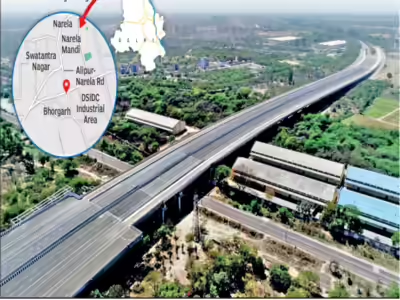
A Flyover-cum-ROB is a grade-separated structure that combines the functional features of a flyover and a Road Over Bridge. While a flyover allows traffic to pass over another road junction, a ROB specifically carries a road over a railway line. When both these requirements coincide—such as a road crossing a busy railway track near an intersection—the structure is designed as a composite facility known as a flyover-cum-ROB.
This integrated approach optimises land use, reduces construction redundancy, and addresses multiple traffic conflicts through a single infrastructure project.
Need for Flyover-cum-ROB Projects
The need for flyover-cum-ROB projects arises from several urban transport challenges:
- Increasing vehicular traffic leading to frequent congestion at railway level crossings
- High accident risk due to road–rail conflict points
- Delays caused by train movement, affecting emergency services and public transport reliability
- Economic losses resulting from fuel wastage and travel time delays
- Urban growth, requiring uninterrupted connectivity across transport corridors
By eliminating level crossings, flyover-cum-ROB structures significantly enhance safety and operational efficiency.
Planning Considerations
Planning a flyover-cum-ROB involves detailed technical and urban considerations:
- Traffic volume studies to assess current and future demand
- Geometric design standards, including vertical clearance over railway tracks and adequate gradients
- Railway coordination, ensuring compliance with railway safety norms and schedules
- Land acquisition and right-of-way management, especially in dense urban areas
- Utility shifting, including water pipelines, sewers, power lines, and telecom infrastructure
- Environmental and social impact assessment, particularly where residential or commercial properties are affected
Effective planning ensures minimal disruption during construction and long-term functional efficiency.
Design and Structural Components
A flyover-cum-ROB typically consists of:
- Approach ramps designed with gradual slopes to accommodate all vehicle types
- Superstructure, often using reinforced concrete or prestressed concrete girders
- Substructure, including piers, abutments, and foundations designed for heavy loads
- Deck slab and wearing course to provide a durable riding surface
- Crash barriers, railings, and lighting for safety and visibility
- Drainage arrangements to prevent water accumulation on the deck
Structural design must account for dynamic loads, seismic forces, and long-term durability.
Construction Methodology
Construction of a flyover-cum-ROB is complex due to proximity to active railway lines and high-traffic roads. Typical construction stages include:
- Site preparation and traffic diversion planning
- Foundation and substructure construction, often using pile foundations
- Erection of girders, sometimes during night blocks approved by railway authorities
- Deck slab casting and finishing works
- Approach road construction and integration with existing network
- Safety installations and final commissioning
Strict safety protocols are followed during construction to protect both workers and ongoing rail operations.
Benefits of Flyover-cum-ROB
The advantages of constructing a flyover-cum-ROB include:
- Improved traffic flow with reduced delays and congestion
- Enhanced road and rail safety by removing level crossings
- Time and fuel savings, contributing to economic efficiency
- Reduced air and noise pollution due to smoother traffic movement
- Support for public transport reliability, especially buses and emergency vehicles
Such structures also contribute to long-term urban mobility planning.
Challenges and Limitations
Despite their benefits, flyover-cum-ROB projects face challenges such as:
- High capital costs and funding constraints
- Construction-phase traffic disruption
- Coordination issues between multiple agencies
- Urban design concerns, including visual impact and pedestrian accessibility
These challenges highlight the need for integrated planning and stakeholder coordination.
Conclusion
The construction of a Flyover-cum-ROB is a strategic solution for managing complex traffic interactions in growing urban areas. By combining the functions of a flyover and a road over bridge, it ensures safer, faster, and more reliable movement for both road and rail users. When planned and executed with technical precision, environmental sensitivity, and institutional coordination, flyover-cum-ROB projects significantly enhance urban mobility and contribute to sustainable transport infrastructure development.
 Track2Training
You must be logged in to post a comment.