
Zaha Hadid (1950โ€“2016) was a Groundbreaking Iraqi-British Architect

Zaha Hadid (1950โ€“2016) was a groundbreaking Iraqi-British architect, known for her bold, futuristic, and often gravity-defying architectural designs. She was the first woman to receive the Pritzker Architecture Prize in 2004โ€”considered the Nobel Prize of architectureโ€”and remains one of the most influential and iconic architects of the 21st century.


Early Life and Education

  • Full Name: Zaha Mohammad Hadid
  • Born: October 31, 1950, Baghdad, Iraq
  • Died: March 31, 2016, Miami, Florida, USA

Zaha Hadid was born into an upper-class family in Baghdad. Her father, Mohammed Hadid, was a liberal politician and industrialist who promoted Western ideals and education, and her mother was an artist. She grew up in a cosmopolitan environment, attended a Catholic school in Baghdad, and later studied mathematics at the American University of Beirut in Lebanon.

In 1972, she moved to London to study architecture at the Architectural Association School of Architecture, one of the most progressive architecture schools at the time. There she studied under visionary architects such as Rem Koolhaas and Elia Zenghelis, who became her mentors.


Career Highlights

Zaha Hadid Architects (ZHA)

In 1980, Hadid founded her own practice, Zaha Hadid Architects, based in London. However, during the early years of her career, she was often labeled a โ€œpaper architectโ€ because many of her designs were considered too radical or complex to be built. Her drawings and paintingsโ€”often abstract and inspired by Russian Constructivismโ€”were celebrated, but few of her designs were realized.

Her big break came in the 1990s and early 2000s when advances in digital technology enabled the construction of her complex, flowing, and sculptural forms.


Architectural Style and Philosophy

Hadidโ€™s work is often described as:

  • Futuristic and avant-garde
  • Deconstructivist, though she resisted being labeled as such
  • Fluid, with curves, sharp angles, and fragmented geometries
  • Inspired by mathematics, nature, and landscape forms

She rejected traditional architectural constraints like symmetry, right angles, and uniformity. Her buildings often appear to float, twist, or ripple.


Major Works

Here are some of her most celebrated architectural achievements:

1. Vitra Fire Station (Weil am Rhein, Germany, 1993)

Her first major built project, made of sharp concrete planes and dramatic angles.

2. MAXXI โ€“ National Museum of the 21st Century Arts (Rome, Italy, 2010)

A striking structure with flowing corridors and dynamic interior spaces. Won the RIBA Stirling Prize.

3. London Aquatics Centre (London, UK, 2011)

Built for the 2012 Olympics, this wave-like structure features a sweeping roof inspired by the fluidity of water.

4. Heydar Aliyev Center (Baku, Azerbaijan, 2012)

A stunning, curved structure that appears to rise and fall like a waveโ€”considered one of her greatest masterpieces.

5. Guangzhou Opera House (Guangzhou, China, 2010)

Inspired by river pebbles, this building is composed of interlocking, organic forms.

6. Galaxy SOHO (Beijing, China, 2012)

A commercial complex with seamless flowing volumes and bridges connecting domed structures.


Awards and Honors

  • Pritzker Architecture Prize (2004) โ€“ first woman to win
  • RIBA Stirling Prize (2010, 2011)
  • Dame Commander of the Order of the British Empire (DBE) (2012)
  • Royal Gold Medal from RIBA (2016) โ€“ first woman to be awarded in her own right
  • Honorary degrees and awards from institutions across the globe

Teaching and Influence

Zaha Hadid was also an academic and educator. She taught at prestigious institutions such as:

  • Harvard Graduate School of Design
  • Yale School of Architecture
  • Columbia University
  • University of Applied Arts, Vienna

Her influence has extended far beyond her own buildings, shaping the next generation of architects and changing how architecture is conceived and constructed.


Legacy

Zaha Hadid passed away suddenly in 2016 at the age of 65 due to a heart attack. Despite her untimely death, her firm, Zaha Hadid Architects, continues to build on her legacy with ongoing projects across the globe.

Her legacy includes:

  • Pioneering work in parametric and digital design
  • Promoting women in architecture
  • Creating a distinctive signature style that broke the mold of modern architecture

Conclusion

Zaha Hadid was more than just an architectโ€”she was a visionary who redefined the boundaries of design. She challenged conventions, opened doors for women in a male-dominated field, and created some of the most iconic buildings of our time. Her work continues to inspire architects, designers, and creatives around the world.
Arithmetic, Geometrical, and Decadal Population Growth methods

Arithmetic, Geometrical, and Decadal Population Growth methods, including formulas and their interpretation. These are widely used techniques in demography and urban planning to estimate or analyze population growth trends.


1. Arithmetic Growth Method

โœ… Definition:

The Arithmetic growth method assumes that the population increases by a constant number of people every year. This method is suitable for short-term projections and when population growth is linear or slow.

โœ… Formula:

Where:

  • PtP_tPtโ€‹ = Projected population at time ttt
  • P0P_0P0โ€‹ = Base year population
  • rrr = Average annual increase in population
  • ttt = Number of years from base year

โœ… How to calculate r:

If data from two known years is available: r=Pnโˆ’P0nr = \frac{P_n – P_0}{n}r=nPnโ€‹โˆ’P0โ€‹โ€‹

Where:

  • PnP_nPnโ€‹ = Population at the end of nnn years
  • P0P_0P0โ€‹ = Initial population
  • nnn = Number of years between the two known populations

โœ… Example:

  • Population in 2000 = 50,000
  • Population in 2010 = 60,000
  • r=(60,000โˆ’50,000)/10=1,000r = (60,000 – 50,000)/10 = 1,000r=(60,000โˆ’50,000)/10=1,000 people/year

So, for 2015: P2015=50,000+(1,000ร—15)=65,000P_{2015} = 50,000 + (1,000 \times 15) = 65,000P2015โ€‹=50,000+(1,000ร—15)=65,000


2. Geometric Growth Method

โœ… Definition:

In the Geometric growth method, the population increases at a constant rate (percentage) every year. Each yearโ€™s increase is compounded on the previous year’s population. It follows exponential growth.

โœ… Formula:

Where:

  • PtP_tPtโ€‹ = Projected population at time ttt
  • P0P_0P0โ€‹ = Base year population
  • rrr = Annual growth rate (expressed as a decimal, e.g., 2% = 0.02)
  • ttt = Number of years

โœ… How to calculate rrr:

r=(PnP0)1nโˆ’1r = \left(\frac{P_n}{P_0}\right)^{\frac{1}{n}} – 1r=(P0โ€‹Pnโ€‹โ€‹)n1โ€‹โˆ’1

Where:

  • PnP_nPnโ€‹ = Population at year nnn
  • P0P_0P0โ€‹ = Population at base year
  • nnn = Number of years

โœ… Example:


3. Decadal Growth Method

โœ… Definition:

The Decadal Growth Method calculates the percentage increase in population over a 10-year (decade) period. Itโ€™s commonly used in census analysis to measure long-term growth trends.

โœ… Formula:

Where:

  • P0P_0P0โ€‹ = Population at the start of the decade
  • PnP_nPnโ€‹ = Population at the end of the decade

โœ… Average Annual Growth Rate:

Annual Growth Rate (%)=Decadal Growth Rate10\text{Annual Growth Rate (\%)} = \frac{\text{Decadal Growth Rate}}{10}Annual Growth Rate (%)=10Decadal Growth Rateโ€‹

Alternatively, Compounded Decadal Growth Rate (CDGR) can also be used: r=

โœ… Example:


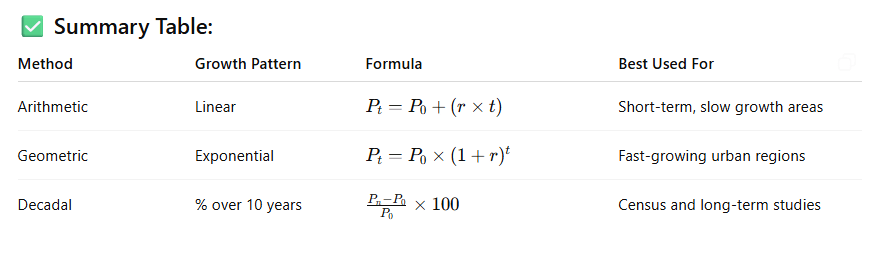
โœ… Summary Table:

MethodGrowth PatternFormulaBest Used For
ArithmeticLinearPt=P0+(rร—t)P_t = P_0 + (r \times t)Ptโ€‹=P0โ€‹+(rร—t)Short-term, slow growth areas
GeometricExponentialPt=P0ร—(1+r)tP_t = P_0 \times (1 + r)^tPtโ€‹=P0โ€‹ร—(1+r)tFast-growing urban regions
Decadal% over 10 yearsPnโˆ’P0P0ร—100\frac{P_n – P_0}{P_0} \times 100P0โ€‹Pnโ€‹โˆ’P0โ€‹โ€‹ร—100Census and long-term studies

โœ… Application in Urban Planning and Demography:

  • Arithmetic: Small towns, rural settlements, or areas with stable growth
  • Geometric: Rapidly urbanizing regions, metropolitan cities
  • Decadal: Used by national census authorities to compare growth between decades

VOSviewer: A Powerful Tool for Literature Review and Bibliometric Analysis

By Shashikant Nishant Sharma

VOSviewer (Visualization of Similarities Viewer) is a widely used software tool for constructing and visualizing bibliometric networks. Developed by Nees Jan van Eck and Ludo Waltman at the Centre for Science and Technology Studies (CWTS) of Leiden University, the Netherlands, VOSviewer plays a crucial role in conducting systematic and in-depth literature reviews by enabling researchers to analyze large volumes of scientific data from databases like Scopus, Web of Science, and Dimensions.


Key Features of VOSviewer

  1. Network Visualization
    • Visualizes bibliometric networks such as:
      • Co-authorship (authors, institutions, countries)
      • Co-citation (authors, sources)
      • Bibliographic coupling
      • Co-occurrence of keywords or terms
  2. Text Mining
    • Extracts important terms from the titles and abstracts of scientific articles.
    • Useful for identifying emerging trends and patterns in specific research fields.
  3. Interactive Visual Maps
    • Nodes (items) represent units like authors or terms.
    • Edges (links) show relationships like citation or co-occurrence.
    • Color, size, and distance indicate clusters, strength of connections, and relevance.
  4. Clustering
    • Groups related items together using clustering algorithms.
    • Helps to understand the structure and thematic areas of the research domain.
  5. Ease of Use
    • Simple interface with support for large-scale data.
    • Export and integration options for further analysis.

Why Use VOSviewer for Literature Review?

Conducting a literature review involves analyzing, synthesizing, and identifying gaps in existing research. VOSviewer enhances this process in the following ways:

1. Mapping Research Trends

  • Identifies frequently occurring keywords and their interrelationships.
  • Detects emerging research topics and how they have evolved over time.

2. Identifying Influential Authors and Journals

  • Through co-citation and bibliographic coupling, VOSviewer highlights leading contributors and key sources in a field.

3. Cluster Analysis for Thematic Categorization

  • Helps categorize literature into coherent themes.
  • Facilitates systematic classification and thematic discussion.

4. Detecting Research Gaps

  • By visually analyzing clusters and isolated nodes, researchers can identify under-researched areas.

5. Efficient and Scalable Analysis

  • Handles large datasets (thousands of articles) quickly.
  • Reduces manual effort in reviewing vast literature.

Steps to Use VOSviewer in Literature Review

  1. Data Collection
    • Export bibliographic data (in RIS, CSV, or BibTeX format) from databases like:
      • Scopus
      • Web of Science
      • Dimensions
      • CrossRef
      • PubMed (indirectly through conversion)
  2. Data Preprocessing
    • Clean and filter data to avoid duplication and irrelevant entries.
    • Use VOSviewerโ€™s thesaurus file to merge similar terms (e.g., “AI” and “Artificial Intelligence”).
  3. Import into VOSviewer
    • Choose the appropriate analysis type (co-authorship, co-occurrence, citation, etc.)
    • Select items and thresholds (e.g., minimum number of occurrences)
  4. Visualization and Interpretation
    • Explore clusters, link strengths, and node proximities.
    • Analyze based on size, color coding (e.g., citation impact, publication year), and linkages.
  5. Reporting
    • Take screenshots or export visualizations.
    • Include maps in your literature review to support your narrative.

Example Use Case: Literature Review on Artificial Intelligence in Education

  • Keywords Co-occurrence Map reveals dominant themes like “machine learning”, “student engagement”, “learning analytics”.
  • Author Co-citation Map identifies leading researchers in the domain.
  • Temporal Analysis (color by year) shows how the field evolved, e.g., shift from adaptive learning to generative AI.

Limitations of VOSviewer

  • Limited to bibliometric and text-based data; cannot assess article quality.
  • Interpretation requires domain knowledge to avoid misrepresentation.
  • Doesn’t support data from Google Scholar due to export limitations.
  • Lacks in-depth statistical tools (needs to be combined with R, Python, or Bibliometrix for advanced analysis).

Integration with Other Tools

  • Can be combined with Bibliometrix (R package) or CiteSpace for deeper bibliometric or citation analysis.
  • Works well alongside NVivo or ATLAS.ti for qualitative review.

Conclusion

VOSviewer is an essential tool for researchers undertaking systematic, scoping, or narrative literature reviews. By enabling visualization of the intellectual structure of a research field, it transforms complex bibliographic data into understandable patterns. Whether mapping keyword trends, identifying top authors, or classifying research themes, VOSviewer adds scientific rigor and clarity to literature reviews.


References

  • Dehalwar, K., & Sharma, S. N. (2023).ย Fundamentals of research writing and uses of research methodologies. Edupedia Publications Pvt Ltd.
  • Sharma, S. N., & Dehalwar, K. (2025). A Systematic Literature Review of Transit-Oriented Development to Assess Its Role in Economic Development of City.ย Transportation in Developing Economies,ย 11(2), 23.
  • Sharma, S. N., & Dehalwar, K. (2024). Review of Evergreen ILS: Highly-Scalable Open Source Library Management Solution.ย Available at SSRN 4853757.
  • Sharma, S. N., & Dehalwar, K. (2025). Assessing the Transit-Oriented Development and Travel Behavior of the Residents in Developing Countries: A Case of Delhi, India.ย Journal of Urban Planning and Development,ย 151(3), 05025018.
  • Sharma, S. N. (2024). Understanding Scientometric Analysis: Applications and Implications.Track2Training
  • Sharma, S. N. (2018). Review of National Urban Policy Framework 2018.ย Think India Journal,ย 21(3), 74-81.
  • Sharma, S. N., Singh, D., & Dehalwar, K. (2024). Surrogate safety analysis-leveraging advanced technologies for safer roads.ย Suranaree Journal of Science and Technology,ย 31(4), 010320.
  • Dehalwar, K., & Sharma, S. N. (2024). Social Injustice Inflicted by Spatial Changes in Vernacular Settings: An Analysis of Published Literature.
  • Van Eck, N. J., & Waltman, L. (2010). Software survey: VOSviewer, a computer program for bibliometric mapping. Scientometrics, 84(2), 523โ€“538. https://doi.org/10.1007/s11192-009-0146-3
  • VOSviewer Official Website: https://www.vosviewer.com/