


By Shashikant Nishant Sharma
The Growth Pole Theory is a concept in urban and regional planning that revolves around the idea that economic development is not uniform across a region but instead concentrates around certain key locations or “poles.” These poles act as catalysts for economic activity, stimulating growth in surrounding areas. The theory was developed in the mid-20th century by the French economist François Perroux, who initially applied it to industrial economics. However, it has since been adapted and applied to urban and regional planning.

Key Concepts of the Growth Pole Theory
- Growth Poles as Economic Catalysts:
- A growth pole is a specific location, such as a city or an industrial area, where economic activity is concentrated. This concentration of economic activities often includes industries, services, infrastructure, and capital, which together drive economic growth in the area.
- The growth pole functions as an engine of development, generating economic momentum that can extend to surrounding areas through the spread of investment, innovation, and employment opportunities.
- Polarization Effects:
- Growth pole theory suggests that economic development is inherently uneven, with some areas (the poles) experiencing rapid growth while others (the periphery) may lag behind.
- Polarization effects refer to the concentration of economic activities and wealth in the growth pole, which can lead to increased regional disparities. The pole attracts resources, talent, and investment, potentially at the expense of less developed areas.
- Spread or Diffusion Effects:
- While growth poles concentrate economic activities, the theory also posits that these poles can generate positive spillover effects, known as spread or diffusion effects.
- These effects occur when the economic benefits of the growth pole, such as increased employment, technological advancements, and infrastructure development, extend to surrounding areas, promoting regional development.
- Development of Industries:
- Growth poles often focus on key industries that drive economic growth. These industries typically have strong forward and backward linkages, meaning they generate demand for products and services from other sectors and stimulate further economic activities.
- For example, an industrial hub might focus on manufacturing, attracting suppliers, and related businesses to the area, which in turn boosts local economies.
- Role of Infrastructure:
- Infrastructure development is a critical component of the growth pole strategy. Investment in transportation, communication, energy, and social infrastructure in and around the growth pole enhances connectivity, reduces transaction costs, and supports economic activities.
- The growth of the pole is often accompanied by significant public and private investment in infrastructure, which helps integrate the pole with surrounding regions.
- Urbanization and Population Concentration:
- Growth poles often lead to urbanization, as people move to these areas in search of employment and better living conditions. This migration results in population concentration in and around the pole, which can drive further economic activities and urban development.
- Over time, the growth pole can evolve into a large urban center, with a diverse economy and a significant population.
- Government and Policy Interventions:
- Governments play a crucial role in implementing the growth pole strategy by identifying potential growth poles and providing the necessary support, such as infrastructure investment, incentives for businesses, and regulatory frameworks.
- Policy interventions are often needed to manage the challenges associated with growth poles, such as regional disparities, environmental impacts, and social inequalities.
Applications and Examples of Growth Pole Theory
- Regional Development in Developing Countries:
- Many developing countries have adopted the growth pole strategy to stimulate regional development and reduce disparities between urban and rural areas. By focusing on specific cities or regions as growth poles, governments aim to create economic hubs that can drive broader national development.
- For example, in India, cities like Bengaluru and Hyderabad have been developed as growth poles in the technology sector, attracting investment and talent, which in turn has spurred economic growth in surrounding regions.
- Industrial Growth Centers:
- The growth pole concept has been applied to the development of industrial growth centers, where specific industries are concentrated. These centers attract related businesses, creating an industrial cluster that drives regional economic growth.
- The Ruhr region in Germany is an example of an industrial growth pole, where the concentration of coal and steel industries historically drove economic development in the area.
- Economic Zones and Clusters:
- Economic zones, such as Special Economic Zones (SEZs) or Free Trade Zones (FTZs), are often developed as growth poles. These zones offer favorable conditions for businesses, such as tax incentives, relaxed regulations, and advanced infrastructure, attracting investment and driving regional economic growth.
- Shenzhen in China is a prominent example of a growth pole developed as a Special Economic Zone, which transformed from a small town into a global manufacturing and innovation hub.
Strengths of the Growth Pole Theory
- Focused Economic Development: By concentrating resources and efforts on specific areas, the growth pole strategy can effectively drive economic development in targeted regions, leading to significant economic gains.
- Promotion of Industrialization: The theory encourages the development of key industries and industrial clusters, which can create economies of scale, innovation, and increased productivity.
- Regional Development: Growth poles can serve as anchors for regional development, helping to reduce disparities between urban and rural areas by spreading economic benefits to surrounding regions.
Criticisms of the Growth Pole Theory
- Regional Disparities: One of the main criticisms of the growth pole theory is that it can exacerbate regional disparities. The concentration of economic activities in specific areas may lead to the neglect of other regions, deepening inequalities.
- Environmental and Social Issues: Rapid urbanization and industrialization around growth poles can lead to environmental degradation, overpopulation, and social challenges such as housing shortages and increased cost of living.
- Dependency on Key Industries: Growth poles that rely heavily on specific industries may become vulnerable to economic downturns in those sectors, leading to economic instability if the industry declines.
Before discussing Perroux theory, one first needs to understand the basic terminology used in the model:
Basic terminologies
Firms: The firm is an organization involved in trading goods and services. For example, Flipkart, Amazon, Walmart, TATA Consultancy, Wipro, etc.
Industry:
The industry is an organization involved in the manufacturing of goods. For Example, the Steel industry, Iron ore industry, coal industry, sugar industry, etc.
Firms or industries can be two types as per Perroux:
- Dominant industry/ Firms
- Dynamic propulsive firm/industry
Dominant industry:
If industry A is dominant over B then the flow of goods or services or both from A to B will be greater than A’s output than B’s output. For example, the iron ore industry or coal industry will be the dominant industry over the steel industry; a larger proportion of the iron ore industry or coal industry will be consumed by the steel industry.
They can dominate the economic environment because of their:
- Negotiating strength
- Nature of operations
- Their innovative skill
- Impression and brand values
Dynamic Propulsive Firms:
If the firm has high degrees of interaction with others with a highly advanced level of technology and expertise. The firms are fast-growing and have advanced in technology and the ability to innovate. For Example, Walmart, Flipkart, and Automobile industries.
Perroux ‘s Growth Pole: As per Perroux, growth poles do not mean geographical areas such as cities, or towns. Growth poles may be single firms or industries or groups of industries. Generally, the growth pole is an economic space where a large number of economic activities happen.
Economic polarization:Division of opposite economic activities and agglomeration of similar types of activities into one location.
External economics:
External economics exist if a change in the output of a particular firm or industry affects the cost of other firms or industries. It can be:
Negative external economy:
The polluting industry costs the other industries. The coal industry is a negative external economy in the sugar industry.
Positive external industry:
The development of one industry helps to grow another industry is called a positive industry. For example, the development of the Robots industry helps to grow many industries, hospitals, etc.
Linkage;Production or services of one industry or firm is linked with other industries or firms. the linkage can be forward or backward linkage.
Forward linkage:
forward linkage of the Steel industry is the automobile and construction industry. The forward linkage of the iron ore and coke industry is the steel industry.
Backward linkage;
The backward linkage of the steel industry is the iron ore and coal industry. The backward linkage of the automobile industry is the steel industry.
Schumpeter’s’ theory.
As per Schumpeter’s theory, innovation and technology development is key to any industry, and they always try to maximize profit through research, innovation, and technological advancement.
Growth pole theory by Perroux:
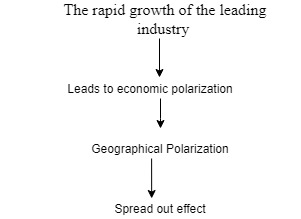
The central idea of the growth pole theory is that economic development or growth does not happen uniformly in the entire region, first, it starts in a specific pole/cluster and then diffusion of this growth happens around the pole.
The place where propulsive or dominant industries are located that region becomes the pole of the region, and due to spread out effect or trickle-down effect development gets spread around the pole. The polarization of economic activities around the pole happened because of external economics.
Limitation of Perroux Growth Pole Theory
- Dynamic propulsive firms are normally found in Capitalist countries.
- Perroux economic polarization was unnecessarily transferred to geographical polarization.
- Geographical polarization generally happens in underdeveloped countries.
Conclusion
The Growth Pole Theory is a powerful tool in urban and regional planning that provides a framework for understanding and promoting economic development. By focusing on specific areas as catalysts for growth, the theory helps planners and policymakers identify strategic locations for investment and development. While the theory has proven effective in driving economic growth and industrialization, it also poses challenges related to regional disparities, environmental sustainability, and social equity. Effective implementation of the growth pole strategy requires careful planning, strong policy support, and a balanced approach to managing the potential negative impacts.
References
Benedek, J., Varvari, Ş., & Litan, C. M. (2019). Urban growth pole policy and regional development: old wine in new bottles?. Regional and Local Development in Times of Polarisation: Re-Thinking Spatial Policies in Europe, 173-195.
Thomas, M. D. (1975). Growth pole theory, technological change, and regional economic growth. Papers in Regional Science, 34(1), 3-25.
Lasuen, J. R. (1969). On growth poles. Urban studies, 6(2), 137-161.
Perroux, F. (2017). The pole of development’s new place in a general theory of economic activity. In Regional economic development (pp. 48-76). Routledge.
Sharma, S. N. (2013). Sustainable development strategies and approaches. International Journal of Engineering and Technical Research (IJETR), 2.

 Track2Training
You must be logged in to post a comment.