


By Shashikant Nishant Sharma
Introduction to Central Place Theory
Central Place Theory (CPT) is a geographical theory developed by German geographer Walter Christaller in 1933. The theory aims to explain the size, number, and distribution of human settlements in a region, focusing on the relationships between cities (central places) and the surrounding rural areas. It is a fundamental concept in urban geography and regional planning, providing insights into how and why urban centers develop in specific locations and how they are organized spatially.
Core Concepts of Central Place Theory
- Central Places: According to Christaller, central places are settlements that provide goods and services to the surrounding population. These places vary in size and function, ranging from small towns offering basic services to large cities with specialized services. The theory categorizes central places based on the range and threshold of the goods and services they provide.
- Range and Threshold:
- Range: The range refers to the maximum distance people are willing to travel to obtain a particular good or service. It depends on the nature of the product; for example, people may travel farther for specialized medical care than for daily groceries.
- Threshold: The threshold is the minimum population required to sustain a particular service or business. If a central place does not have enough people to support a service, that service will not be provided.
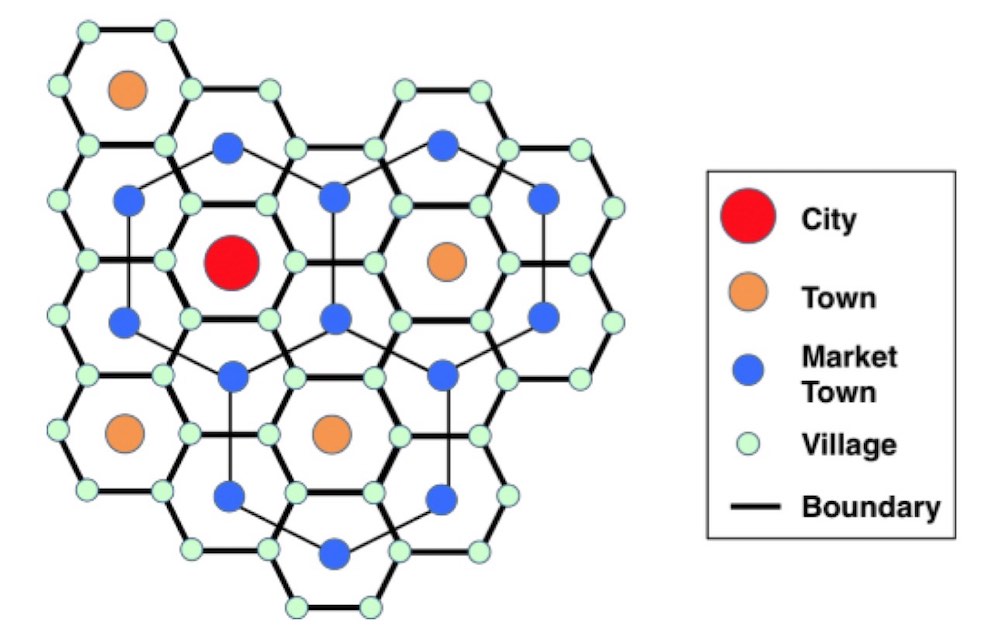
- Hierarchy of Central Places: Central Place Theory proposes a hierarchical structure of settlements, with larger, more specialized cities at the top and smaller, less specialized towns and villages at the bottom. Larger cities serve as regional hubs, offering a wide variety of goods and services, while smaller towns provide only basic necessities. This hierarchy is often represented in a hexagonal pattern, with smaller settlements evenly spaced between larger ones.
- Hexagonal Spatial Pattern: Christaller’s model uses a hexagonal grid to represent the spatial organization of central places. He chose this shape because it efficiently covers space without overlap or gaps, unlike circular patterns. The hexagons represent the market areas of different central places, where each central place serves as the center of a hexagonal region.
- Principles of Central Place Theory: Christaller identified three principles that determine the arrangement of central places:
- Marketing Principle (K=3): Under this principle, each central place serves three surrounding smaller settlements. This results in a hierarchical network where each larger settlement has a greater range and serves as a market center for smaller ones.
- Transportation Principle (K=4): This principle focuses on minimizing transportation costs by organizing central places along transportation routes. In this model, each central place serves four surrounding settlements.
- Administrative Principle (K=7): The administrative principle organizes central places based on political and administrative boundaries, with each central place overseeing seven surrounding settlements.
Applications and Limitations of Central Place Theory

Applications:
- Urban Planning: Central Place Theory is used to plan the location of new towns, shopping centers, and services by understanding the distribution of existing settlements and market areas.
- Regional Development: The theory helps in the analysis of regional development patterns, identifying areas that may be underserved or overpopulated in terms of services and infrastructure.
- Retail Location Analysis: Businesses use the concepts of range and threshold to determine the best locations for new stores or services, ensuring they are accessible to a sufficient customer base.
Limitations:
- Assumptions of Uniformity: Christaller’s model assumes a flat, featureless landscape with uniform transportation costs and evenly distributed populations, which is rarely the case in reality.
- Technological Changes: The theory was developed in the 1930s and does not account for modern transportation and communication advancements, which can alter the dynamics of central place relationships.
- Variability in Consumer Behavior: The model assumes that consumers will always choose the nearest central place for services, but in reality, preferences, brand loyalty, and other factors can influence consumer choices.

Conclusion
Central Place Theory remains a foundational concept in urban and regional geography, despite its limitations. It provides a framework for understanding the spatial organization of settlements and the distribution of services. While modern developments and technologies have modified some of Christaller’s original ideas, the theory’s core principles continue to inform urban planning and regional development practices.
 Track2Training
You must be logged in to post a comment.