Syama Prasad Mookerjee Port, Kolkata (Erstwhile Kolkata Port Trust), under the aegis of the Ministry of Ports, Shipping & Waterways, Government of India, is pleased to invite you to be part of SMPA Mindstorm Quiz, a National-level Quiz, being organized as part of India Maritime Week 2025.
This unique quiz aims to engage young minds and professionals alike in exploring India’s rich maritime heritage, contemporary port operations, and global shipping dynamics. The event seeks to foster awareness and enthusiasm for the maritime sector among students, future leaders, and trade stakeholders.
Prizes Worth ₹6 Lakhs at The Grand Finale with top 10 participants:
• 1st Prize – ₹2.5 Lakh
• 2nd Prize – ₹1.5 Lakh
• 3rd Prize – ₹1 Lakh
• 4th–10th – ₹15,000 each as consolation prizes
Event Details:
• Preliminary Round: Online Quiz on Unstop platform, on 22nd October 2025
• Semi-Final: Online Quiz on Unstop platform for Top 200 participants, on 23rd October 2025
• Grand Finale: An exciting on-stage quiz on 29th October 2025 for Top 10 participants,
Bombay Exhibition Centre, NESCO, Mumbai
The finale will bring together the top 10 finalists from across India at India Maritime Week, 2025, offering a vibrant confluence of maritime knowledge, youthful energy, and industry participation.
We warmly invite students from leading educational institutions, as well as members of the maritime and trade fraternity, to take part in the online quiz rounds. We also encourage you to join us at the Grand Finale and encourage participation from your institutions and professional networks.
Enclosed is a formal invitation letter from the Chairman, SMPA, inviting your institution to participate in this national initiative.
Your presence and support will add immense value to this national initiative celebrating India’s maritime spirit.
The health of terrestrial ecosystems determines the stability of our planet’s climate, food systems, and water cycles. Forests, wetlands, grasslands, and mountains provide the air we breathe, the food we eat, and the resources upon which human civilization depends. The fifteenth Sustainable Development Goal (SDG 15) — Life on Land — seeks to protect, restore, and promote sustainable use of terrestrial ecosystems, sustainably manage forests, combat desertification, and halt and reverse land degradation and biodiversity loss by 2030.
Yet, despite growing awareness, terrestrial ecosystems continue to deteriorate at alarming rates. According to the United Nations Convention to Combat Desertification (UNCCD, 2024), over 75% of the Earth’s land areas are degraded, affecting more than 3 billion people. Deforestation, agricultural expansion, urbanization, and illegal wildlife trade are destroying natural habitats and accelerating biodiversity loss. SDG 15 thus calls for urgent global and local action to safeguard land-based ecosystems — not only for environmental reasons but also for human survival and sustainable development.
Understanding SDG 15
Land ecosystems provide crucial ecosystem services — from carbon sequestration and water purification to soil fertility and climate regulation. Forests, which cover about 31% of Earth’s land area, support more than 80% of terrestrial biodiversity and serve as a major carbon sink. However, unsustainable agricultural practices, industrial expansion, and mining have led to extensive deforestation and land degradation.
Biodiversity — the variety of life on Earth — underpins ecosystem resilience. Its loss threatens food security, health, and livelihoods. SDG 15 integrates the goals of international agreements like the Convention on Biological Diversity (CBD), UNCCD, and the Convention on International Trade in Endangered Species of Wild Fauna and Flora (CITES) to ensure holistic conservation and sustainable land use.
Targets of SDG 15
The United Nations outlines several key targets for SDG 15 to be achieved by 2030:
Ensure the conservation, restoration, and sustainable use of terrestrial and inland freshwater ecosystems and their services.
Promote sustainable management of all types of forests, halt deforestation, restore degraded forests, and substantially increase afforestation and reforestation.
Combat desertification, restore degraded land and soil, and strive for a land-degradation-neutral world.
Ensure the conservation of mountain ecosystems, including their biodiversity, to enhance their capacity to provide essential services.
Take urgent and significant action to reduce the degradation of natural habitats and halt biodiversity loss.
End poaching and trafficking of protected species and address the demand for illegal wildlife products.
Integrate ecosystem and biodiversity values into national and local planning, development processes, and poverty reduction strategies.
Mobilize resources to finance sustainable forest management and support conservation in developing countries.
Enhance global support for halting biodiversity loss through scientific cooperation and technology transfer.
These targets reflect the interdependence between ecological preservation, sustainable development, and human well-being.
Global Progress and Challenges
The world has made some progress in halting deforestation and expanding protected areas. As of 2023, more than 16% of terrestrial areas were designated as protected lands. Efforts such as reforestation campaigns, community forestry, and ecosystem restoration initiatives have gained global attention. The UN Decade on Ecosystem Restoration (2021–2030) aims to restore 350 million hectares of degraded land, creating jobs and combating climate change.
However, progress remains insufficient. The Food and Agriculture Organization (FAO) reports that approximately 10 million hectares of forest are still lost annually, primarily due to agricultural expansion and logging. The Global Assessment Report on Biodiversity (IPBES, 2019) warns that one million species are at risk of extinction, many within decades. Land degradation costs the global economy over $6 trillion per year, reducing agricultural productivity and exacerbating poverty.
Climate change further intensifies these challenges, contributing to droughts, soil erosion, and desertification. Sub-Saharan Africa, South Asia, and Latin America are particularly vulnerable due to reliance on land-based livelihoods. Unsustainable consumption patterns in developed countries also drive resource extraction and deforestation in developing regions.
Strategies for Achieving SDG 15
Sustainable Forest Management Implementing community-based forest management, promoting agroforestry, and enforcing anti-deforestation laws are critical to protecting forests. Certification schemes like the Forest Stewardship Council (FSC) encourage responsible timber production.
Land Restoration and Soil Conservation Rehabilitating degraded lands through reforestation, soil conservation techniques, and sustainable agriculture can restore productivity and ecosystem balance. Initiatives such as The Great Green Wall of Africa aim to restore 100 million hectares of degraded land across the Sahel region.
Combating Desertification Sustainable land management practices, such as crop rotation, conservation tillage, and water harvesting, help combat desertification. Early warning systems for droughts can enhance resilience.
Biodiversity Conservation Expanding and effectively managing protected areas, wildlife corridors, and nature reserves can safeguard species. Integrating biodiversity into urban planning and infrastructure design also helps reduce habitat loss.
Combating Illegal Wildlife Trade Strengthening enforcement of international agreements like CITES, increasing penalties for poaching, and supporting alternative livelihoods for local communities can reduce wildlife trafficking.
Integrating Ecosystem Values into Policy Governments must integrate ecosystem services into national accounts and decision-making. Green accounting and environmental impact assessments (EIAs) ensure that economic development respects ecological limits.
Community and Indigenous Participation Indigenous peoples and local communities are effective stewards of biodiversity. Recognizing their land rights and traditional knowledge is vital for conservation success.
Financing and Global Partnerships Increased investment in conservation and restoration is essential. Mechanisms like REDD+ (Reducing Emissions from Deforestation and Forest Degradation) provide financial incentives for forest protection.
Education and Awareness Environmental education promotes stewardship and behavioral change. Awareness campaigns about biodiversity, waste reduction, and sustainable resource use can mobilize citizens toward conservation.
Case Studies and Best Practices
Costa Rica reversed deforestation through payments for ecosystem services (PES) and strong environmental legislation, doubling its forest cover since the 1980s.
China’s Grain-for-Green Program has restored over 25 million hectares of degraded land by converting farmlands back to forests.
Kenya’s Community Forest Associations empower local people to co-manage forests, balancing livelihoods and conservation.
India’s Green India Mission aims to increase forest cover and enhance ecosystem services as part of its climate strategy.
The Way Forward
Achieving SDG 15 requires integrating ecosystem protection into all aspects of development — from agriculture and infrastructure to education and finance. Governments must strengthen land-use planning, enforce anti-deforestation laws, and invest in ecosystem restoration. Global cooperation and financing are crucial to support developing nations in implementing sustainable land management.
Private sectors should adopt nature-positive business models, ensuring supply chains do not contribute to deforestation or habitat destruction. Individual actions, such as responsible consumption, tree planting, and advocacy, also play a role in restoring the planet’s ecological balance.
Conclusion
SDG 15: Life on Land represents humanity’s duty to live in harmony with nature. Healthy terrestrial ecosystems are the foundation of life — sustaining biodiversity, regulating climate, and supporting livelihoods. Yet, human activity continues to push planetary boundaries. Achieving SDG 15 requires a transformative shift from exploitation to restoration, from degradation to regeneration.
Protecting and restoring land is not only an environmental goal but a moral and economic imperative. It is the key to ensuring food security, climate stability, and sustainable prosperity for future generations. The message of SDG 15 is clear: by protecting life on land, we secure the future of all life on Earth.
Urbanization is one of the most transformative trends of the 21st century. More than half of the world’s population now lives in cities, and by 2050, this number is projected to rise to nearly 70%. Cities are engines of economic growth, innovation, and cultural exchange — but they are also epicenters of inequality, congestion, pollution, and vulnerability to climate change. Recognizing these challenges, the eleventh Sustainable Development Goal (SDG 11) — Sustainable Cities and Communities — aims to make cities and human settlements inclusive, safe, resilient, and sustainable by 2030.
Sustainable urban development lies at the intersection of social inclusion, environmental responsibility, and economic vitality. SDG 11 acknowledges that how we design, govern, and inhabit cities will determine the future of humanity and the planet. It calls for rethinking urban planning, infrastructure, and housing to create cities that are livable for all — not just for the privileged few.
Understanding SDG 11
Cities are complex systems where people, resources, and institutions interact dynamically. They generate over 80% of global GDP, but they also consume two-thirds of the world’s energy and produce 70% of carbon emissions (UN-Habitat, 2023). The rapid pace of urban growth, especially in developing countries, has led to challenges such as inadequate housing, poor transport infrastructure, slums, and unplanned expansion.
SDG 11 recognizes that urbanization can be a positive force if it is well-managed and inclusive. Sustainable cities should provide access to basic services, housing, transportation, green spaces, and cultural amenities while maintaining environmental sustainability and resilience to disasters.
Targets of SDG 11
The United Nations has outlined several key targets for SDG 11 to guide global action:
Ensure access for all to adequate, safe, and affordable housing and basic services, and upgrade slums.
Provide access to safe, affordable, accessible, and sustainable transport systems for all, improving road safety and expanding public transit.
Enhance inclusive and sustainable urbanization through participatory and integrated planning and management.
Strengthen efforts to protect and safeguard the world’s cultural and natural heritage.
Reduce the number of deaths and economic losses caused by disasters, including those related to water and climate.
Reduce the adverse per capita environmental impact of cities, including air pollution and waste management.
Provide universal access to safe, inclusive, and accessible green and public spaces, particularly for women, children, older persons, and persons with disabilities.
Support positive economic, social, and environmental links between urban, peri-urban, and rural areas.
Substantially increase the number of cities adopting and implementing integrated policies toward inclusion, resource efficiency, and resilience.
Support least developed countries in building sustainable and resilient buildings using local materials.
These targets highlight the holistic nature of urban sustainability — encompassing housing, mobility, environment, resilience, and governance.
Global Progress and Challenges
Significant progress has been made in recent decades toward improving living conditions in urban areas. Between 2000 and 2020, the proportion of the global urban population living in slums declined from 28% to 23%, largely due to housing and infrastructure initiatives in Asia and Latin America. Many cities have invested in public transportation, green infrastructure, and waste management systems.
However, challenges remain daunting. Over 1 billion people still live in informal settlements without access to safe water, sanitation, or secure tenure. Rapid and unplanned urban growth continues to strain infrastructure, leading to congestion, pollution, and inequality. The COVID-19 pandemic further revealed urban vulnerabilities — overcrowded housing, unequal access to healthcare, and inadequate public spaces exacerbated risks for low-income populations.
Moreover, cities are on the frontlines of climate change. Rising temperatures, flooding, and extreme weather events threaten lives, livelihoods, and infrastructure. Urban areas must therefore adapt by adopting climate-resilient planning, reducing emissions, and enhancing green cover.
Strategies for Achieving SDG 11
Inclusive Urban Planning and Governance Participatory planning that engages citizens, especially marginalized groups, ensures that urban development reflects diverse needs. Decentralized governance and community-led housing programs can improve accountability and inclusiveness.
Affordable Housing and Slum Upgrading Governments must invest in affordable housing and upgrade informal settlements by improving sanitation, access to services, and secure land tenure. Partnerships with NGOs, private developers, and residents can make these efforts more effective.
Sustainable Mobility and Public Transport Expanding affordable and efficient public transport systems reduces congestion, pollution, and inequity. Non-motorized transport infrastructure — such as cycling lanes and pedestrian pathways — promotes health and sustainability.
Green and Resilient Infrastructure Urban resilience depends on climate-adaptive infrastructure such as green roofs, rainwater harvesting systems, and permeable pavements. Integrating nature-based solutions helps cities manage floods, improve air quality, and enhance biodiversity.
Waste Management and Circular Economy Cities must transition from linear to circular economies by promoting recycling, waste segregation, and resource recovery. Waste-to-energy technologies can reduce landfill use and provide clean energy.
Cultural Heritage and Public Spaces Preserving cultural sites strengthens community identity and tourism potential. Equitable access to parks, plazas, and recreational areas improves mental and physical well-being, fostering social inclusion.
Reducing Urban Inequality Policies should address unequal access to services, employment, and housing. Urban development must prioritize the poor, women, and persons with disabilities, ensuring equitable benefits from growth.
Smart Cities and Innovation Digital technologies can enhance urban management through real-time monitoring of traffic, energy, and waste. Smart city initiatives can improve efficiency, transparency, and sustainability if implemented inclusively.
Disaster Preparedness and Climate Resilience Building codes, risk mapping, and early warning systems are critical for reducing disaster risks. Integrating resilience planning into urban policy safeguards both lives and investments.
Case Studies and Best Practices
Curitiba, Brazil is celebrated for its innovative urban planning, prioritizing public transport, green spaces, and recycling.
Singapore demonstrates how integrated water management, vertical greenery, and efficient governance can make a city both livable and sustainable.
Copenhagen, Denmark aims to be carbon neutral by 2025 through energy-efficient buildings, cycling infrastructure, and renewable energy use.
Ahmedabad, India has successfully implemented slum redevelopment programs and heat action plans to protect vulnerable populations from extreme heat.
The Way Forward
Achieving SDG 11 requires a paradigm shift in how cities are planned and managed. Urban development must balance growth with sustainability, inclusion, and resilience. Governments should integrate SDG 11 into national urban policies and foster collaboration between public agencies, civil society, and the private sector.
Investment in sustainable infrastructure — housing, water, transport, and digital connectivity — is key to improving the quality of urban life. Equally important is empowering local communities to participate in decision-making and ensuring that urban development benefits all residents, not just elites.
Conclusion
SDG 11: Sustainable Cities and Communities envisions cities that are equitable, green, and resilient — places where people of all backgrounds can thrive in safety and dignity. Sustainable urbanization is not merely about infrastructure; it is about inclusiveness, justice, and environmental harmony.
As urban populations continue to grow, cities must become the driving force for sustainable development rather than sources of inequality and pollution. Achieving SDG 11 will define the future of humanity — building cities that serve as models of sustainability, innovation, and shared prosperity for generations to come.
The second Sustainable Development Goal (SDG 2) — Zero Hunger — aims to end hunger, achieve food security, improve nutrition, and promote sustainable agriculture by 2030. Despite advancements in agricultural technology and food production, hunger and malnutrition continue to affect hundreds of millions of people worldwide. According to the United Nations Food and Agriculture Organization (FAO), over 735 million people faced chronic hunger in 2023. The persistence of hunger is not merely a result of food scarcity, but of inequality, poverty, conflict, and unsustainable agricultural practices. SDG 2 recognizes that ending hunger requires transforming global food systems to ensure that everyone, everywhere, has access to sufficient, safe, and nutritious food all year round.
Understanding Hunger and Food Insecurity
Hunger is defined as the condition in which a person is unable to consume enough calories to maintain a normal, active, and healthy life. However, hunger is only one aspect of food insecurity. Food insecurity occurs when people lack reliable access to affordable, nutritious food. It is influenced by factors such as poverty, inflation, conflicts, climate change, and weak agricultural infrastructure.
Malnutrition—another critical component of SDG 2—refers to deficiencies, excesses, or imbalances in a person’s intake of nutrients. Malnutrition manifests in various forms, including undernutrition, micronutrient deficiencies, and obesity. Alarmingly, these conditions can coexist within the same population, household, or even individual.
The world currently faces a “triple burden of malnutrition”—hunger, nutrient deficiencies, and rising obesity rates—driven by unhealthy diets and inequitable food systems.
Targets of SDG 2
SDG 2 encompasses several interconnected targets that guide global action toward ending hunger and achieving food security:
End hunger and ensure access to safe, nutritious, and sufficient food for all people, particularly the poor and vulnerable, including infants, throughout the year.
End all forms of malnutrition by 2025, including achieving internationally agreed targets on stunting and wasting in children under five years of age, and address the nutritional needs of adolescent girls, pregnant and lactating women, and older persons.
Double the agricultural productivity and incomes of small-scale food producers, particularly women, indigenous peoples, family farmers, and fishers, through secure access to land, resources, and technology.
Ensure sustainable food production systems and implement resilient agricultural practices that increase productivity, maintain ecosystems, and adapt to climate change.
Maintain the genetic diversity of seeds, cultivated plants, and domesticated animals, and promote fair and equitable sharing of the benefits from their use.
Increase investment in rural infrastructure, agricultural research, and technology development to enhance productivity and reduce hunger.
These targets collectively aim to create a food system that is inclusive, sustainable, and resilient to crises.
Global Progress and Emerging Challenges
Over the past few decades, the world has made considerable progress in reducing hunger, largely due to improvements in agricultural productivity and economic growth. However, the pace of progress has slowed—and even reversed in some regions.
The COVID-19 pandemic, climate change, armed conflicts, and economic instability have intensified food insecurity worldwide. For example, disruptions in global supply chains and rising food prices have pushed millions into hunger. Additionally, prolonged droughts, floods, and other climate-related disasters have affected crop yields, livestock, and fisheries, particularly in developing countries that depend heavily on agriculture for livelihoods.
The FAO’s 2023 report warns that without transformative action, the world will fall far short of achieving Zero Hunger by 2030. Sub-Saharan Africa and South Asia remain the regions most affected by chronic food insecurity and malnutrition.
Strategies for Achieving Zero Hunger
Sustainable Agriculture and Food Systems Transitioning to sustainable agricultural practices is essential to ensure food security without depleting natural resources. Agroecology, crop diversification, organic farming, and precision agriculture can improve soil health, water efficiency, and biodiversity while maintaining high productivity.
Empowering Smallholder Farmers Small-scale farmers produce nearly one-third of the world’s food, yet many live in poverty. Providing access to land, markets, finance, and agricultural technology can boost productivity and income. Women farmers, who constitute a large share of agricultural workers, should be given equal rights and opportunities.
Nutrition-Sensitive Policies Governments and institutions should integrate nutrition goals into agricultural and health policies. This includes fortifying foods with essential micronutrients, promoting breastfeeding, and encouraging diverse diets that include fruits, vegetables, and proteins.
Reducing Food Waste and Loss Approximately one-third of all food produced globally is wasted each year. Reducing food waste through better storage, transport, and consumer awareness can significantly enhance food availability and environmental sustainability.
Resilience to Climate Change Climate-smart agriculture (CSA) offers strategies to help farmers adapt to changing weather patterns. Investments in research, early warning systems, and water management can strengthen resilience to droughts and floods.
Global Partnerships and Investments Achieving Zero Hunger requires international cooperation. Partnerships among governments, international organizations, private sectors, and civil society are crucial to mobilize resources, share technology, and implement effective policies.
Case Studies and Best Practices
Countries like Brazil and Ethiopia have demonstrated that well-designed public policies can drastically reduce hunger. Brazil’s “Fome Zero” (Zero Hunger) program combined social protection, school feeding, and support for smallholder farmers, reducing hunger and poverty levels significantly. Similarly, Ethiopia’s Productive Safety Net Programme (PSNP) has helped rural households build resilience to food insecurity through public works and livelihood support.
The Way Forward
To realize the vision of SDG 2 by 2030, global food systems must undergo a fundamental transformation—one that prioritizes equity, sustainability, and human well-being over profit and exploitation. Governments must integrate food security into national policies, while private sectors can play a role in sustainable food production, value-chain transparency, and reducing waste.
Moreover, education and awareness are vital. Citizens must understand the environmental and social impact of their food choices and advocate for sustainable consumption patterns.
Conclusion
The goal of Zero Hunger represents humanity’s collective commitment to ensuring that no one goes to bed hungry. Ending hunger is not only about producing more food but ensuring fair access, nutritious diets, and resilient food systems. It calls for coordinated global action—combining science, policy, innovation, and compassion.
As the 2030 deadline approaches, achieving SDG 2 remains both a challenge and an opportunity: a challenge to address the structural roots of hunger and inequality, and an opportunity to build a more just, sustainable, and nourished world for all.
Migration is the movement of individuals from their regular abode to another, with a temporary or permanent relocation in a place of abode. A key demographic process with immense consequences for societies across the world, migration occurs in several forms, with the main ones being internal migration, whereby individuals relocate within a nation, and international migration, whereby individuals cross international borders. Internal migration can take the form of rural-urban migration and interstate relocation, while international migration can be prompted by economic ambition, flight from hostilities, reunification with family, or environmental stress.
It is crucial to understand migration since it defines economic frameworks, social formations, political processes, and environmental regimes. It also affects labour markets, cultural interchanges, urbanization processes, demographic alignments, and policymaking processes. The report extends to deliver a detailed analysis on causes and multi-dimensional effects of human movement, with relevant country and worldwide illustrations. The main goals are to study the process of migration in a detailed manner and to showcase its economic-social and political effects.
Understanding Migration
It is a complex process with several major ideas:
Emigration is the act of leaving one’s country or place of origin.
Immigration is the act of settling into a new territory to live.
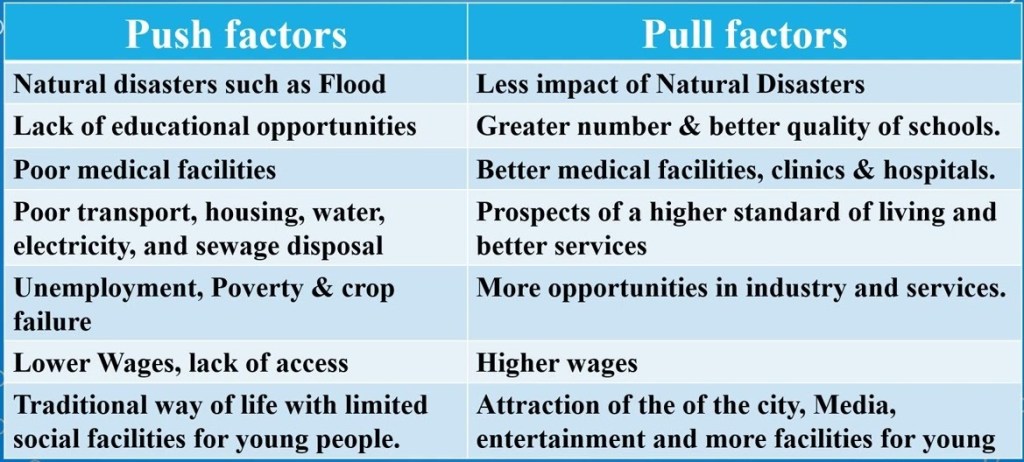
Push–Pull Theory asserts that migrants are attracted by positive factors such as work, security, or schooling, and pushed by adverse factors such as poverty, joblessness, or war.
The migration flows have specific patterns:
Rural-urban movement is prevalent in developing nations, led primarily by industrialization and economic growth in urban areas.
South-North migration, or migration from less prosperous developing countries to higher income developed countries, is extensive globally.
Seasonal and circular migrants are frequent workers in construction and agriculture.
It is deeply linked with globalization, which has developed inter-connected economies and societies; conflict and persecution are still powerful motivators; and the new challenge posed by climate change is ever more rendering environments inhospitable, compelling millions to move.
Causes Of Migration
Economic Causes
Economic impulses are prime motivators for migrants. A majority migrate in search of jobs to get away from unemployment, poverty, and underemployment in rural or economically stagnant areas. Significant interregional or international wage gaps are excellent motivators for migrants. In India, for example, vast rural poverty and farm modernization have reduced labor requirements, compelling many migrants to urban centres like Mumbai, Delhi, and Bengaluru, where industrial and service sectors have higher-wage opportunities. Urban industrialization, higher incomes, and increased occupational selection are the attractors. Remittances back home also significantly raise rural incomes, also highlighting economic imperatives to migrate.
Social Causes
Social motivations comprise improved education and health care, family reunification, as well as marriage. Cities have schools, higher-order medical facilities, and enhanced infrastructure that draw families and the young with ambitions for mobility. Improved telecommunication technologies have enabled migrants to sustain contact across distance, making social migration possible. In India, women mostly migrate for marriage, while men move mostly for work reasons, indicating gendered social motivations. Migration is also a consequence of a desire for a higher standard of living, social liberation, and enhanced personal security.
Political Reasons
Political unrest, violent conflicts, and persecution are main push factors. Wars such as the Syrian civil war, ethnic conflicts, and authoritarian repression have led millions to become refugees or asylum seekers. Political reasons leading to forced migration typically conclude in humanitarian crises, with displaced persons fleeing for asylum in proximal or distant countries. Geopolitical tensions and stringent immigration policies also spill into migration. Political refugees experience long displacement with challenging assimilation into receiving states.
Environmental Causes
Man-made and natural environmental changes like droughts, floods, cyclones, and long-term consequences of climate change like desertification and rising ocean levels have become significant migration forces. Coastal villages in Bangladesh, for example, are threatened with rising ocean levels rendering territories impassable, while drought in Africa and southern Asia has devastated farming communities, prompting migration. Environmental degradation often fosters economic frailties, creating compounding push forces. Migration is either seasonal or definitive based on the recovery potential. This side of migration is bound to escalate with climate change gathering steam.
Technological and Global Considerations
Technological advances in transport and communication make migration easier by cutting costs and risks. Greater mobility across the globe by air transport and road network, and the potential to sustain social networks across distance by internet and cellular phones, make migrating easier. Global labour markets are more linked together, with institutional and informal avenues assisting individuals to acquire work overseas. Social media also influence individuals’ aspirations and preferences, and inform migration flows more and more.
Effects of Migration
Economic Impacts
Economic consequences of migration are inconclusive:
Benefits for origin regions: Reduced surplus labour, reduced unemployment, inflows of remittances augment family incomes, education budgets, and domestic investment. Returing migrants will usually bring enhanced skills and new technologies.
Negative for origin jurisdictions: Brain drain or loss of skilled workers harms long-run potential and human capital, particularly in education and health facilities.
Beneficial to destination regions: Immigrants fill key gaps in labour, support aging societies, activate goods and services, provide tax revenues, and boost economic growth.
Negative for destination locations: Resource and service pressure (shelter, health facilities, schools), job competition above all in the low-skill segments, and exploitive or informal working arrangements are possible consequences.
Social Implications
Migrants bring with them cultural diversity, adding destination societies with new languages, cuisine, religions, and customs. Cultural diversity can promote tolerance and world awareness, and migrants can enjoy enhanced accessibility to higher-quality social services. Social problems can also be generated, such as social exclusion, discrimination, xenophobia, and cultural disputes. Migrants can experience identity crises or alienation, and rapid changes can also put pressure on social cohesion as well. Out-migration in the source regions can also change family structures and impose a greater social burden on staying family members, also primarily women.
Demographic Implications
It alters demographic outlines significantly. Urban centres bulge, at times, more than infrastructure can sustainably support. Rural areas are common with aging populations, as a consequence of their children moving away, slowing economic vigor and distorting dependency rates. Gender disparities can also result, in cases where migration is differential by sex. They have effects on electoral politics, resource distributions, and social planning at the region and national levels.
Abiotic Impacts
It contributes to a shortage of houses and more slums, increased pollution, sanitary problems with waste, water shortages, and green spaces degradation. Expansion due to migration frequently occurs without sufficient planning for cities, therefore putting stress on the environment. In contrast, depopulation in non-urban areas can leave room for natural regeneration while also lessening maintenance and care for farmed land, contributing further to degradation. Impacts on the environment are significantly dependent on both scale of migration and policy effectiveness.
Political and Policy Implications
Migration requires holistic policy responses with a focus on border control, integration, labour rights, and humanitarian protection. Recipient countries are torn between social cohesion and migrants’ inclusion. Global cooperation is critical for refugee protection and governing labour migration. Incompetent handling of migration in a balanced manner can lead to a risk of a nationalist backslash, social tensions, and a humanitarian disaster. Policies must focus on migrants’ rights, sustainable urbanisation, and climate resilience.
Case Studies / Examples
Internal Migration in India
India’s fast-paced rural-urban migration is a prime example of modern demographic transition. Approximately 30 million individuals migrate every year from rural interior districts to urban metropolises in response to economic emergencies and improved employments opportunities. Cities such as Mumbai, Delhi, and Bengaluru have witnessed infrastructure failure, widespread-slum expansion, and growing requirements for water supply and sanitation facilities. Migrants provide crucial labour force in construction, service, and manufacturing activities. Female migrants, under-represented and under-documented, experience problems such as under-employment and exposure to risk but also achieve new levels of autonomy. Policy measures have been responses such as affordable habitation schemes and urban renewal programs, though problems linger.
Syrian Refugee Crisis
Since 2011, Syria’s civil conflict ignited one of history’s biggest forced migrations. More than six million Syrians were made refugees in states within close proximity and far away, with millions internally displaced. The migration has had colossal humanitarian, political, and social effects on hosting states such as Turkey, Lebanon, and Germany. Barriers to assimilation are faced by refugees, and hosting states are exposed to tensions in accommodation, schooling, and health infrastructure. Depopulation and brain drainage afflict areas in Syria. Global responses are relief, resettlement, and rule-of-law regimes based on refugee protection, but the crisis is not solved.
Conclusion
It is a multifaceted and multidimensional process that is even driven by changing economic, social, political, and environmental forces. Even its outcomes reflect both opportunities — economic expansion, cultural diversity, and skill upgrading — and challenges — social friction, environmental pressure, and policy problems.
By dealing with migration, balanced territorial development, inclusive integration policies, migrants’ rights protection, and climate adaptation are key. Seeing migration as a dynamic force that shapes human geography offers key knowledge for sustainable development in a growingly interdependent world.
References
Black, R., Biao, X., Collyer, M., Engbersen, G., Heering, L., & Markova, E. (2006). Migration and development: Causes and consequences. The Dynamics of International Migration and Settlement in Europe, 41, 41-63.
Afsar, R. (1994). Internal migration and women: An insight into causes, consequences and policy implications. The Bangladesh Development Studies, 22(2/3), 217-243.
Ritchey, P. N. (1976). Explanations of migration. Annual review of sociology, 2, 363-404.
Drishti IAS. (2025).
Reasons and effects of. UN DESA. (2023).
World Migration Report. International Organization for Migration.
Government of India.
National Sample Survey: Patterns of Migration.
UNHCR. 2025. Reports on Syria Refugee. European Parliament. (2024).
Exploring Migration Causes. Internet Geography. 2022.

 Prizes Worth ₹6 Lakhs at The Grand Finale with top 10 participants:
 Event Details:
 Bombay Exhibition Centre, NESCO, Mumbai
 Registration: https://unstop.com/p/smpa-mindstorm-quiz-kolkata-port-trust-1574697


 Track2Training
You must be logged in to post a comment.