
SEVEN INTERESTING FACTS ABOUT SPACE

1.In 3.75 billion years, the Milky Way and Andromeda galaxies will collide.

The Andromeda Galaxy is approaching the Milky Way- where our solar system is at a rate of around 110 kilometers per second (68 mi/s) and, the two will collide to form a giant elliptical galaxy.

Milky way
Milky way

2.Andromeda is probably the most massive galaxy in the Local Group.

There are around 1 trillion stars in the Andromeda galaxy, compared with the Milky Way, which has 200-400 billion.
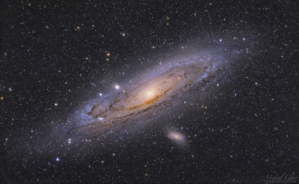
Andromeda galaxy
Andromeda galaxy

3.If two pieces of the same type of metal touch in space, they will permanently bond.

This incredible fact is also known as cold welding, and it happens because the atoms of two pieces of metal have no way of knowing they are separate. It doesn’t happen on Earth because of the air and water found between the pieces.

Fusion of metal on space

4.The Moon was once a piece of Earth.

The theory is that when Earth was a relatively young planet, was struck by a giant object, and this collision broke a piece of the Earth away to create the moon. This piece then began to orbit the Earth as a result of its gravitational pull.

Earth and Moon
Earth and Moon

5.Space is completely silent.

Sound waves need a medium to travel through. Since there is no atmosphere in the vacuum of space, the realm between stars will always be eerily silent. Astronauts use radio waves to communicate.

Space
Space

6.The Apollo astronauts’ footprints on the moon will probably stay there for at least 100 million years.

Since the moon doesn’t have an atmosphere, there’s no wind or water to erode or wash away the Apollo astronauts’ mark on the moon. That means their footprints, overprints, spaceship prints, and discarded materials will stay preserved on the moon for a very long time. Erosion is still happening on the moon, just very slowly.

Astronaut in Moon
Astronaut in Moon

7.Some planets have no surface to land on.

There are four gas giants in our solar system — Jupiter, Saturn, Uranus, Neptune — where it wouldn’t be possible to land on. Although different in composition, a gas giant is usually made out of hydrogen and helium and has a small rocky center.

Jupiter
Jupiter

Ganymede – Largest Moon in Solar System

Jupiter has 79 moons, 53 named and 26 unnamed, still waiting for their official name. Among them is a moon named Ganymede, is the largest satellite in our Solar System. It has it’s own magnetic field. It has a diameter of 5,268 km which is larger than Mercury and Pluto, and slightly smaller than Mars. It would be easily classified as a planet if it were orbiting around the sun rather than jupiter.  It is the ninth-largest object in the Solar System. It orbits around the Jupiter at a distance of 1070400 km.

Ganymede was discovered by Galileo Galilei on January 7, 1610. The discovery, along with three other Jovian moons, was the first time a moon was discovered orbiting a planet other than Earth. Galileo called this moon Jupiter III. Its name was abandoned in mid-1800s and a new name was given as suggested by astronomer Simon Marius, after the mythological Ganymede, a Trojan prince desired by Zeus (the Greek counterpart of Jupiter), who carried him off to be the cupbearer of the gods.

Several spacecraft have flown by Jupiter and its moons. The first spacecraft explored Ganymede was Pioneer 10 in 1973 followed by Pioneer 11 in 1974. Voyager 1 and Voyager 2 returned striking photos during their flybys. The Galileo spacecraft passed as low as 162 miles (261 km) over the surfaces of the Galilean moons and produced detailed images and discovered Ganymede’s underground ocean and magnetic field.

The next planned mission to the Jovian system is the European Space Agency’s Jupiter Icy Moon Explorer (JUICE), due to launch in 2022 for arrival at Jupiter in 2030. While the mission will look at Ganymede, Callisto and Europa. Ganymede will be the focus and scientists will try to figure out more about its ocean and icy crust, map its surface in detail, learn about the interior, probe the atmosphere and study the magnetic field.

In February 2014, NASA and the United States Geological Survey unveiled the first detailed map of Ganymede in images and a video animation created using observations from NASA’s Voyager 1 and Voyager 2 spacecraft, as well as the dedicated Jupiter-orbiting Galileo spacecraft.

Ganymede has three main layers. A sphere of metallic iron at the center (the core, which generates a magnetic field) above which is a spherical shell of rock (mantle) and then the spherical shell of mostly ice surrounding the rock shell and the core. According to scientists the ice shell on the outside is very thick, maybe 800 km (497 miles) thick. The surface is the very top of the ice shell. Though it is mostly ice, the ice shell might contain some rock mixed in. Scientists believe there must be a fair amount of rock in the ice near the surface. Ganymede’s magnetic field is embedded inside Jupiter’s massive magnetosphere.


40 percent of the surface of Ganymede is covered by highly dark cratered dark regions and the remaining 60 percent is covered by a light grooved terrain, which forms intricate patterns across Ganymede. The grooved terrain is probably formed by tensional faulting or the release of water from beneath the surface. Groove ridges as high as 700m and runs for thousands of kilometres across Ganymede’s surface. The grooves have relatively few craters and probably developed at the expense of the darker crust. The dark regions on Ganymede are old and rough and the dark cratered terrain is believed to be the original crust of the satellite. Lighter regions are young and smooth.The largest area on Ganymede is called Galileo Region.

Scientists believe that Ganymede has a saltwater ocean below its surface. In 2015, a study by the Hubble Space Telescope looked at Ganymede’s auroras and how they change between Ganymede’s and Jupiter’s magnetic fields. The “rocking” seen by the auroras gives evidence that the probable ocean underneath is salty, more salty than oceans of Earth, scientists said at the time.

Some scientists believe that life may start in Ganymede. However there is so high pressure at the base of the ocean that any water down there would turn to ice. This would make it difficult for any hot-water vents to bring nutrients into the ocean. Because of which scientists believe extraterrestrial life would occur. This would be so fascinating to know about extraterrestrial life if it would exist in our own Solar System.