
Introduction:
Electrical Cables are the cables which are used in Electrical power systems for transmission and distribution of electric power and for many other purposes. Insulated Cables are the type of cables which are insulated with help of different type of materials, but what is a cable? A cable can be a single thick conductor wire which is called as Single Strand Cable or a thick wire made up by using multiple strands of seperate thin wire which is called as Multiple Strand Wire or Cable, where the material of these wires are metals like Copper, aluminium or steel or of mixed materials like ACSR (Aluminium Conductor Steel Reinforced Cable). Similarly, insulation on cable can also be made up of various types of materials like rubber, PVC (poly vinyl chloride), etc.
These insulated cables are used for transferring from electrical power from one electrical/electronic device to another electrical/electronic device or we can say that these insulated cables connect various circuits with each other in the power system. These cables connect source of generation of electricity with the various loads present.
The transmission or distribution of electrical power is done by help of either overhead cables or underground cables. Usually, most of the transmission and distribution is done by overhead cables but places which are highly populated, the electrical distribution in such places is done by using underground cables.
General Construction of cables:
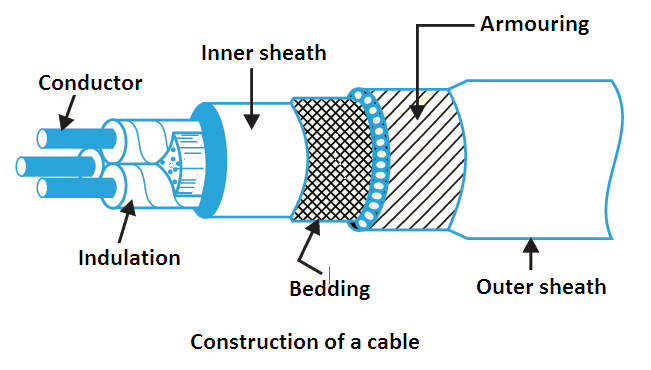
- Conductor: The conductor present may be single conductor or more than one conductors. The conductors are stranded in order to provide flexibility to the cable. Some examples of the material of the conductor are ACSR (Aluminium Conductor Steel Reinforced), Cadmium Copper Conductor, Steel Cored Copper Conductor, etc.
- Insulation: Each conductor is covered with proper insulation of right thickness. The insulating materials commonly used are impregnated paper, vulcanized bitumen, varnished cambric, etc.
- Inner Sheath: It is also called as lead sheath or metallic sheath. As the sheath used is usually used is made up of aluminium or lead. This provide mechanical strength and restricts the interaction of insulation with moisture or any other reactive gas.
- Bedding: It consist of paper tape compounded with fibrous material like jute strands. its purpose is to restrict moisture and protect metallic sheath from corrosion. It also protect sheath from mechanical injury.
- Armouring: This is made up of layers of galvanized steel which provides mechanical strength and prevents mechanical damage.
- Outer Sheath or Serving: This the last layer of the cable. It is layer made up of fibrous material like jute clothing, its main purpose is to protect the wire from the atmospheric conditions.
Different Types of Cables:
There are many different types of Electrical cables which each serve a different purpose, Some of these cables are:
Low Tension Cable: These cables are used for voltage levels upto 6.6kV. Paper is used as insulatuion in these type of cables. Over this paper insulation another insulation of impregnated paper is provided after that lead sheath, bedding, aromouring and serving are provided.

Medium and High Tension Cable: These are Three core cables i.e. multi core cables and are used for voltage leel upto 66kV. It is of two types, belted cables and screened type cables. The screened type cables are further divided into H-type Cables and S-L (Seperate Lead) type Cables.
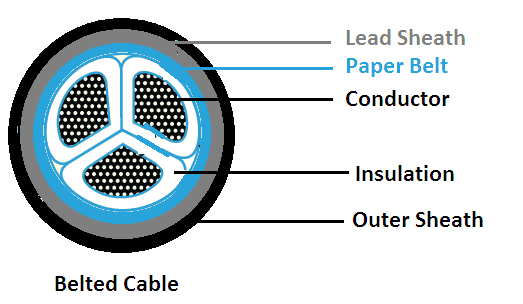
Belted cables: These cables are used for voltage level up to 11kV. The cores are not circular in shape and insulation present is of impregnated paper and these cores are belted together with help of paper belt. Gaps are filled with fibrous material like jute and then it is covered with sheath and other things.
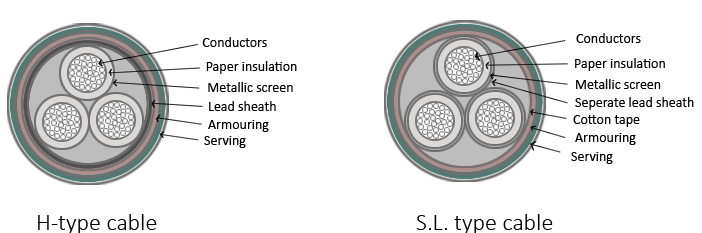
Screened type cables: These cables are used for voltage levels upto 22kV – 33kV In H-type cable there is no paper belt used and each conductor is insulated with paper covered with metallic screen of aluminium foil. In Sl- type, each core is first insulated with impregnated paper and then with separate lead sheath.
Super Tension Cable: These are used for voltage levels upto 132kV to 275kV. It is also of two types:
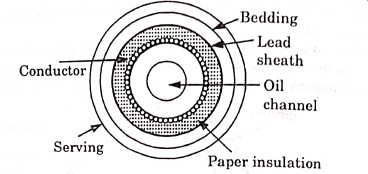
Oil filled Cable: In this the channes or ducts are provided within or adjacent to the cores through which oil under pressure is circulated. It has concentric stranded conductor, built around a hollow cylicndrical steel spiral core. This hollow core acts as channel for oil.
Gas Pressure Cable: In this a inert gas like nitrogen at high pressure (12-15atm) is introduced. There is no bedding and serving in this cable. The working power factor of these type of cables are high.

 Track2Training
You must be logged in to post a comment.