
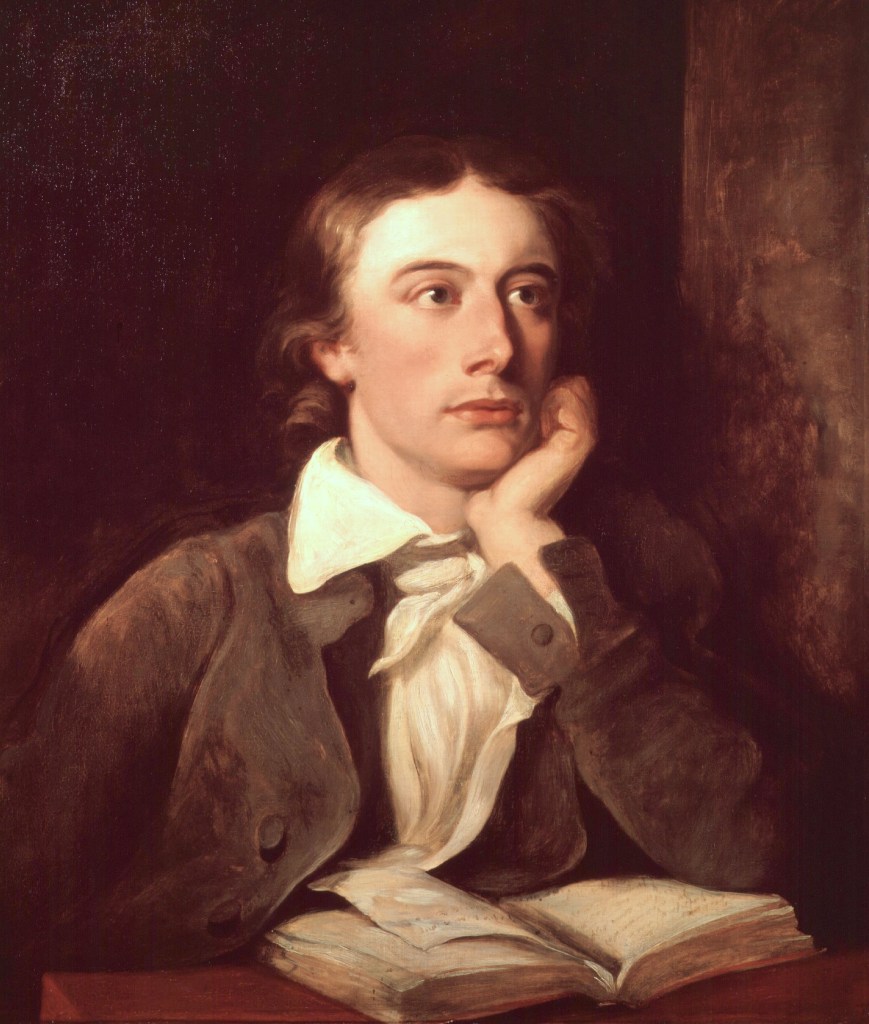
The Life of John Keats

John Keats was an English Romantic poet. He was one of the main figures of the second generation of Romantic poets, along with Lord Byron and P B Shelley. Although his poems were not generally well-received by critics during his lifetime, his reputation grew after his death, and by the end of the 19th century, he had become one of the most beloved of all English poets. Today his poems and letters are some of the most popular and most analyzed in English literature.

John Keats was born in Moorgate, London on 31 October 1795 to Thomas Keats and his wife, Frances Jennings, and was the oldest of 5 siblings. He lost both his parents at a young age. Keats attended the Clarke school at Enfield, two miles away, that was run by John Clarke, whose son Charles Cowden Clarke did much to encourage Keats’s literary aspirations.

After the death of Keats’s mother in 1810, his grandmother made Richard Abbey their guardian. In 1811, John Keats was apprenticed to a surgeon at Edmonton. He broke off his apprenticeship in 1814 and went to London, where he worked as a dresser, or junior house surgeon, at Guy’s and St. Thomas’ hospitals. In 1816 Keats became a licensed apothecary, but he never practiced his profession, deciding instead to write poetry. His literary interests had crystallized by this time, and after 1817 he devoted himself entirely to poetry.

Charles Cowden Clarke had introduced the young Keats to the poetry of Edmund Spenser and the Elizabethans, and these were his earliest models. His first mature poem is the sonnet “On First Looking into Chapman’s Homer” (1816), which was inspired by his reading of George Chapman’s classic 17th-century translation of the Iliad and the Odyssey. Clarke also introduced Keats to the journalist, contemporary poet, and editor of the Examiner – Leigh Hunt, and Keats made friends in Hunt’s circle of literary men, including poets Percy Bysshe Shelley, William Wordsworth, and John Hamilton Reynolds. The group’s influence enabled Keats to see his first volume, Poems by John Keats, published in March 1817.

In 1817 Keats left London briefly for a trip to the Isle of Wight and Canterbury and began work on Endymion, his first long poem. On his return to London, he moved into lodgings in Hampstead with his brothers. Endymion appeared in 1818. This work is a long poem divided into four 1,000-line sections and composed in loose rhymed couplets. The poem narrates a version of the Greek legend of the love of the moon goddess Diana for Endymion, a mortal shepherd, but Keats emphasizes Endymion’s love for the goddess rather than on hers for him.

Soon after the completion of Endymion, Keats wrote “Isabella or the Pot of Basil” in 1818 which was a narrative poem based on a grotesque and tragic tale from Boccaccio’s Decameron. It was during the year 1819 that all his greatest poetry was written, which included: The Eve of St. Agnes, a romantic love story amid a family feud and Lamia, the story of a witch who is transformed by Hermes from a serpent into a beautiful maiden and then into a serpent again, and the two versions of Hyperion.

During the same year, he also wrote the great odes (“On Indolence,” “On a Grecian Urn,” “To Psyche,” “To a Nightingale,” “On Melancholy,” and “To Autumn”). All the odes were composed between March and June 1819 except “To Autumn,” which is from September. These odes are Keats’s most distinctive poetic achievement. They are essentially lyrical meditations on some object or quality that prompts the poet to confront the conflicting impulses of his inner being and to reflect upon his longings and their relations to the wider world around him. This subject was forced upon Keats by the painful death of his brother and his failing health, and the odes highlight his struggle for self-awareness and certainty through the liberating powers of his imagination.

Keats’ central theme of all his poetry is imagination mainly concerned with beauty because it was the only consolation he found in a life full of sadness and misunderstanding. The memory of beauty was to him a source of pure joy. For Keats, beauty is intrinsically tied to life as it should be, where humans and nature are in complete harmony with one another, where beauty is dynamic, changeable, in process, and includes its fulfillment. He loved nature just for its own sake and for the glory and loveliness’ which he everywhere found in it, and no modern poet has even been nearer than he was to the simple ‘poetry of earth’.

Keats’ letters were first published in 1848 and 1878. During the 19th century, critics disregarded them as distractions from his poetic works. During the 20th century, they became almost as admired and studied as his poetry, and are highly regarded within the canon of English literary correspondence. T. S. Eliot described them as, “certainly the most notable and most important ever written by any English poet.”

He had been increasingly ill throughout 1819, and by the beginning of 1820, he was diagnosed with tuberculosis, a disease that had afflicted many of his family members, Keats traveled along with Joseph Severn to Italy in hopes of finding treatment. Keats died in Rome on 23 February 1821 at the age of 25.

About that author- Emily Dickinson

One of the most prominent 19th century poet, who sharpened her skill with self reflection and seclusion and made such a huge impact in literature

Emily Elizabeth Dickinson born in 1830, in Amherst, Massachusetts, U.S. her father Edward Dickinson was a Whig lawyer and her mother was a docile housekeeper. Her parents were loving but strict with their 3 children. So Emily and her siblings Austin and Lavinia got closer. The 2 sisters never got married and stayed at home.

Emily was a well behaved, docile little girl just like anyone would expect a 19th century girl to be like. All the siblings went to the same school where Emily excelled academically and was particularly good in music and composition and she also played the piano. 

Emily’s family was highly religious and she grew up with religious faith all around her household and it inspired some of her work as well. Contrary to her family’s beliefs, Emily herself was not particularly religious and was the only member from her family who did not join Amherst’s First Congregational Church.

Dickinson was introduced to the works of  William Wordsworth,  Ralph Waldo Emerson by one of her father’s friends Benjamin Franklin Newton, who she also talks about in one of her poems.

It was during her late teens when Dickinson started writing poetry consistently. And later her poems took the form of letters assorted with a little bit of humor which she sent to her brother and her friends, one of whom was married to Austin. She was especially close with Susan Gilbert, her brother’s wife and sent more than 300 letters to her. Susan was very supportive of Dickinson’s work and was a very dear friend.

Her poems also possessed a sense of alienation and seclusion as she faced loss of friends in her life. 

As time passed Emily withdrew to herself and became isolated from the outside world. This was because of her mother’s illness and someone had to stay with her at all times. During this time she found comfort in reading and writing. In 1858, she started rewriting her previously written poems. Between 1858 and 1865 she wrote around 800 poems, which no one was aware of until after her death. These are the works that Dickinson is most famous for.

Dickinson’s work possessed a certain melancholy to it, the kind that can also be seen in Sylvia Plath’s work, which shows that Plath was inspired by Dickinson. Her poems mostly revolved around death, which for some weird reason she seemed aggressive, self reflection and immortality. Her poems have been punctuated with dashes that critics are still not sure as to why they were used by the poet.

The last few years of Emily’s life were extremely tough for the Dickinsons; one death followed another. In an 1884 poem she wrote “The Dyings have been too deep for me, and before I could raise my Heart from one, another has come.” In 1886 she died, her physician gave the cause of her death as Bright’s disease. Before her death she asked her sister Lavinia to burn all her poems. Lavinia found 1800 poems after her sister’s death. Her first volume of poems was published four years after her death and Thomas H. Johnson published Dickinson’s Complete Poems in 1955.   

Edgar Allan Poe

By Track2Training

About that author- Edgar Allan Poe

Edgar Allan Poe established his name in literature majorly as a short story writer and poems with his great command in writing. He is also considered as the architect of the modern short story. Edgar Allan Poe, often discussed through his writing which was usually in the horror genre.

Early Life 

Edgar Allan Poe was born in 1809 in Boston, Massachusetts, U.S. his parents were both actors. He was very young when he lost both his parents and was then taken care of by John Allan and his wife. In 1824 Poe got into the University of Virginia and was doing well academically but had to leave due to financial stress. 

Early career 

After living with Allan for sometime Poe went to Boston and published a collection of poems Tamerlane, and Other Poems in 1827. He also was forced to join the army, because of his poverty. 

He published his next collection of poetry Al Aaraaf, Tamerlane, and Minor Poems in 1829. Both of the collections that were published did not receive much attention. The same year Poe’s father helped him secure him an appointment at the U.S. Military Academy at West Point.

About 2 years later Poe moved to New York  , where he published another collection of his works, Poems.

He later went back to Baltimore to his aunt and began writing stories. His stories were getting published in newsletters, he also won a 50 USD cash prize for one of his short stories MS. Found in a Bottle involving an unnamed narrator who sails a ship and encounters a bunch of terrifying situations along his journey.

Poe was offered the position of an editor at Southern Literary Messenger in Richmond where he married his 13 year old cousin, which is bizarre but it was 1836. 

Poe established himself as a fine literary critic over the years although his writing did not grab people’s eyes until the late 1930s. 

Later Years 

His career was going well but he was still not earning enough, his jobs were not getting him enough money so he went to New York again, where he was often seen drinking. In 1838, he published The Narrative of Arthur Gordon Pym, the only complete novel by him.

A year later, he was the editor of Burton’s Gentleman’s Magazine in Philadelphia and after that he was the editor of Broadway Journal in New York City. While editing in Philadelphia and New York he published several stories like Broadway Journal in New York City. which was published in Burton’s Gentleman’s Magazine while he was editing there, Burton’s Gentleman’s Magazine, his first detective story published in 1842 in Graham’s magazine.

Poe’s work grabbed national attention after the publishing of his poem The Raven which led him to become an editor of the Broadway Journal. Virginia, Poe’s wife passed away due to tuberculosis in 1847 after which he was involved romantically with multiple women. 

Poe moved to Baltimore in 1849, where one morning Poe was discovered lying, almost unconscious and a few days later, he died. The cause of his death is still not known  

References

Beaver, H., & Poe, E. A. (2006). The Science Fiction of Edgar Allan Poe. Penguin UK.

Jain, Sarika, Kavita Dehalwar, and Shashikant Nishant Sharma. “Explanation of Delphi research method and expert opinion surveys.” Think India 27, no. 4 (2024): 37-48.

Kennedy, J. G. (Ed.). (2001). A historical guide to Edgar Allan Poe. Oxford University Press, USA.

Poe, E. A. (1895). The Works of Edgar Allan Poe (Vol. 2). AC Armstrong &son.

About that author- Charles Bukowski

“We are here to laugh at the odds and live our lives so well that Death will tremble to take us.”

This very famous quote by Charles Bukowski gives us an idea about the kind of individual he was. He was the kind of poet who wrote whatever was in his heart, whenever it was. He always spoke about a part of himself that exists inside us all but we choose to silence it. Bukowski, afraid of that part, still chooses to give it a voice through his poems.

Life 

Charles Bukowski was a German-American poet, writer known for the violent imagery he tries to depict with his writing. Bukowski left his home in Los Angeles to move to New York to pursue writing. In New York he took up a lot of odd jobs so that he could continue to write, but he did not see much success during that period of his life.

Career 

Charles Bukowski published his first story, titled  “Aftermath of a Lengthy Rejection Slip” in 1944, at the age of 24 in a magazine. He published another story titled “20 Tanks from Kasseldown” about 2 years later in 1946, but unfortunately he failed to make a breakthrough and was left disappointed. Bukowski wrote a lot, was published too little and received even less recognition. This led him to quit writing or rather take a break from writing in the year 1946.

Now, one could say that Bukowski did not do anything during his hiatus but I disagree. During these years Bukowski gathered material for his future work. He moved back to Los Angeles and lived the life of a hippie and wandered around the country staying in cheap places. He would travel. drink alcohol and observe. The observations are talked about in his later published books.

Bukowski talked about the harsh and crude reality of existence and is known for his raw and bare writing.

After a hiatus of almost a decade, Bukowski got back to writing. In the mid 1950s he was hospitalized for a fatal bleeding ulcer. After being released from the hospital he started to write poetry, at the age of 35. Charles Bukowski, in 1957 married Barbara Frye, who later died in India. This incident resulted in Bukowski going back to alcohol and writing poetry.

By this time, Bukowski’s poems were published in literary magazines. But still he was unable to see the success he very much deserved. In the 1960s, he published a lot of poems and short stories and only tasted success in his 50s.

Bukowski spent more than half of his life writing and not seeing any considerable amount of success. He did not give up, in fact there was no point in him giving up because he was not one of the writers who wrote to achieve success, he wrote because he was extraordinarily in love with his art. He did not try to be a writer, in fact he didn’t try to be anything but true to himself and his work. He did not force himself to write, evident by his decade long hiatus. He thought that there had been too many writers in the past who forced themselves to try, whereas in his opinion if you truly love an art form you wouldn’t have to try, it would come to the artist. In his opinion if you had to try to be or do something you shouldn’t try at all. Even his grave has the words “don’t try” engraved on it.

He died in 1994, due to leukemia after living an adventurous and fulfiled life. 

About that author- Sylvia Plath

If the moon smiled, she would remember you. You leave the same impression of something beautiful but annihilating.

This quote is from one of my favorite Sylvia Plath poems “The Rival”. 

If you read Sylvia Plath you would find that her poetry wasn’t about the beauty that surrounded her, the fruity aroma of the garden flowers or blistering sun shining on her face or the wind sweeping her way. No, it was about none of that. Her poetry style was confessional.

LIFE

Sylvia Plath was born on october 27 of 1932 in Boston Massachusetts. She was a poet and a novelist who shaped American literature to a great extent. Plath published her first poem at the age of 8 in an American newspaper under the children’s section.From then on Plath went on to write  and publish multiple poems in different magazines and newspapers. At the age of 8 Plath also faced a great deal of personal loss, her father passed away due to untreated diabetes. Her father was also a subject for a lot of her poems that she wrote in her later years.

Plath was a good student, she excelled in academics and attended the Smith’s College in Massachusetts. Plath also suffered from depression, which she elaborates in her poems. She underwent electrocution therapy for her depression. We are talking about the year 1950, when mental illness was not a socially acceptable concept. No points for guessing that the electrocution therapy did not work in fact it made matters worse for plath. In 1953, at the age of 21, the feeling of which she describes in one of her works as “blissfully succumbed to the whirling blackness that I honestly believed was eternal oblivion.” plath made her first suicide attempt by taking her mother’s sleeping pills. After this incident she remained in psychiatric care for months. 

Career 

In 1960, Sylvia Plath released a collection of her poems, entitled the colossus and other poems.. In this collection she talks about death, suicide, her father, and her depressive periods and thoughts.

Sylvia Plath’s poetry wasn’t particularly happy and that is because it was confessional or even autobiographical in a sense and Plath herself was deeply depressed. Here is an excerpt from one of her poems called Lady Lazarus;

“Dying is an art,

like everything else. 

I do it exceptionally well. 

I do it so it feels like hell. 

I do it so it feels real. 

I guess you could say I’ve a call”.

If it wasn’t clear until now, then these lines give us an idea of the intensity of torment that her own mind was subjecting her to.

Marriage and the aftermath

Plath married Ted Hughes, a poet and writer in 1956. They had 2 children together. The two later separated in 1962. The couple did not have a great relationship, some controversy and rumors surrounded Hughes even after Plath’s death.

During the last few years of her life Plath published exceptional work, some of the best work ever written. This vey period of Plath’s life is the one that shaped literature and inspired the future confessional poets. Plath poured her heart out on the pages during these years. She published a novel “the bell jar” in 1963 which did exceptionally well. But her career was cut short when at the age of 30, in 1962 after what is described as “a burst of creativity” she took her own life. Her posthumously published collection of poems “Ariel” also attracted a lot of readers and to this day transcends her.