



Return on Investment (ROI) in Architecture and Planning Projects
1️⃣ What is Return on Investment (ROI)?
Return on Investment (ROI) is a financial performance indicator used to evaluate the profitability of an investment. It measures how much return is generated relative to the cost invested in a project.
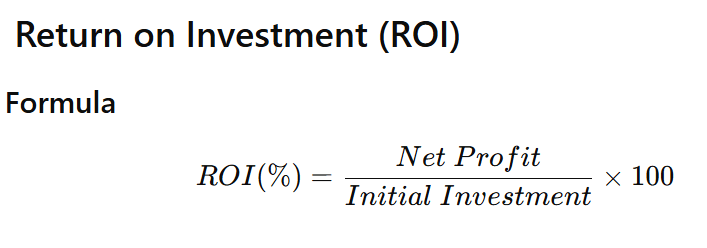
🔹 Formula
ROI(%)=Initial InvestmentNet Profit×100
Where:Net Profit=Total Gain−Initial Investment
ROI expresses profitability as a percentage, making it easy to compare different projects.
2️⃣ Why ROI is Important in Architecture and Planning
In architecture and urban planning projects, investments are usually large and long-term. ROI helps:
- Assess financial feasibility
- Compare alternative design options
- Justify project approval to stakeholders
- Evaluate redevelopment projects
- Support public-private partnership (PPP) decisions
- Prioritize infrastructure investments
For planners and architects, ROI bridges design thinking and economic rationality.
3️⃣ Where ROI is Used in Architecture and Planning
1. Real Estate Development Projects
- Residential apartments
- Commercial office buildings
- Shopping malls
- Mixed-use developments
2. Urban Redevelopment Projects
- Brownfield redevelopment
- Transit-Oriented Development (TOD) zones
- Heritage adaptive reuse
3. Infrastructure Projects
- Parking structures
- Bus terminals
- Metro station area development
- Smart city projects
4. Sustainable Design Decisions
- Solar panel installation
- Rainwater harvesting systems
- Energy-efficient façades
- Green building materials
5. Public Projects (Cost-Benefit Support)
- Urban parks
- Pedestrian infrastructure
- Streetscape improvements
4️⃣ How to Use ROI in Architecture and Planning Projects
Step 1: Identify Initial Investment
Include:
- Land cost
- Construction cost
- Consultant fees
- Approval charges
- Equipment cost
- Marketing cost
Step 2: Estimate Total Return
Returns may include:
- Sale revenue
- Rental income
- Increased property value
- Energy savings
- Reduced maintenance cost
- Increased tax revenue (public projects)
Step 3: Calculate Net Profit
Net Profit=Total Returns−Initial Investment
Step 4: Apply ROI Formula
ROI=Initial InvestmentNet Profit×100
5️⃣ Detailed Examples in Architecture & Planning Context
✅ Example 1: Residential Apartment Project
Initial Investment:
- Land: ₹40,00,000
- Construction: ₹50,00,000
- Other costs: ₹10,00,000
Total Investment = ₹1,00,00,000
Total Sales Revenue = ₹1,25,00,000
Net Profit:1,25,00,000−1,00,00,000=25,00,000 ROI=1,00,00,00025,00,000×100 ROI=25%
👉 This indicates strong financial viability.
✅ Example 2: Solar Panel Installation in Commercial Building
Installation Cost = ₹5,00,000
Annual Energy Savings = ₹80,000
Project Life Considered = 5 years
Total Savings in 5 years:80,000×5=4,00,000
Assume property value increase = ₹2,20,000
Total Return = ₹6,20,000
Net Profit:6,20,000−5,00,000=1,20,000 ROI=5,00,0001,20,000×100 ROI=24%
👉 Supports sustainable investment decision.
✅ Example 3: Parking Structure in Urban Area
Investment = ₹2,50,00,000
Total Parking Revenue over 5 years = ₹2,75,00,000
Net Profit:2,75,00,000−2,50,00,000=25,00,000 ROI=2,50,00,00025,00,000×100 ROI=10%
👉 Moderate ROI; planner may compare alternatives.
6️⃣ ROI in Urban Planning Decision-Making
ROI helps in:
✔ Comparing Design Alternatives
Example:
- Glass façade vs energy-efficient façade
- Conventional materials vs green materials
✔ Evaluating TOD Projects
- Increased land value near transit
- Higher rental income
- Increased density returns
✔ Public Investment Justification
- Economic multiplier effects
- Tax increment financing
- Urban regeneration impact
7️⃣ Advantages of ROI in Planning
- Simple to calculate
- Easy to interpret
- Comparable across projects
- Useful for private investors
- Supports financial feasibility studies
8️⃣ Limitations of ROI in Architecture & Planning
- Does not consider time value of money
- Ignores social and environmental benefits
- Not suitable alone for long-term public projects
- Does not capture intangible value (livability, safety, aesthetics)
Therefore, ROI should be used along with:
- Net Present Value (NPV)
- Internal Rate of Return (IRR)
- Cost-Benefit Analysis (CBA)
- Social Return on Investment (SROI)
9️⃣ Practical Application for Architects & Planners
When preparing a Detailed Project Report (DPR):
- Estimate project cost
- Forecast revenue or savings
- Compute ROI
- Compare multiple scenarios
- Present ROI to clients/investors
- Use ROI to optimize design choices
🔟 Conclusion
Return on Investment (ROI) is a fundamental financial tool that connects design, planning, and economics. In architecture and urban planning, ROI supports:
- Investment decisions
- Sustainable design adoption
- Real estate feasibility
- Infrastructure planning
- Policy justification
While ROI is not sufficient alone for public welfare projects, it remains essential for financially driven development and strategic planning decisions.
 Track2Training
You must be logged in to post a comment.