

All might be pretty familiar with the political usage of the terms ‘left’ and the ‘right’ with hundreds of political parties being established in these lines. However, the concept of the left-right divide is pretty complex and controversial. The complexity is explained in terms of two graphs in this article. Moreover, the main differences between the two are also enumerated.
After the legendary landmark of the French Revolution, the first meeting of the Estates-General took place in 1789. In the meeting, the entrenched elites occupied the position right to that of the presiding officer whereas the common people occupied the position to the left of the same. This relative position of a set of people with opposing ideologies with respect to the presiding officer then came to mark the left-right divide.
The leftists were proponents of change. They attempted to produce a change in society. Also, they wanted the change to happen at a very fast pace and so, they were proponents of radical change. In addition to that, they were hardcore proponents of total change. Whereas some leftists support violent change with the use of controlled violence for social change, others were supporters of democratic change. The leftists believed in the social-contract theory that argued that society and State are anthropogenic products or human-made products and are answerable to them. They despised the divine origins of society and the State. Also, they believed that the power to rule wasn’t given by God and the power to rule flows from the below- from the working people.
On the other hand, the Rightists were a heterogeneous group that differed in terms of ideologies. Broadly, they can be divided into three groups. Firstly, the Status Quoists or conservatives believed that the present or the existing social order must continue. They believed that the social hierarchy is a natural product and any change to the existing order will destroy the naturally ordained equilibrium. They aspire for social stability and argue that any tinkering with the existing social hierarchy would result in social instability. Secondly, the Revivalists believed in reviving the grandeur of the past. They tend to glorify the past and they argue that social change will come from the revival of the ancient past. They believe that the pathetic present is the result of the abandoned past. They give examples of social construction and dynamism and technological advancements from mythologies. Nonetheless, they support democratic and non-violent changes. Thirdly, the Recationists or the Fascists were violent, frenetic and intolerant revivalists who justified violence as a medium of social change. Here, social change refers to reviving the lost cultural glory.
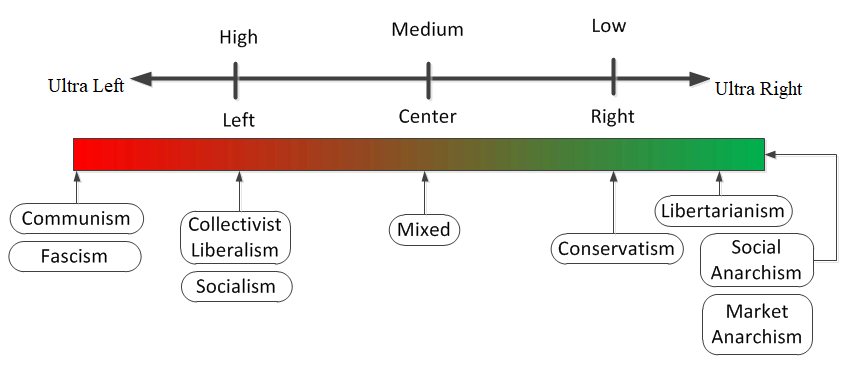

The following facts make this division complicated:
- Some group of Rightists are proponents of change
- Some groups of leftists and certain Rightists believe in change through democracy whereas others of the same ranks believe in change through violence.
- The Leftists are the proponents of liberty, equality and fraternity but supports economic intervention and fiscal regulations. On the other hand, the Rightists argue for hierarchy and social order but are proponents of free and unregulated markets.
The third point makes this division far more complicated. While liberty, equality, fraternity along with the free market economy are the cardinal principles of liberalism, it should be concluded that both the leftists and the rightists support liberal ideas. This makes liberalism more or less a neutral and central concept located in the middle of both the leftists and the rightists.
| Sl.no | Particulars | Leftists | Rightists |
| 1 | Values | Liberty, equality and fraternity | Social order, hierarchy and authority |
| 2 | Views on social progress through change | Optimistic | Pessimistic |
| 3 | Economy | Regulated economy | Free market economy |
| 4 | Nature of the State | Interventionist State | Restricted State |
| 5 | Origin of the State | Social contract | God/Nature |
 Track2Training
You must be logged in to post a comment.