
A Transformer is an electrical device which works on principle of Faraday’s Law of electromagnetic induction. It transfers electrical power from one circuit to the other circuit by electromagnetic induction. It is a passive electrical device. It used for increasing low AC voltages at high current (called as step-up transformer) or decreasing high AC voltages at low current (called as step-down transformer), which is required for transmission and distribution of electricity.
Parts of Transformer:
A transformer has three main parts:
- Primary Winding: It is connected to an external AC source and its purpose is to produce magnetic flux inside of transformer.
- Secondary Winding: The flux produced by primary winding passes through the core and gets linked with the secondary winding. This winding is also present on the same core and provides the output of the transformer.
- Magnetic Core: The flux produced by the primary winding, that will pass through this low reluctance path linked with secondary winding and create a closed magnetic circuit.
How does a Transformer work?
In a transformer there are two Windings (coils) which are called as ‘primary coil’ and ‘secondary coil’ of transformer. These coils are wound up on a soft iron core on the two opposite sides. So, when the AC voltage is connected with primary winding, an alternating flux is produced inside of transformer and surrounds the primary winding. Now if another coil is brought closer to this primary coil, the continuously changing flux will get linked with the coil and induce a voltage in it according to Faraday Law of Electromagnetic Induction and the current will flow in the circuit attached to the winding. The voltage may be higher or lower than supplied voltage depending upon the number of turns of coils. The winding which gives the output voltage due to voltage induced in it is known as the ‘secondary winding’ and the winding in which the AC voltage is provided is called ‘primary winding’.
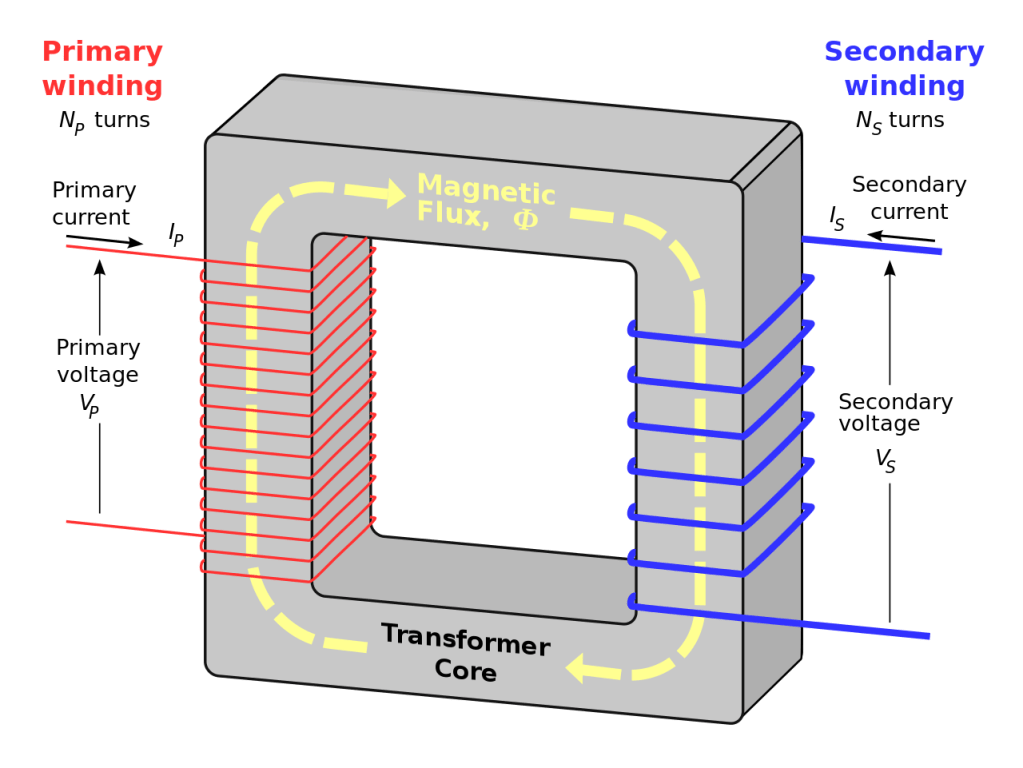
Now, increase or decrease in voltage by transformer depends upon the number of turns present in secondary and primary winding. If there are more turns on the primary coil than the secondary coil than the voltage will decrease, which means transformer will work as a step down transformer and if there are less turns on the primary coil than the secondary coil than the voltage will increase, which means the transformer will work as a step up transformer.
Now, both these winding are wound up on a same magnetic core which is usually of soft iron. This is done because in open air very little flux will get linked with secondary winding and the current induced will be very small. That’s why we use magnetic core or soft iron core, whose purpose is to provide a low reluctance path, through which the maximum amount of flux produced by the primary winding is passed through and linked with the secondary winding.
Some important formulae related to transformer are,
The transformer turns ratio is the number of turns of the primary winding divided by the number of turns of the secondary coil. Denoted by K.
No. of turns in primary coil = Np No. of turns in secondary coil = Ns
Voltage in primary coil = Vp Voltage in secondary coil = Vs
Np/Ns = Vp/Vs = Is/Ip K
Emf Equation of Transformer:
Erms = 4.44fNΦmax where,
f = flux frequency in Hz = ω/2π,
N= Number of turns in winding
Φmax = Maximum flux
Erms= RMS value of EMF.
 Track2Training
You must be logged in to post a comment.