
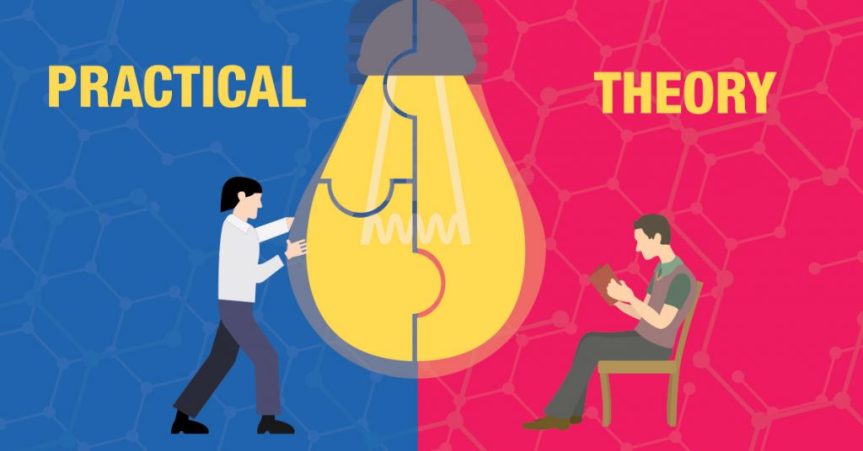
Education is important and should be obtained by everyone in order to gain information and abilities. It is the only way to raise a generation of responsible human beings capable of absorbing good teachings and passing them on to others. It teaches us many topics and opens up a wide range of professional alternatives for us that we would not be able to pursue if we were ignorant. Education can be delivered in two ways: theoretically or practically. However, which of these two is more beneficial to the learner, and which should we value more?
- It does not necessitate the use of a cup.Some people have the uncanny ability to recall everything they read, even if they have only read it once. Others, on the other hand, must cram it in order to remember it. And theoretical knowledge can necessitate a lot of memorization. If you don’t want your child to become a bookworm who is always immersed in a stack of books, you must balance practical education with theoretical instruction. We don’t need to cram information from a book when we’re looking at things and experiencing them in the real world.
- When we cram a lesson for a test, our brain tends to retain it for a short period of time, which may be smaller than the duration of the test, and so does not serve that goal because our brain forgets it quickly. You make an effort to memorize a theorem or explanation word for word, yet you constantly forget something. While putting it into practice, whether through experiments, real-life projects, or educational excursions, the knowledge and the whole learning experience stay with us for a long time.
- Could you have ever grasped the concept of light reflection if you hadn’t seen a mirror? Even if you read about a phenomenon or a lesson in the greatest possible way, it will not be able to penetrate your mind. You had to watch it happen in front of your eyes rather than hear it through someone else’s words. Because everything is available, practical knowledge can be quite beneficial. Whether it’s comprehending scientific phenomena or immersing oneself in literature.
- Reading a lesson over and again isn’t always helpful. However, carrying out exercises or investigations based on it necessitates practice, and as the saying goes, “practice makes perfect.” You will make no progress if you continue to read a guide book for a new language without speaking it. But if you start utilizing that language and conversing with other people, you’ll notice a difference. You’ll notice a difference. So, until the theoretical training is turned into practical activity, simply sitting in a corner with a book or listening to a lecture does not constitute practice.
- Learning facts and ideas is useless unless you are aware of how they are used in real-life situations. I spent the most of my middle school years wondering why knowing Sine theta square plus cosine theta square equals one is useful. However, after learning about its applications, I realized how important trigonometry is in architecture and related professions. So, until you apply your theoretical knowledge to real-life situations through practical experiments, theory won’t help you much, and you’ll keep asking why you’re studying that particular topic in the first place.
- Don’t you prefer field excursions, projects, and experiments than books, assignments, and lectures? I’m sure they do because they’re far more intriguing and engrossing than reading your typical book.
- While most activities involve team projects or programs where students are required to work in a group or as a team while imparting practical knowledge to students, the majority of activities involve team projects or programs where students are required to work in a group or as a team while imparting practical knowledge to students. For one thing, it increases a student’s capacity to engage with his or her peers and encourages everyone to work together. Furthermore, learning in a group makes the process more enjoyable because pupils are able to grasp more information. They enjoy each other’s company, and the entire teaching process becomes less tedious and more enjoyable. You also learn more while having a good time.
- Theoretical education is far less engaging than practical education. It entails more than just lecturing and educating, regardless of whether the student understands the principles or not. Teachers who teach in a straightforward manner or publications that may or may not include interactive tasks are commonly used in theoretical education. In contrast, student contributions are not only welcomed but often required in practical projects. Interactive sessions, experiments, and interactive exercises are all vital aspects of practical education that assure student engagement and help them learn and understand more. And since learning is the primary goal of school, it is necessary to raise one’s degree of learning.
 Track2Training