

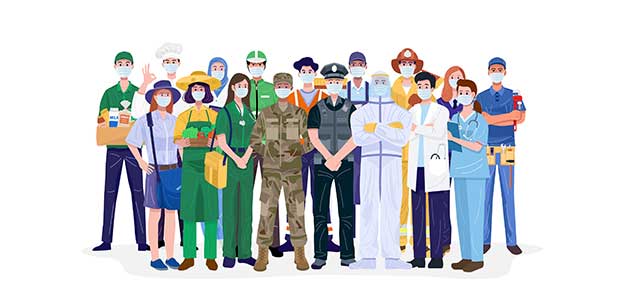
Despite the hardships and health risks, millions of essential front-line workers continue to do their jobs during the COVID-19 pandemic. These hardworking heroes are picking their up their trash, providing them life-saving medicine, delivering their groceries and packages, preparing their food, cleaning their hospitals, caring for those who are most vulnerable, and keeping us safe often while earning low wages and few benefits. Although doctors and nurses who earn a median wage of Rs.7875 per hour and Rs.2550 per hour, respectively receive the lion’s share of public recognition for their life-saving role in the fight against COVID-19, they represent less than 20% of all essential health workers. Millions of other health workers ear significantly lower wages while receiving less recognition for their roles, despite their sacrifices. Nearly 7 million essential workers are employed in low wages health jobs on the COVID-19 front-lines, including:
- Health care support workers such as orderlies and phlebotomists.
- Direct care workers such as home health and personal care aides
- Health care service workers such as house-keepers and cooks
Median wages across these occupations were just Rs.1011 per hour in 2019 well short of a living wages. More than 80% of them are women, and they are also disproportionately workers of color.
Risk of infection
Shortage of PPEs-Shortage of personal protective equipment have been reported from several countries. The shortage of PPE has put many healthcare workers at risk for getting infected with COVID-19. Healthcare workers have recreated a solution to make up for the lack of PPE by using by using the resources they do to have in stock. They have used plastic bags has gowns and plastic water bottle cut-outs for eye protection.
The shortage of PPE is worst in low income hospitals. Items such as PPE has always been scare commodities in low income countries. UICEF reported that the organization was only able to acquire one tenth of 240 million masks requested by these communities.
Deaths
Doctors and nurses death due to COVID-19 has reported in many countries. In May 2020 at-least 260 nurses have died due to COVID-19. In March at-least 50 doctors have died due to COVID-19 in Italy. The number of deaths in Italy continued to go up. Two of the deaths within those who were nurses were suicides due to un-sustainable pressure at work. The Indian Medical Association announced that 198 doctors have died in India due to COVID-19. By February 2021, the India Medical Association said the number of deaths of doctor in India due to COVID-19 had increased to 734, however the government of India said that only 162 doctors died due to COVID-19.
Psychological impact
A study from Singapore showed that healthcare workers caring for patients with COVID-19 reported anxiety, depression and stress. Increasing work demands on healthcare professionals conflict with their duties to family and friends, which causes psychological stress. Healthcare professionals reported being anxious about having to self-isolate, quarantine or becoming ill. Healthcare workers like nurses, doctors and other medical staff that worked on the front-line in China experienced symptoms of anxiety, depression and difficulty in sleeping. Health care workers are at risk for developing trauma or other stress-related disorders due to fears of falling ill and no knowing what will happen in the future. Post-traumatic stress was common among health workers with nurses demonstrating a higher likelihood of developing or having anxiety among others in the medical field. An Italian committed suicide after being traumatized trying to save the lives of those with COVID-19. In Mexico, healthcare professional have also reported high levels of anxiety, because of the fear of being an asymptomatic patient, which could potentially lead to the unknowingly spread of the disease among their patients and their families.
 Track2Training
You must be logged in to post a comment.