


By Kavita Dehalwar
Sociology is the scientific study of society, human social behavior, and the structures and processes that shape and influence it. It is a discipline that seeks to understand the patterns and dynamics of human interaction, social institutions, and the broader social forces that impact individuals and groups. Sociology examines how societies are organized, how they change over time, and how individuals are shaped by their social environments.
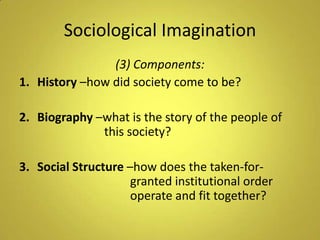
One key concept in sociology is the sociological imagination, which was introduced by American sociologist C. Wright Mills in his 1959 book of the same name. The sociological imagination encourages individuals to connect their personal experiences to larger social issues and historical contexts. Mills argued that people should be able to see the intersection between their private lives and the broader social structures in which they exist. This perspective helps individuals understand how personal troubles are often connected to public issues and how societal factors influence personal experiences.
The sociological imagination involves the ability to view one’s own life and the lives of others from a sociological perspective. It requires considering the broader social, historical, and cultural context in which individuals live. This perspective enables individuals to move beyond personal anecdotes and recognize the social forces at play in shaping their lives.
Key components of the sociological imagination include:
- Biography and History: Understanding the interplay between personal experiences (biography) and historical and social contexts (history). It involves recognizing that personal choices and experiences are influenced by societal structures and historical developments.
- Social Structure: Examining the overarching patterns and structures that organize society, such as institutions, social classes, and power dynamics. Social structure influences individuals and shapes their opportunities and constraints.
- Culture and Society: Recognizing the role of culture in shaping values, beliefs, norms, and practices within a society. Sociological imagination involves understanding how culture influences individual behavior and societal trends.
- Critical Thinking: Developing a critical and reflective mindset to question assumptions, challenge common beliefs, and analyze social phenomena. This involves looking beyond individual experiences to identify broader social patterns and inequalities.
Sociological imagination is a powerful tool for both sociological research and personal development. It encourages individuals to go beyond individualistic explanations for their circumstances and consider the broader social context. By understanding the societal forces at play, individuals can develop a more informed and critical perspective on their own lives and the world around them.
In the field of sociology, researchers use the sociological imagination to conduct studies and analyze social issues. Sociologists explore topics such as inequality, crime, education, family dynamics, and more, aiming to understand the underlying social structures and processes that contribute to these phenomena. This sociological perspective is crucial for developing insights into societal problems and proposing solutions that address root causes rather than merely addressing symptoms.
References
Dehalwar, K., & Sharma, S. N. (2023). Fate of Slums of Bhopal-A Tale of Struggle and Resilience. Think India Journal, 26(4), 12-18.
Harvey, D. (2005). The sociological and geographical imaginations. International journal of politics, culture, and society, 18, 211-255.
Hughes, E. C. (1963). Race relations and the sociological imagination. American Sociological Review, 879-890.
Mills, C. W. (2023). The sociological imagination. In Social Work (pp. 105-108). Routledge.
Sharma, S. N. (Ed.). (2016). New perspectives in sociology and allied fields. EduPedia Publications (P) Ltd.
Thomson, R. (2014). Generational research: between historical and sociological imaginations. International Journal of Social Research Methodology, 17(2), 147-156.
 Track2Training