


By Kavita Dehalwar
Core-Periphery Planning Theory is a spatial-economic model that describes the relationship between economically developed regions (core) and less developed regions (periphery). This theory is often used in the context of regional development, urban planning, and economic geography. The core-periphery model explains how economic, social, and political power is concentrated in the core areas, leading to uneven development between the core and periphery. Below is a detailed discussion of the core-periphery planning theory:

1. Origins and Theoretical Foundation
- Dependency Theory: Core-periphery theory is rooted in the broader dependency theory, which explains the global economic system as one where the core (developed countries) exploits the periphery (developing countries). This relationship is marked by unequal exchange and a flow of resources from the periphery to the core.
- World Systems Theory: Immanuel Wallerstein’s World Systems Theory further elaborates on core-periphery dynamics, emphasizing the hierarchical structure of the global economy, where core countries dominate in production, finance, and technology, while peripheral countries are dependent on primary commodities and low-value-added industries.
2. Core-Periphery Model in Regional Development
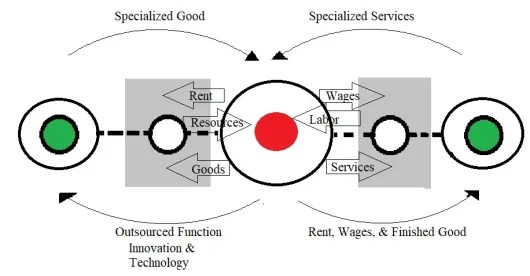
- Core Regions: These are economically advanced regions with high levels of industrialization, infrastructure, and urbanization. Core regions often serve as hubs for economic activities, political power, and cultural influence. Examples include major cities or industrialized regions within a country.
- Periphery Regions: These regions are less developed, often characterized by lower income levels, inadequate infrastructure, and a dependence on primary sectors like agriculture or mining. Peripheral regions may struggle with issues such as outmigration, unemployment, and poor access to services.
- Semi-Periphery: Some models introduce a semi-periphery category, which represents regions that are in transition between core and periphery. These areas might have emerging industries and infrastructure but still face challenges in fully integrating into the core.
3. Spatial Patterns and Processes
- Polarization: The core-periphery model suggests that economic growth and development tend to be polarized, concentrating in core regions and leaving peripheral areas lagging. This can lead to increased inequalities between regions.
- Circular Causation: Gunnar Myrdal’s concept of circular causation explains how initial advantages in core regions (e.g., better infrastructure, skilled labor) attract more investment, leading to further growth. Conversely, peripheral regions may experience a downward spiral due to a lack of investment.
- Backwash Effects: This refers to the negative impacts on peripheral regions as resources, labor, and capital migrate to core regions. Peripheral areas may suffer from depopulation, deindustrialization, and a decline in economic opportunities.
- Spread Effects: In contrast to backwash effects, spread effects describe the positive impacts that core regions can have on the periphery, such as through technology transfer, investment, and increased demand for peripheral products. However, these effects are often weaker than backwash effects.

4. Implications for Planning and Policy
- Balanced Regional Development: One of the main objectives of planning in the context of core-periphery theory is to reduce regional disparities. Policies might include decentralizing industries, improving infrastructure in peripheral regions, and promoting regional development initiatives.
- Growth Poles: A common strategy is to develop “growth poles” in peripheral regions—specific areas where investment and development are concentrated in the hope that growth will radiate outwards to surrounding areas.
- Incentives and Subsidies: Governments may offer incentives, such as tax breaks or subsidies, to encourage businesses to invest in peripheral regions.
- Infrastructure Development: Improving transportation, communication, and energy infrastructure in peripheral areas can help integrate them into the national and global economy, reducing the dominance of core regions.
- 5. Criticisms and Challenges
- Overemphasis on Economic Factors: Critics argue that the core-periphery model overly focuses on economic factors and may neglect social, cultural, and environmental dimensions of development.
- Inequality Perpetuation: Some scholars contend that policies inspired by core-periphery theory may inadvertently reinforce existing inequalities by focusing too much on core areas or by failing to address the root causes of peripheral underdevelopment.
5. Criticisms and Challenges

- Overemphasis on Economic Factors: Critics argue that the core-periphery model overly focuses on economic factors and may neglect social, cultural, and environmental dimensions of development.
- Inequality Perpetuation: Some scholars contend that policies inspired by core-periphery theory may inadvertently reinforce existing inequalities by focusing too much on core areas or by failing to address the root causes of peripheral underdevelopment.
- Globalization: The increasing interconnectedness of the world economy challenges traditional core-periphery dynamics. Some peripheral regions may bypass national cores and engage directly with global markets, leading to new patterns of development.
Applications in Urban and Regional Planning
- Urban-Rural Divide: The core-periphery model is often applied to understand the urban-rural divide, where cities (core) dominate economically and socially over rural areas (periphery).
References
Borgatti, S. P., & Everett, M. G. (2000). Models of core/periphery structures. Social networks, 21(4), 375-395.
Baldwin, R. E. (2001). Core-periphery model with forward-looking expectations. Regional science and urban economics, 31(1), 21-49.
Currie, M., & Kubin, I. (2006). Chaos in the core-periphery model. Journal of Economic Behavior & Organization, 60(2), 252-275.
Sharma, S. N., Dehalwar, K., Kumar, G., & Vyas, S. (2023). Redefining Peri-urban Urban Areas. Thematics Journal of Geography, 12(3), 7-13.
Sharma, S. N., & Dehalwar, K. (2024). Fundamentals of Planning and Design of Housing A textbook for Undergraduate Students of Architecture and Planning. Notion Press. https://doi.org/10.5281/zenodo.13325661
 Track2Training
You must be logged in to post a comment.