


By Kavita Dehalwar
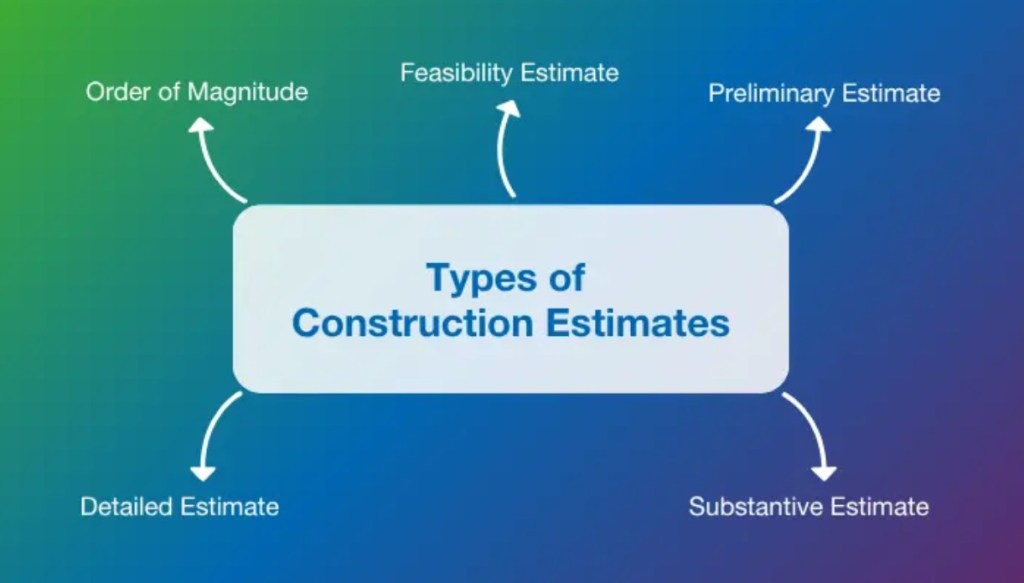
Construction estimates are prepared at different stages of a project depending on the level of information available. The main types are:
1. Order of Magnitude Estimate
This is the earliest and roughest estimate prepared.
Purpose
- To get a broad idea of project cost
- Used for initial decision-making
Basis
- Past experience
- Cost of similar projects
- Very limited data
Accuracy
- ±30–40%
Use
- Project idea stage
- Go / No-go decision
2. Feasibility Estimate
Prepared to assess whether the project is financially viable.
Purpose
- To evaluate economic feasibility
- To compare alternatives
Basis
- Approximate quantities
- Area or unit rates
- Preliminary layouts
Accuracy
- ±20–25%
Use
- Feasibility studies
- Investment appraisal
3. Preliminary Estimate
Prepared once the basic design and layout are available.
Purpose
- To obtain administrative approval
- To estimate project budget
Basis
- Plinth area / floor area / cubic content method
- Approximate specifications
Accuracy
- ±15–20%
Use
- Budget sanction
- Planning stage decisions
4. Substantive Estimate
Prepared after the design is finalized.
Purpose
- To obtain technical sanction
- To refine cost estimates
Basis
- Detailed drawings
- Updated specifications
- Refined quantities
Accuracy
- ±10–15%
Use
- Before tendering
- Final cost assessment
5. Detailed Estimate
This is the most accurate and comprehensive estimate.
Purpose
- For tendering and execution
- To control project cost
Basis
- Item-wise quantity take-off
- Rate analysis using SOR
- Detailed specifications
Accuracy
- ±5–10%
Use
- Contract award
- Construction and payment
Summary Table
| Type of Estimate | Project Stage | Accuracy |
|---|---|---|
| Order of Magnitude | Concept stage | Very Low |
| Feasibility Estimate | Feasibility stage | Low |
| Preliminary Estimate | Planning stage | Medium |
| Substantive Estimate | Design finalization | Medium–High |
| Detailed Estimate | Execution stage | High |
Conclusion
As a project progresses, estimates become more detailed and accurate. Early estimates guide decisions, while detailed estimates ensure financial control and successful execution.
 Track2Training
You must be logged in to post a comment.