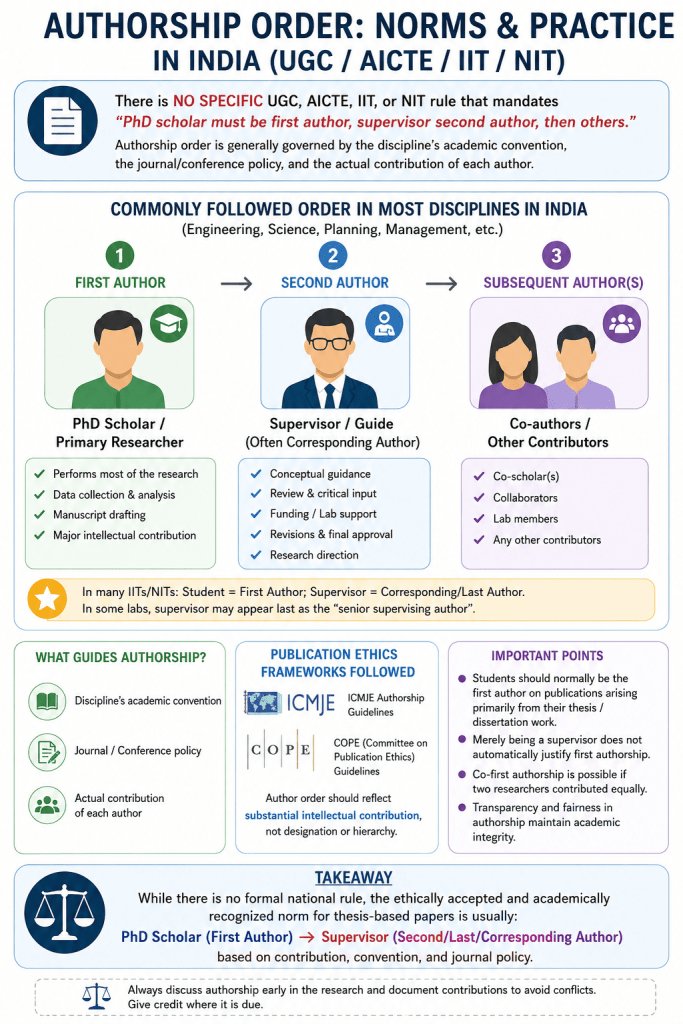
Baerlocher, M. O., Newton, M., Gautam, T., Tomlinson, G., & Detsky, A. S. (2007). The meaning of author order in medical research. Journal of Investigative Medicine, 55(4), 174-180.
Bhandari, M., Guyatt, G. H., Kulkarni, A. V., Devereaux, P. J., Leece, P., Bajammal, S., … & Busse, J. W. (2014). Perceptions of authors’ contributions are influenced by both byline order and designation of corresponding author. Journal of clinical epidemiology, 67(9), 1049-1054.
Peidu, C. (2019). Can authors’ position in the ascription be a measure of dominance?. Scientometrics, 121(3), 1527-1547.
Mattoon, E. R., Miles, M., Broderick, N. A., & Casadevall, A. (2024). Analysis of justification for author order and gender bias in author order among those contributing equally. Mbio, 15(5), e00646-24.
McCann, T. V., & Polacsek, M. (2018). Addressing the vexed issue of authorship and author order: A discussion paper. Journal of Advanced Nursing, 74(9), 2064-2074.
da Silva, A. P. A., & Vanz, S. A. (2022). Authorship, authorship order and author contribution: a literature review. RDBCI: Revista Digital de Biblioteconomia e Ciência da Informação, 20, e022028.
Liboiron, M., Ammendolia, J., Winsor, K., Zahara, A., Bradshaw, H., Melvin, J., … & Liboiron, G. (2017). Equity in author order: A feminist laboratory’s approach. Catalyst: Feminism, Theory, Technoscience, 3(2).
Riesenberg, D., & Lundberg, G. D. (1990). The order of authorship: who’s on first?. Jama, 264(14), 1857-1857.
Daily writing prompt
What’s a moment that made you realize you were stronger than you thought?
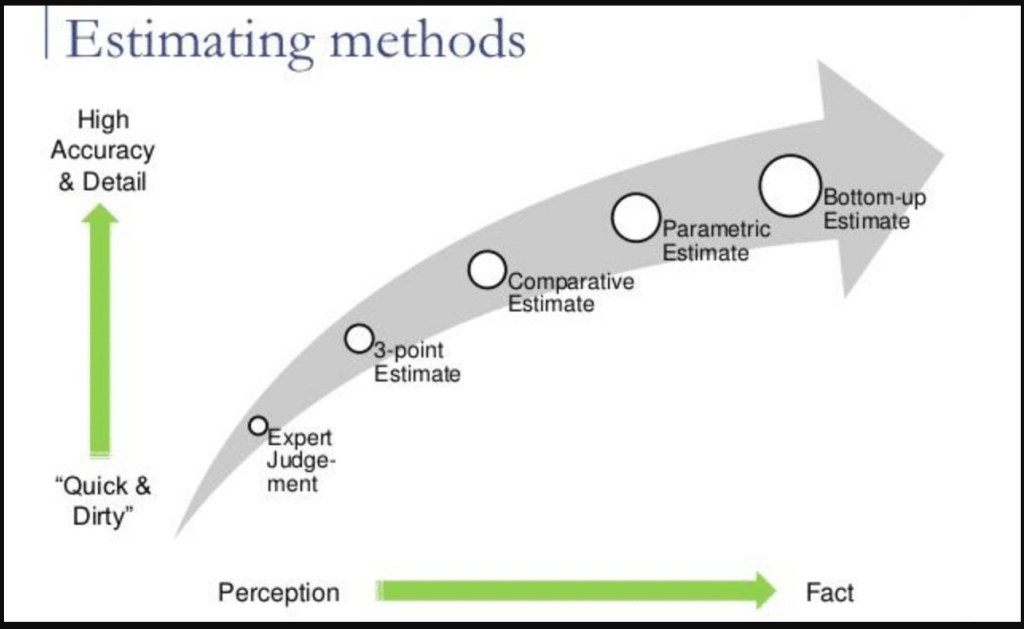
Estimation is a critical activity in construction and project management, as it directly influences decision-making, budgeting, scheduling, and resource allocation. The attached image clearly illustrates how estimating methods evolve from quick, perception-based approaches to highly detailed, fact-driven techniques, with a corresponding increase in accuracy and level of detail. This progression reflects the maturity of project information and the purpose for which the estimate is prepared.
The horizontal axis in the image represents a shift from perception to fact, while the vertical axis highlights the movement from “quick and dirty” estimates to high accuracy and detail. As projects move forward, estimation methods transition along this curve.
1. Expert Judgment Estimate
At the earliest stage of a project, expert judgment is often the primary estimation method. This approach relies on the experience, intuition, and professional knowledge of experts who have worked on similar projects.
Characteristics:
Based largely on perception and past experience
Minimal data or documentation required
Very fast and inexpensive
Applications:
Conceptual planning
Initial idea screening
Early discussions with stakeholders
Limitations:
Highly subjective
Accuracy depends heavily on expert competence
Difficult to justify quantitatively
This method is positioned at the far left of the image, emphasizing its low accuracy but high speed. It is useful for rough direction-setting rather than firm decision-making.
2. Three-Point Estimate
The three-point estimate improves upon pure expert judgment by incorporating uncertainty into the estimation process. Instead of a single value, three scenarios are considered:
Optimistic (O)
Most likely (M)
Pessimistic (P)
These values are combined to produce a weighted average estimate.
Characteristics:
Accounts for risk and uncertainty
More structured than expert judgment
Still relatively quick
Applications:
Risk assessment
Early feasibility analysis
Schedule and cost forecasting
Advantages:
Reduces bias
Encourages realistic thinking
Although still partially perception-based, this method moves slightly upward on the accuracy scale, as shown in the image.
3. Comparative Estimate
A comparative estimate (also known as analogous estimation) uses historical data from similar completed projects as a reference.
Characteristics:
Relies on documented past projects
Adjustments made for size, location, complexity, and inflation
Moderately accurate
Applications:
Feasibility studies
Preliminary budgeting
Alternative evaluation
Strengths:
Faster than detailed estimation
More objective than judgment-based methods
Weaknesses:
Accuracy depends on similarity of reference projects
Adjustments may introduce errors
In the image, comparative estimates occupy the mid-zone, representing a balance between speed and reliability.
4. Parametric Estimate
The parametric estimating method uses statistical relationships between variables to estimate cost or time. For example, cost per square meter, cost per bed, or cost per classroom.
Characteristics:
Uses mathematical models and cost drivers
Requires reliable historical data
Scalable and repeatable
Applications:
Large-scale projects
Budget forecasting
Institutional and infrastructure planning
Advantages:
Higher accuracy than comparative estimates
Data-driven and transparent
Limitations:
Requires validated parameters
Less effective for unique or complex designs
As shown in the image, parametric estimation is closer to the “fact” end of the spectrum, offering higher accuracy and greater confidence.
5. Bottom-Up Estimate
The bottom-up estimate represents the most detailed and accurate estimation method shown in the image. It involves breaking the project into individual components or work items and estimating each separately before aggregating the total cost.
Characteristics:
Item-by-item quantity take-off
Detailed rate analysis
High time and effort requirement
Applications:
Tendering and bidding
Final project approval
Cost control during execution
Advantages:
Highest accuracy
Strong justification and traceability
Suitable for contracts and audits
Disadvantages:
Time-consuming
Requires complete drawings and specifications
This method appears at the far right and highest point in the image, clearly indicating maximum accuracy, detail, and factual basis.
The image conveys a powerful message: no single estimating method is universally best. Instead, the choice of method depends on:
Project stage
Availability of information
Required accuracy
Time and resources
Early-stage decisions benefit from fast, perception-based methods, while later stages demand rigorous, fact-based approaches. Attempting a bottom-up estimate too early can waste effort, while relying on expert judgment too late can lead to cost overruns.
Conclusion
The progression of estimating methods—from expert judgment to bottom-up estimation—reflects the natural evolution of project information and decision needs. As shown in the image, accuracy and detail increase as estimates move from perception to fact. Effective project management lies in selecting the right estimation method at the right time, ensuring informed decisions without unnecessary complexity.
Understanding this hierarchy of estimating methods enables engineers, planners, and project managers to balance speed, accuracy, and reliability, ultimately contributing to successful project outcomes.
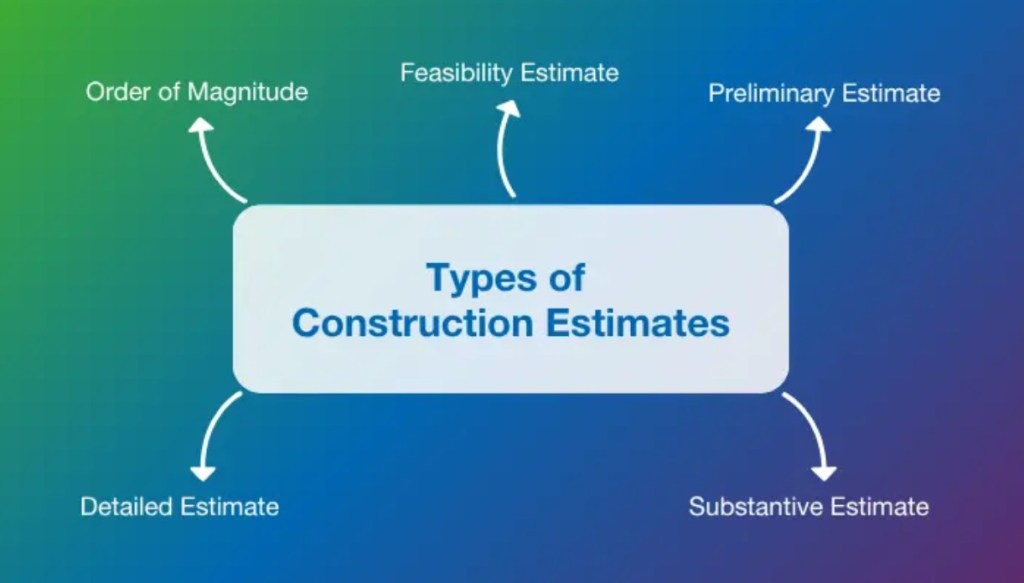
Construction estimates are prepared at different stages of a project depending on the level of information available. The main types are:
1. Order of Magnitude Estimate
This is the earliest and roughest estimate prepared.
Purpose
To get a broad idea of project cost
Used for initial decision-making
Basis
Past experience
Cost of similar projects
Very limited data
Accuracy
±30–40%
Use
Project idea stage
Go / No-go decision
2. Feasibility Estimate
Prepared to assess whether the project is financially viable.
Purpose
To evaluate economic feasibility
To compare alternatives
Basis
Approximate quantities
Area or unit rates
Preliminary layouts
Accuracy
±20–25%
Use
Feasibility studies
Investment appraisal
3. Preliminary Estimate
Prepared once the basic design and layout are available.
Purpose
To obtain administrative approval
To estimate project budget
Basis
Plinth area / floor area / cubic content method
Approximate specifications
Accuracy
±15–20%
Use
Budget sanction
Planning stage decisions
4. Substantive Estimate
Prepared after the design is finalized.
Purpose
To obtain technical sanction
To refine cost estimates
Basis
Detailed drawings
Updated specifications
Refined quantities
Accuracy
±10–15%
Use
Before tendering
Final cost assessment
5. Detailed Estimate
This is the most accurate and comprehensive estimate.
Purpose
For tendering and execution
To control project cost
Basis
Item-wise quantity take-off
Rate analysis using SOR
Detailed specifications
Accuracy
±5–10%
Use
Contract award
Construction and payment
Summary Table
Type of Estimate
Project Stage
Accuracy
Order of Magnitude
Concept stage
Very Low
Feasibility Estimate
Feasibility stage
Low
Preliminary Estimate
Planning stage
Medium
Substantive Estimate
Design finalization
Medium–High
Detailed Estimate
Execution stage
High
Conclusion
As a project progresses, estimates become more detailed and accurate. Early estimates guide decisions, while detailed estimates ensure financial control and successful execution.
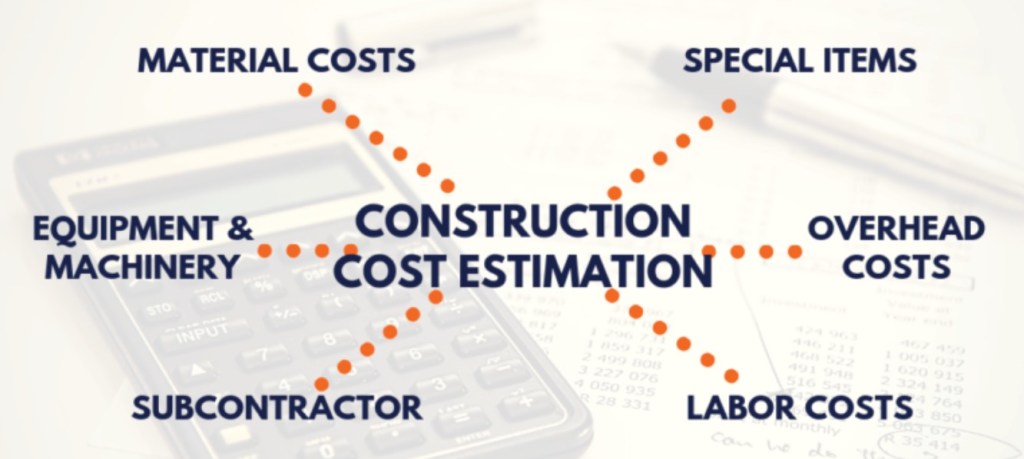
Item-wise cost is summarized.Total Cost=∑(Quantity×Rate)
Major heads:
Substructure cost
Superstructure cost
Finishing cost
Services cost
6. Additions to Basic Cost
Additional percentages are added to arrive at final project cost.
6.1 Contingencies
3%–5% of estimated cost
6.2 Work-Charged Establishment
1.5%–2%
6.3 Contractor’s Profit
10%–15%
6.4 Taxes and Duties
GST, royalty, cess (as applicable)
7. Cost per Square Meter (Plinth Area Method)
Used for preliminary estimates.Cost per sqm=Plinth AreaTotal Project Cost
This method is useful at the planning stage when detailed drawings are unavailable.
8. Final Estimated Cost
The final construction cost includes:
Civil works
Services
External development
Professional fees (if included)
This figure is used for:
Budget approval
Tendering
Financial planning
9. Accuracy and Revision
Preliminary estimate: ±15–20%
Detailed estimate: ±5–10%
Revised estimates prepared if cost exceeds sanctioned limit (usually 5–10%)
10. Summary Flow of Estimation Process
Define project scope
Study drawings & specifications
Measure quantities
Analyze rates
Prepare abstract of cost
Add contingencies, profit, taxes
Arrive at final estimated cost
References
V Montes, M., M Falcón, R., & Ramírez-de-Arellano, A. (2014). Estimating building construction costs by production processes. The Open Construction & Building Technology Journal, 8(1).
Holm, L., & Schaufelberger, J. E. (2021). Construction cost estimating. Routledge.
Asal, E. M. (2014). Factors affecting building construction projects’ cost estimating. Arab Academy for Science, Technology and Maritime Transport (AASTMT), 95.
Fazeli, A., Dashti, M. S., Jalaei, F., & Khanzadi, M. (2021). An integrated BIM-based approach for cost estimation in construction projects. Engineering, Construction and Architectural Management, 28(9), 2828-2854.
Ji, S. H., Park, M., & Lee, H. S. (2011). Cost estimation model for building projects using case-based reasoning. Canadian Journal of Civil Engineering, 38(5), 570-581.
Gender-sensitive planning interventions are deliberate strategies that acknowledge and address the different needs, experiences, and priorities of all genders, especially women and marginalized gender groups, in planning and development processes. Traditional planning practices — whether in urban development, policymaking, infrastructure design, or social programs — have often been male-centric, assuming that the “neutral citizen” is male. As a result, many systems unintentionally perpetuate gender inequalities.
Gender-sensitive planning moves beyond mere acknowledgment of gender differences; it actively seeks to create equitable spaces, opportunities, and outcomes for all. It integrates gender analysis into every stage of planning — from research to design, implementation, monitoring, and evaluation.
The Importance of Gender-Sensitive Planning
Addressing Systemic Inequalities: Societal structures often disadvantage women and gender-diverse individuals, whether in access to resources, decision-making, mobility, safety, or representation. Gender-sensitive planning can dismantle these barriers.
Enhancing Effectiveness: Programs and projects that consider diverse gendered needs tend to have better participation rates, more sustainable outcomes, and stronger community support.
Fostering Social Justice and Inclusion: Ensuring that all genders have equitable access to services, resources, and opportunities is a fundamental aspect of human rights and social justice.
Promoting Economic and Social Development: Gender equality is strongly linked to broader development goals such as poverty reduction, improved health outcomes, and economic growth.
Key Principles of Gender-Sensitive Planning
Participation and Representation: Ensuring that women and gender-diverse groups are meaningfully involved in decision-making processes.
Equity, Not Just Equality: Recognizing that equal treatment is not sufficient; specific measures may be needed to address existing inequalities.
Intersectionality: Understanding that gender interacts with other factors like race, class, ability, and age, shaping people’s experiences and needs.
Safety and Accessibility: Designing spaces and services that prioritize safety, mobility, and ease of access for everyone.
Flexibility: Adapting planning processes to different social, cultural, and economic contexts.
Accountability: Embedding monitoring and evaluation mechanisms to assess gender impacts and ensure commitments are met.
Stages of Gender-Sensitive Planning Interventions
1. Gender Analysis and Needs Assessment
Before designing interventions, planners must conduct a gender analysis to understand:
Roles and responsibilities differentiated by gender
Access to and control over resources
Specific needs, challenges, and opportunities faced by different gender groups
Power dynamics and cultural norms that influence gender relations
Tools and methods include:
Gender-disaggregated data collection
Focus group discussions with women and marginalized genders
Participatory rural appraisal (PRA)
Gender audits of existing policies and programs
2. Inclusive Goal Setting and Policy Development
Goals should explicitly aim to promote gender equity. For example:
Urban transport policies aiming to increase safety and accessibility for women commuters.
Agricultural programs ensuring equal access to land, training, and credit for women farmers.
Policies should be backed by clear commitments, resource allocation, and legal frameworks that support gender equity.
3. Design and Implementation
Design solutions should consider gender-specific needs:
Urban Infrastructure: Well-lit streets, safe public transport, accessible toilets for women, child-friendly public spaces.
Health Services: Maternal health care, reproductive services, mental health support sensitive to gender issues.
Economic Programs: Women-friendly banking, gender-sensitive vocational training, support for women entrepreneurs.
Implementation should ensure:
Equal participation of women and marginalized genders in implementation teams.
Flexibility in service delivery (e.g., providing childcare during public meetings).
4. Monitoring, Evaluation, and Feedback
Gender-sensitive indicators must be built into monitoring and evaluation frameworks. Examples:
Percentage of women participating in decision-making bodies.
Reduction in gender-based violence cases in public spaces.
Improved access to services for all genders.
Feedback loops should be established to adjust interventions based on real-world impacts and community input.
Examples of Gender-Sensitive Planning Interventions
1. Urban Transportation
Case Study: Vienna, Austria Urban planners in Vienna undertook gender-sensitive analysis and redesigned city spaces to better serve women, who often made multiple short trips with children or groceries. They expanded sidewalks, improved lighting, and added seating areas, making the city more accessible and safer.
2. Housing and Shelter
Women’s Shelter Projects: Housing designs that ensure privacy, safety, and accessibility for women survivors of domestic violence, with integrated childcare and legal support services.
3. Disaster Risk Reduction
Gender-Inclusive Disaster Planning: In many regions, women are more vulnerable during natural disasters due to caregiving roles or restrictions on mobility. Gender-sensitive disaster planning includes early warning systems, female-focused evacuation plans, and female-only spaces in refugee camps.
4. Rural Development
Women’s Agricultural Cooperatives: Rural development programs that support women’s cooperatives with access to seeds, training, credit, and markets, thereby empowering women economically and socially.
Challenges in Implementing Gender-Sensitive Planning
Resistance to Change: Deep-seated patriarchal norms can resist gender equity initiatives.
Limited Capacity: Planners may lack training or tools to effectively integrate gender perspectives.
Resource Constraints: Gender-sensitive measures often require additional investment in research, training, and community engagement.
Superficial Commitment: Tokenistic inclusion without genuine structural change can undermine the effectiveness of interventions.
Strategies to Strengthen Gender-Sensitive Planning
Capacity Building: Train planners, officials, and community leaders in gender analysis and gender mainstreaming.
Policy Mandates: Institutionalize gender-sensitive practices through legislation and policy guidelines.
Partnerships: Collaborate with women’s organizations, grassroots movements, and gender experts.
Funding Prioritization: Allocate specific budgets for gender-focused initiatives.
Continuous Learning: Treat gender-sensitive planning as an evolving practice, responsive to feedback and new insights.
Conclusion
Gender-sensitive planning interventions are critical for creating inclusive, equitable, and resilient societies. They move planning practices beyond a one-size-fits-all approach, acknowledging that people’s experiences and needs are deeply shaped by gender dynamics. By embedding gender perspectives into every phase of planning and implementation, governments, organizations, and communities can foster environments where everyone, regardless of gender, can thrive with dignity and opportunity.
References
Gurstein, P. (1996). Gender sensitive community planning: A case study of the Planning Ourselves In Project. Canadian Journal of Urban Research, 199-219.
Horelli, L., & Wallin, S. (2016). Gender-sensitive e-planning for sustaining everyday life. In Fair Shared Cities (pp. 231-247). Routledge.
Jaeckel, M., & van Geldermalsen, M. (2006). Gender sensitive urban planing. Urbanism & Gender, 95.
Jafry, T., & Sulaiman V, R. (2013). Gender-sensitive approaches to extension programme design. The Journal of Agricultural Education and Extension, 19(5), 469-485.
Rodríguez-García, M. J., & Donati, F. (2021). European integral urban policies from a gender perspective. Gender-sensitive measures, transversality and gender approaches. Sustainability, 13(17), 9543.
Dehalwar, K. Gender and Its Implications for Spatial Planning: Understanding the Impact.
In an increasingly complex and interconnected world, stakeholder participation has become essential for effective governance, community development, corporate responsibility, and environmental management. Stakeholders — individuals, groups, or organizations affected by or interested in a particular issue — bring diverse perspectives, interests, and resources to decision-making processes. However, fostering genuine participation is often challenging. This is where sociological understanding becomes a critical tool, offering deep insights into the dynamics of social behavior, group interactions, power relations, and cultural contexts that influence stakeholder engagement.
The Role of Sociology in Stakeholder Participation
Sociology is the study of society, social relationships, and social institutions. By applying sociological principles and methods, facilitators of stakeholder participation can better navigate complexities such as differing values, systemic inequalities, and community dynamics. Sociology helps to answer key questions: Who are the stakeholders? What are their motivations? How do social structures and cultural backgrounds shape their participation? What barriers exist to inclusive engagement?
Let’s explore the various ways sociological understanding enhances stakeholder participation:
1. Identifying and Mapping Stakeholders Accurately
Sociological methods like ethnography, surveys, and social network analysis allow for a comprehensive identification of stakeholders, beyond just the most vocal or visible groups. It helps uncover marginalized or less obvious stakeholders — such as indigenous communities, informal workers, or future generations — who may otherwise be overlooked. Sociology insists on understanding the relational ties between groups, highlighting alliances, tensions, and dependencies crucial for inclusive participation.
2. Appreciating Diversity and Cultural Contexts
Stakeholders come from diverse social, ethnic, and cultural backgrounds, each with their own worldviews, communication styles, and decision-making processes. Sociological sensitivity to cultural diversity helps in designing participation processes that are respectful and inclusive. Recognizing cultural narratives, traditional knowledge systems, and collective identities ensures that participation is not merely tokenistic but meaningful.
3. Understanding Power Dynamics and Social Inequalities
Stakeholder participation does not occur on an equal footing. Certain groups often hold more power, resources, or influence, while others are marginalized. Sociology provides analytical tools to examine power relations, social stratification, and institutional biases. This understanding is vital to creating participatory processes that consciously address power imbalances — for example, by giving marginalized groups a stronger voice or designing processes that reduce barriers to entry.
4. Enhancing Communication and Trust-Building
Effective stakeholder participation relies on open communication and trust. Sociological insights into group behavior, conflict resolution, and norms of reciprocity help facilitators design engagement strategies that foster dialogue, empathy, and trust. This could include using participatory approaches like focus groups, storytelling, or deliberative forums that allow stakeholders to express their perspectives in a safe and supportive environment.
5. Fostering Collective Action and Social Learning
Participation is not just about collecting individual opinions; it is about fostering collective action and building shared understanding. Sociology emphasizes the role of social learning — the process by which stakeholders learn from each other through interaction and dialogue. By understanding how norms evolve, how consensus is built, and how collective identities are formed, facilitators can create spaces that support collaborative problem-solving and innovation.
6. Anticipating Resistance and Managing Conflict
Participation processes often encounter resistance, especially when stakeholders perceive threats to their interests or identities. Sociological understanding of group conflict, social movements, and resistance dynamics allows practitioners to anticipate potential sources of tension and design conflict-sensitive engagement strategies. Rather than avoiding conflict, they can use it constructively to surface underlying issues and build more robust agreements.
7. Evaluating Participation Processes
Finally, sociology provides frameworks and methodologies for evaluating the effectiveness and inclusivity of participation processes. Qualitative and quantitative evaluation methods can assess not just outcomes, but also the quality of the engagement — who participated, whose voices were heard, and what changes were made as a result.
Practical Applications: Examples
Urban Planning: In community-driven urban development, sociological insights help planners engage diverse groups, understand local identities, and mediate conflicts between residents and developers.
Environmental Management: In conservation projects, recognizing indigenous knowledge systems and power imbalances helps ensure that environmental policies are co-created with local communities rather than imposed upon them.
Corporate Social Responsibility (CSR): Companies seeking stakeholder input on CSR initiatives benefit from understanding social expectations, cultural values, and local community dynamics to build trust and legitimacy.
Conclusion
Sociological understanding is not just an academic exercise — it is a practical necessity for meaningful stakeholder participation. By bringing a deep awareness of social complexity, cultural diversity, and power relations, sociology equips practitioners to design participatory processes that are inclusive, equitable, and transformative. In a world facing complex social and environmental challenges, integrating sociological insights into stakeholder engagement is not only beneficial but essential for sustainable and just outcomes.
References
Bell, S., Morse, S., & Shah, R. A. (2012). Understanding stakeholder participation in research as part of sustainable development. Journal of environmental management, 101, 13-22.
Dehalwar, K., & Singh, J. Determining the Role of Different Stakeholders Towards Sustainable Water Management within Bhopal. Madhya Pradesh.
DEHALWAR, K., & SINGH, J. DETERMINING THE ROLE OF DIFFERENT STAKEHOLDERS TOWARDS SUSTAINABLE WATER MANAGEMENT WITHIN BHOPAL, MADHYA PRADESH.
Fish, R., Saratsi, E., Reed, M., & Keune, H. (2016). Stakeholder participation in ecosystem service decision-making. In Routledge Handbook of Ecosystem Services (pp. 256-270). Routledge.
Jain, S., Dehalwar, K., & Sharma, S. N. (2024). Explanation of Delphi Research Method and Expert Opinion Surveys.
Luyet, V., Schlaepfer, R., Parlange, M. B., & Buttler, A. (2012). A framework to implement stakeholder participation in environmental projects. Journal of environmental management, 111, 213-219.
Reed, M. S. (2008). Stakeholder participation for environmental management: a literature review. Biological conservation, 141(10), 2417-2431.
Sharma, S. N. (2020). Evaluation of Implementation of Pradhan Mantri Awas Yojana (Urban). Think India Journal, 1, 1-13.
Zheng, X., Sun, C. & Liu, J. Exploring stakeholder engagement in urban village renovation projects through a mixed-method approach to social network analysis: a case study of Tianjin. Humanit Soc Sci Commun11, 27 (2024). https://doi.org/10.1057/s41599-023-02536-7









You must be logged in to post a comment.