
By Shashikant Nishant Sharma
There is no specific UGC, AICTE, IIT, or NIT rule that mandates:
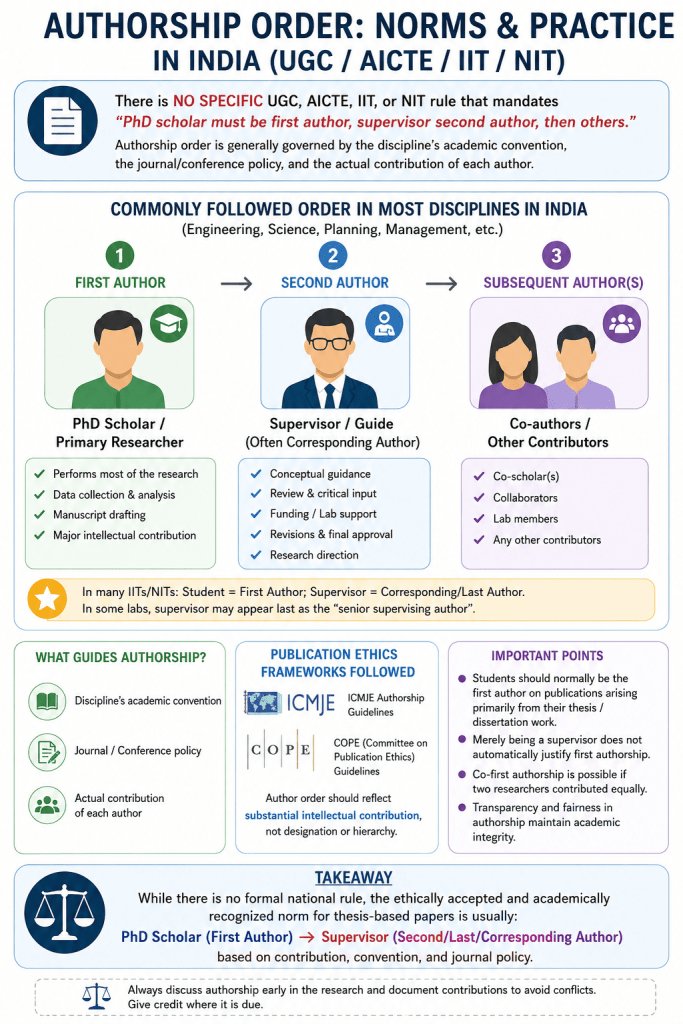
“PhD scholar must be first author, supervisor second author, then others.”
In India, authorship order is generally governed by:
- the discipline’s academic convention,
- the journal/conference policy, and
- the actual contribution of each author.
However, across most engineering, planning, science, and management fields in India (including many IITs/NITs), the common academic practice is:
- PhD scholar / primary researcher → First Author
- Supervisor / Guide → Second Author or Last Author (often corresponding author)
- Other contributors/co-supervisors → subsequent authors
This convention is widely followed because the student usually:
- performs most of the research,
- data collection/analysis,
- manuscript drafting.
The supervisor contributes through:
- conceptual guidance,
- review,
- funding/lab support,
- revisions,
- research direction.
Many institutions also follow international ethics frameworks such as:
- ICMJE authorship guidelines
- COPE (Committee on Publication Ethics)
These state that author order should reflect substantial intellectual contribution, not designation or hierarchy.
Some important practical conventions:
- In many IITs/NITs:
- Student = first author
- Supervisor = corresponding/last author
- In some labs, supervisor may appear last because the last author is treated as the “senior supervising author.”
- Co-first authorship is also possible if two researchers contributed equally.
- Merely being a supervisor does not automatically justify first authorship under publication ethics.
A strong statement often used in institutional research ethics is:
Students should normally be the first author on publications arising primarily from their thesis/dissertation work.
So, while there is no formal national rule, the ethically accepted and academically recognized norm for thesis-based papers is usually:
PhD Scholar (First Author) → Supervisor (Second/Last/Corresponding Author).
References
Baerlocher, M. O., Newton, M., Gautam, T., Tomlinson, G., & Detsky, A. S. (2007). The meaning of author order in medical research. Journal of Investigative Medicine, 55(4), 174-180.
Bhandari, M., Guyatt, G. H., Kulkarni, A. V., Devereaux, P. J., Leece, P., Bajammal, S., … & Busse, J. W. (2014). Perceptions of authors’ contributions are influenced by both byline order and designation of corresponding author. Journal of clinical epidemiology, 67(9), 1049-1054.
Peidu, C. (2019). Can authors’ position in the ascription be a measure of dominance?. Scientometrics, 121(3), 1527-1547.
Helgesson, G., & Eriksson, S. (2019). Authorship order. Learned Publishing, 32(2), 106-112.
Mattoon, E. R., Miles, M., Broderick, N. A., & Casadevall, A. (2024). Analysis of justification for author order and gender bias in author order among those contributing equally. Mbio, 15(5), e00646-24.
McCann, T. V., & Polacsek, M. (2018). Addressing the vexed issue of authorship and author order: A discussion paper. Journal of Advanced Nursing, 74(9), 2064-2074.
da Silva, A. P. A., & Vanz, S. A. (2022). Authorship, authorship order and author contribution: a literature review. RDBCI: Revista Digital de Biblioteconomia e Ciência da Informação, 20, e022028.
Liboiron, M., Ammendolia, J., Winsor, K., Zahara, A., Bradshaw, H., Melvin, J., … & Liboiron, G. (2017). Equity in author order: A feminist laboratory’s approach. Catalyst: Feminism, Theory, Technoscience, 3(2).
Riesenberg, D., & Lundberg, G. D. (1990). The order of authorship: who’s on first?. Jama, 264(14), 1857-1857.


You must be logged in to post a comment.