


By Kavita Dehalwar
1. Project Definition and Scope
The estimation process begins with a clear understanding of the project.
- Type of building: residential / commercial / institutional / industrial
- Nature of construction: new construction / addition / renovation
- Number of floors and plinth area
- Construction system: RCC framed / load-bearing / steel structure
- Level of finish: basic / standard / premium
2. Collection of Drawings and Documents
Accurate estimation depends on complete technical inputs.
- Architectural drawings (plans, elevations, sections)
- Structural drawings (foundation, columns, beams, slabs)
- Service drawings (electrical, plumbing, HVAC, fire-fighting)
- Specifications and material standards
- Local schedule of rates (SOR/DSR)
3. Measurement of Quantities (Quantity Take-Off)
Quantities are calculated item-wise using standard measurement rules (IS 1200).
3.1 Earthwork
- Excavation for foundations
- Backfilling and disposal
Volume=Length×Breadth×Depth
3.2 Foundation and Substructure
- PCC bed
- Footings
- Foundation masonry or RCC
- Plinth beam and DPC
3.3 Superstructure
- RCC columns, beams, slabs, staircases
- Brick/block masonry
- Lintels and chajjas
3.4 Finishing Works
- Plastering (internal & external)
- Flooring and tiling
- Painting and polishing
- Doors and windows
3.5 Services
- Water supply and sanitary installations
- Electrical wiring and fittings
- Fire safety and HVAC (if applicable)
4. Rate Analysis
Rates are derived for each item of work.
4.1 Components of Rate
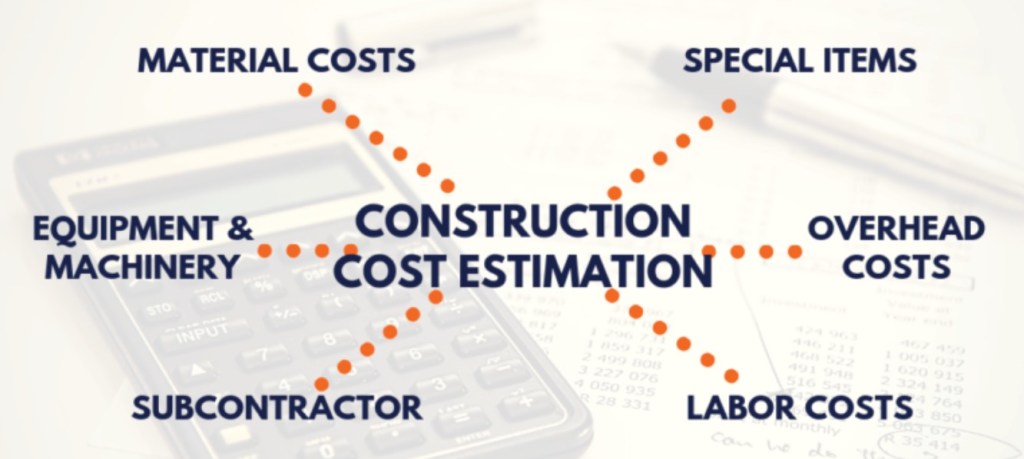
- Material cost (cement, steel, bricks, sand, aggregates)
- Labour cost (skilled, semi-skilled, unskilled)
- Equipment and machinery charges
- Transportation and handling
- Wastage allowances
4.2 Rate Calculation Formula
Rate=Unit QuantityMaterial+Labour+Equipment+Overheads
Rates are taken from:
- Schedule of Rates (SOR/DSR)
- Market analysis (for non-scheduled items)
5. Abstract of Cost (Cost Compilation)
Item-wise cost is summarized.Total Cost=∑(Quantity×Rate)
Major heads:
- Substructure cost
- Superstructure cost
- Finishing cost
- Services cost
6. Additions to Basic Cost
Additional percentages are added to arrive at final project cost.
6.1 Contingencies
- 3%–5% of estimated cost
6.2 Work-Charged Establishment
- 1.5%–2%
6.3 Contractor’s Profit
- 10%–15%
6.4 Taxes and Duties
- GST, royalty, cess (as applicable)
7. Cost per Square Meter (Plinth Area Method)
Used for preliminary estimates.Cost per sqm=Plinth AreaTotal Project Cost
This method is useful at the planning stage when detailed drawings are unavailable.
8. Final Estimated Cost
The final construction cost includes:
- Civil works
- Services
- External development
- Professional fees (if included)
This figure is used for:
- Budget approval
- Tendering
- Financial planning
9. Accuracy and Revision
- Preliminary estimate: ±15–20%
- Detailed estimate: ±5–10%
- Revised estimates prepared if cost exceeds sanctioned limit (usually 5–10%)
10. Summary Flow of Estimation Process
- Define project scope
- Study drawings & specifications
- Measure quantities
- Analyze rates
- Prepare abstract of cost
- Add contingencies, profit, taxes
- Arrive at final estimated cost
References
V Montes, M., M Falcón, R., & Ramírez-de-Arellano, A. (2014). Estimating building construction costs by production processes. The Open Construction & Building Technology Journal, 8(1).
Holm, L., & Schaufelberger, J. E. (2021). Construction cost estimating. Routledge.
Asal, E. M. (2014). Factors affecting building construction projects’ cost estimating. Arab Academy for Science, Technology and Maritime Transport (AASTMT), 95.
Fazeli, A., Dashti, M. S., Jalaei, F., & Khanzadi, M. (2021). An integrated BIM-based approach for cost estimation in construction projects. Engineering, Construction and Architectural Management, 28(9), 2828-2854.
Ji, S. H., Park, M., & Lee, H. S. (2011). Cost estimation model for building projects using case-based reasoning. Canadian Journal of Civil Engineering, 38(5), 570-581.


You must be logged in to post a comment.