


(ii) Up-gradation of District Centre, Nehru Place – Construction of MLCP at Modi Tower (UDF Project)
Multi Level Car Parking (MLCP) is an essential component of modern urban infrastructure, particularly in dense commercial districts where land availability is limited and parking demand is exceptionally high. An MLCP is a vertically developed parking structure designed to accommodate a large number of vehicles within a compact footprint by stacking parking floors. In cities like Nehru Place, where commercial intensity, daily footfall, and vehicular inflow are extremely high, MLCPs play a decisive role in managing traffic congestion, improving accessibility, and enhancing the overall urban environment.
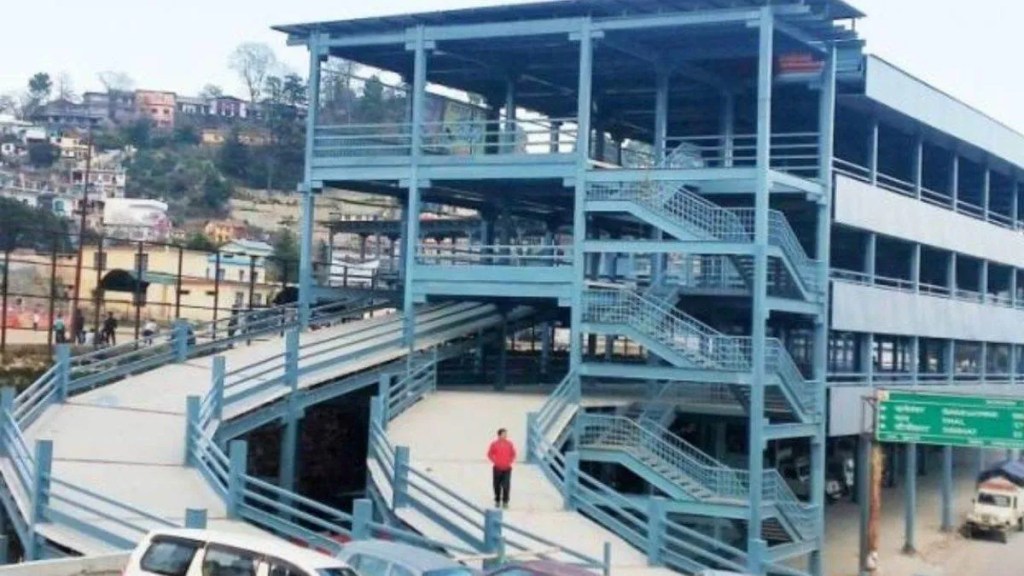
Concept and Importance of MLCP
The fundamental concept of an MLCP is efficient utilisation of scarce urban land. Instead of spreading parking across surface lots—which consume valuable land and disrupt urban activity—MLCPs provide structured, organised, and safer parking solutions. These facilities help decongest roads by reducing on-street and haphazard parking, thereby improving traffic flow and pedestrian safety.
MLCPs are particularly relevant in district centres and central business districts, where parking demand peaks during working hours. They also support public transport systems by enabling park-and-walk or park-and-ride behaviour, indirectly contributing to sustainable urban mobility.
Urban Need for MLCPs in Commercial Districts
High-density commercial areas face multiple parking-related challenges:
- Chronic roadside parking leading to traffic bottlenecks
- Reduced carriageway capacity and unsafe pedestrian conditions
- Increased travel time and fuel consumption
- Visual clutter and poor urban aesthetics
An MLCP addresses these issues by centralising parking in a managed facility, freeing up surface space for better pedestrian infrastructure, landscaping, and public amenities.
MLCP as Part of Urban Up-gradation Strategy
MLCPs are no longer seen as standalone parking structures. In contemporary urban projects, they are integrated into area up-gradation and redevelopment strategies, supporting commercial revitalisation, public realm improvement, and economic efficiency. When planned under structured funding mechanisms such as Urban Development Fund (UDF) projects, MLCPs also ensure financial discipline, lifecycle management, and long-term sustainability.
(ii) Up-gradation of District Centre, Nehru Place
Construction of Multi Level Car Parking (MLCP) at Modi Tower (UDF Project)
The Construction of a Multi Level Car Parking (MLCP) at Modi Tower, Nehru Place is a key component of the broader up-gradation of the Nehru Place District Centre. This project has been taken up as a UDF Project and is being implemented on a Design, Engineering, Procurement, and Construction (EPC) mode, ensuring single-point responsibility and integrated delivery.
Project Scope and Objectives
The primary objective of constructing the MLCP at Modi Tower is to systematically address the acute parking shortage in Nehru Place, which experiences one of the highest daily vehicular inflows in Delhi. The project aims to:
- Accommodate a large volume of cars in a structured manner
- Reduce roadside and surface parking
- Improve traffic circulation within the district centre
- Enhance pedestrian safety and walkability
- Support commercial activity through better accessibility
The MLCP is designed along with all associated development works and services, including internal circulation, ramps, lighting, fire safety systems, drainage, signage, and external area development.
Financial Details and Project Timeline
The sanctioned project cost for the construction of the MLCP is ₹70.15 crore, reflecting the scale and complexity of the infrastructure. Out of this, ₹62.40 crore has been allocated towards execution of works under the EPC contract.
The project commenced on 14 June 2020, marking the beginning of on-site activities. The financial and temporal structuring under the UDF framework ensures better monitoring, accountability, and alignment with the overall redevelopment goals of Nehru Place.
Design and Planning Features
The MLCP at Modi Tower is planned as a high-capacity, user-friendly parking facility, compatible with the dense commercial character of Nehru Place. Key design considerations include:
- Multi-level vertical configuration to maximise parking capacity within limited land
- Efficient ramp design for smooth entry and exit, minimising internal congestion
- Adequate clear heights and bay dimensions to accommodate different vehicle types
- Fire detection and firefighting systems, as per safety norms
- Energy-efficient lighting and ventilation, improving operational sustainability
- Universal accessibility provisions, including lifts and clear pedestrian pathways
The structure is designed to integrate seamlessly with the surrounding built environment while maintaining functional efficiency.
EPC Mode and Development Works
Execution on EPC mode ensures that design optimisation, construction efficiency, and cost control are achieved under a single contractual framework. This approach reduces coordination issues between designers and contractors and accelerates project delivery.
In addition to the main parking structure, the project includes:
- Internal and external road development
- Stormwater drainage and utility integration
- Electrical works, signage, and traffic management systems
- Landscaping and interface treatment with surrounding areas
Role of MLCP in Nehru Place Up-gradation
The MLCP at Modi Tower is a strategic intervention within the overall up-gradation of the Nehru Place District Centre. By removing a substantial volume of vehicles from surface roads, it allows the district centre to reclaim space for footpaths, plazas, landscaping, and safer circulation. This directly complements other redevelopment initiatives such as pedestrian improvements, public amenities, and commercial revitalisation.
Conclusion
The construction of the Multi Level Car Parking at Modi Tower, Nehru Place, under the UDF Project, represents a critical step towards addressing one of the most pressing urban challenges in major commercial hubs—parking management. With a sanctioned cost of ₹70.15 crore, execution cost of ₹62.40 crore, and commencement on 14.06.2020, the project reflects a structured, well-financed, and strategic urban intervention. More than just a parking facility, the MLCP serves as a catalyst for traffic decongestion, pedestrian safety, and overall improvement in the functionality and image of Nehru Place as a premier district centre in New Delhi.


You must be logged in to post a comment.