✍️ By Dileep Verma
Research Expert and Associate Editor of Track2Training, New Delhi, India
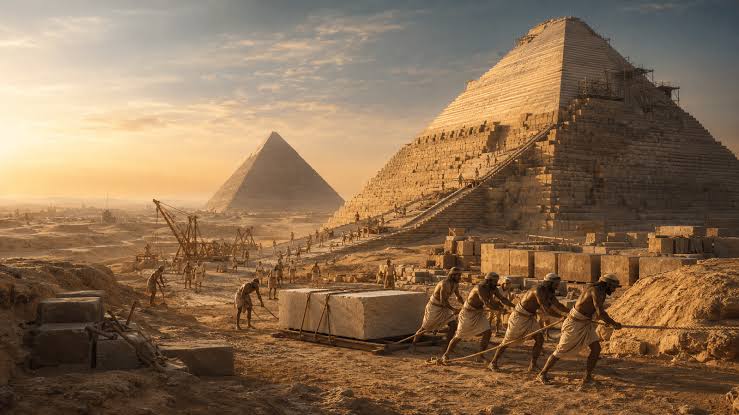
When we look at the Great Pyramid of Giza, we usually think about its enormous stones, extraordinary height, mysterious construction methods, and remarkable survival over thousands of years. It is one of the most recognizable monuments ever created by human civilization.
But there is another way to understand the Great Pyramid.
Beyond architecture and engineering, it represents an extraordinary example of planning, administration, logistics, workforce organization, and long-term project management.
Built for the Egyptian pharaoh Khufu during the Fourth Dynasty, around the 26th century BCE, the Great Pyramid originally stood about 146.5 metres high. According to Egypt’s Ministry of Tourism and Antiquities, it remained the world’s tallest building for approximately 3,800 years.
More than four millennia later, the question is not only how ancient Egyptians built such a monument, but also how they organized the enormous human and material system required to complete it.
More Than an Engineering Achievement
The Great Pyramid was constructed primarily from limestone. Higher-quality Tura limestone was used for its original outer casing, while granite was incorporated into important internal spaces.
Transporting these materials required an organized system extending far beyond the construction site.
Stone had to be quarried and prepared. Boats had to transport material. Workers needed food, water, shelter, equipment, and supervision. Tools had to be produced and maintained. Different teams had to perform specialized tasks while remaining connected to the larger construction programme.
In modern terminology, the project required elements of supply-chain management, human-resource management, procurement, logistics, transportation, supervision, and project coordination.
This was achieved without computers, trucks, cranes, spreadsheets, GPS, or modern communication systems.
That makes the administrative achievement behind the pyramid almost as fascinating as the structure itself.
The Diary of Merer: Evidence of Ancient Administration
One of the most interesting discoveries related to Khufu’s pyramid is the Diary of Merer, part of a collection of ancient papyri discovered at Wadi al-Jarf.
Merer was an official associated with a crew involved in transporting limestone. His records describe journeys connected with moving limestone from Tura toward the pyramid construction area during Khufu’s reign.
This is significant because it gives us a rare glimpse into the administrative machinery behind pyramid construction.
Someone had to organize crews.
Someone had to record activities.
Someone had to coordinate transportation.
Someone had to ensure materials reached their destination.
The pyramid was therefore not simply the product of physical labour. It depended on an administrative system capable of coordinating thousands of activities toward a common objective.
Were the Pyramid Builders Slaves?
Popular movies have often portrayed Egyptian pyramids as products of huge groups of enslaved workers being forced to work under brutal conditions.
Archaeological evidence presents a more complicated picture.
Excavations at Giza have uncovered a workers’ settlement associated with pyramid construction. Archaeologists have identified houses, streets, administrative facilities, storage areas, food-production facilities, and evidence of substantial food provisioning.
Egypt’s Ministry of Tourism and Antiquities describes a settlement south of the Sphinx where workers involved in pyramid construction lived, with evidence including administrative buildings and substantial quantities of animal remains.
This does not mean ancient Egyptian labour conditions should be romanticized. Our evidence is incomplete, and ancient labour systems differed greatly from modern employment.
What it does show is that pyramid construction required a far more organized labour system than the simplistic image of uncontrolled masses performing physical work.
Lesson 1: Large Projects Depend on Logistics
A project of this scale could not continue unless materials arrived when required.
Imagine a construction site where hundreds or thousands of people are ready to work, but the required stone does not arrive.
Or the stone arrives but tools are unavailable.
Or workers are present but food supplies fail.
Construction slows or stops.
Modern organizations face the same basic problem.
Large infrastructure projects, manufacturing plants, hospitals, universities, railways, and government programmes depend on interconnected systems.
The lesson from Giza is simple:
Do not manage only the final project. Manage the entire system that makes the project possible.
Lesson 2: People Are Part of the Infrastructure
The archaeological evidence of worker accommodation and food provisioning provides another important management lesson.
A large project cannot depend only on physical resources.
Workers must also be sustained.
In modern management, organizations often discuss technology, artificial intelligence, automation, finance, and infrastructure. Yet the success of almost every organization ultimately depends on people.
Human-resource management should therefore not be treated merely as an administrative department.
Employee health, training, working conditions, motivation, communication, and organizational clarity can directly influence performance.
The pyramid reminds us that human infrastructure matters alongside physical infrastructure.
Lesson 3: Break a Huge Goal into Smaller Tasks
“Build a pyramid” sounds almost impossible.
But “quarry this stone,” “transport this material,” “prepare these tools,” or “complete this section” is manageable.
This is one of the oldest and most powerful principles of project management.
Complex objectives become achievable when they are divided into smaller tasks and assigned to organized teams.
Different groups involved in pyramid construction would have required different responsibilities and skills.
The broader lesson applies equally well today.
Whether writing a PhD thesis, constructing a highway, implementing public policy, developing software, or running a national programme, a large objective must be transformed into specific, measurable, coordinated activities.
Lesson 4: Long-Term Projects Need Institutional Continuity
The exact construction timeline of the Great Pyramid remains uncertain, but Egypt’s antiquities authority gives an estimate of approximately 10 to 20 years.
A project lasting that long requires continuity.
Workers change. Supervisors change. Weather changes. Resources fluctuate. Unexpected problems emerge.
Yet the larger objective has to continue.
This is particularly important for modern public administration.
Many of today’s biggest challenges cannot be solved within a single financial year or political cycle.
Major transport systems, educational reforms, climate adaptation, scientific programmes, urban development, and institutional reforms may require decades.
Long-term development therefore depends not only on leaders but also on institutions capable of preserving knowledge and maintaining direction over time.
Lesson 5: Administration Is a Form of Technology
We normally associate technology with machines.
But technology can also mean systems and methods that allow humans to accomplish tasks more efficiently.
From this perspective, administration itself can be considered an important organizational technology.
Record keeping, division of labour, supervision, resource allocation, transportation planning, standardization, and coordination enabled ancient societies to undertake projects far beyond the capacity of individuals.
Modern organizations possess dramatically more advanced tools, yet they still fail when coordination breaks down.
A sophisticated computer system cannot compensate indefinitely for unclear responsibilities, poor communication, weak planning, or disorganized leadership.
The ancient lesson remains surprisingly relevant:
Technology improves capability, but organization converts capability into results.
What the Great Pyramid Still Teaches Us
The Great Pyramid is the only surviving monument of the traditional Seven Wonders of the Ancient World.
Its physical survival is extraordinary.
But perhaps its intellectual legacy is equally valuable.
It demonstrates what human beings can achieve when knowledge, labour, resources, planning, and administration are brought together around a clearly defined objective.
Great achievements rarely emerge from one person working alone.
They depend on systems.
Vision without planning remains an idea.
Resources without coordination produce waste.
People without defined responsibilities create confusion.
Technology without organization has limited value.
But when vision, people, knowledge, resources, and administration work together, human beings can accomplish things that initially appear impossible.
More than 4,500 years after its construction, millions of people still look at the Great Pyramid and ask:
“How did they do it?”
Perhaps part of the answer lies not only in engineering.
It lies in the extraordinary power of organized human effort.
One vision. Thousands of workers. Millions of individual tasks. One monument that survived thousands of years.
Suggested website categories: History | Management | Public Administration | Leadership | Project Management | Ancient Civilizations
Suggested tags: Great Pyramid of Giza, Ancient Egypt, Khufu, Project Management, Public Administration, Human Resource Management, Supply Chain Management, Leadership, Organizational Management, Ancient Engineering, History
#GreatPyramid #Giza #AncientEgypt #Management #PublicAdministration #ProjectManagement #Leadership #SupplyChain #HumanResources #Governance #History #OrganizationalManagement #LearningFromHistory

